Most readings of Daniel 7 pass over it in a single breath: the little horn rises, and “three of the first horns” are “plucked up by the roots.” One clause. Yet Daniel returns to it deliberately — the little horn, the angel says, “shall subdue three kings” — and the last of the three falls in the very year the long prophetic clock begins to run. The three plucked horns are not a footnote. They are the door the little horn had to open. The question this study asks is the one the standard outline skips: who were they, why did they have to fall — and what did they believe?
The clause itself
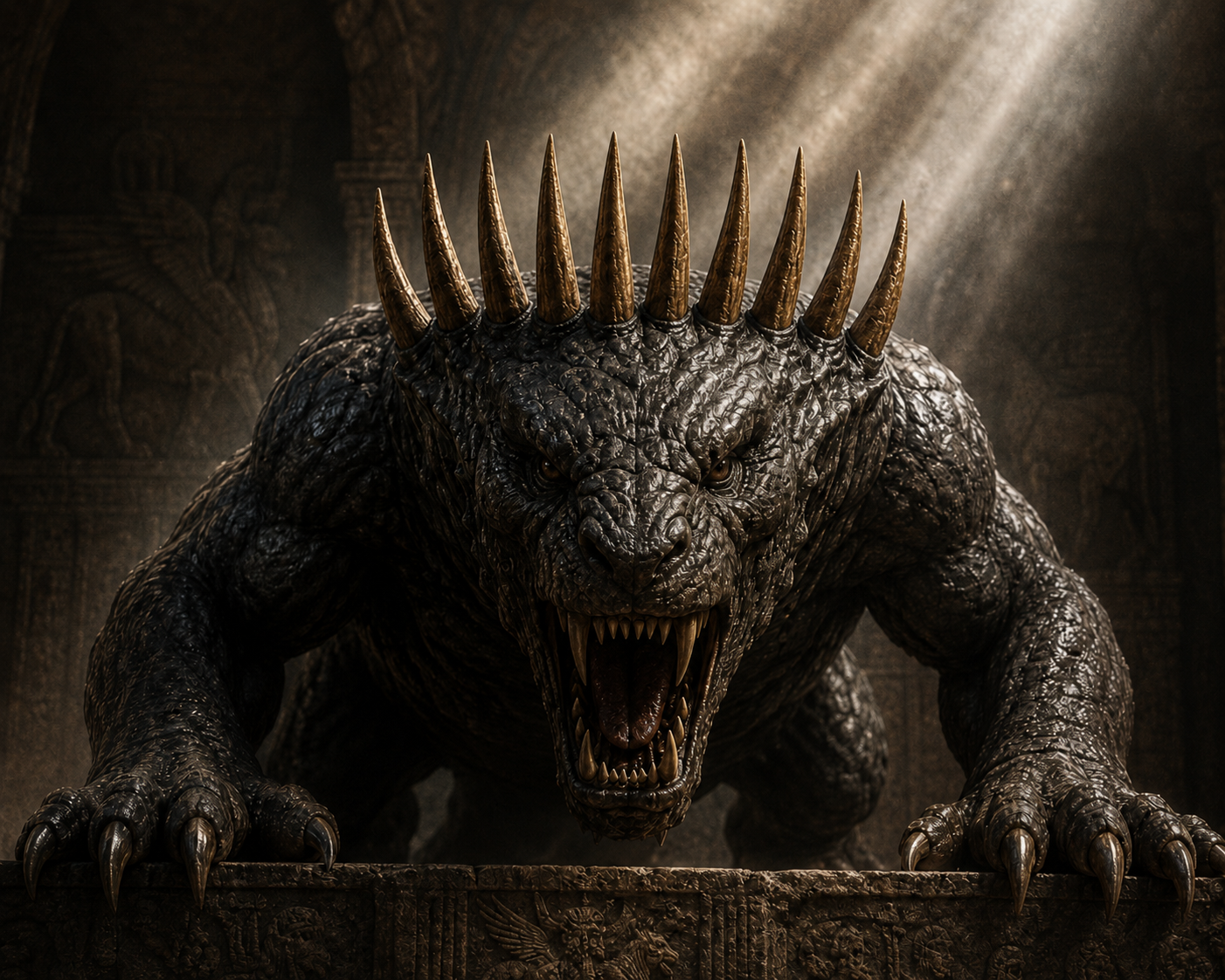
Daniel sees ten horns on the dreadful fourth beast — the kingdoms that divided Rome’s western territory after AD 476. Then he watches one more come up:
I considered the horns, and, behold, there came up among them another little horn, before whom there were three of the first horns plucked up by the roots: and, behold, in this horn were eyes like the eyes of man, and a mouth speaking great things.
The angel’s own interpretation makes the uprooting a precondition, not an accident:
And the ten horns out of this kingdom are ten kings that shall arise: and another shall rise after them; and he shall be diverse from the first, and he shall subdue three kings.
“He shall subdue three.” The little horn cannot become what it becomes — a power that wears out the saints and presumes to “change times and laws” for 1260 years — while three of the ten still stand. So the three matter precisely because they were the obstruction. To ask why they were removed is to ask what stood in the way of the power that followed.
Who the three were
The historicist tradition — Reformation and Adventist alike — identifies the three as the Heruli, the Vandals, and the Ostrogoths, all swept from the board within forty-five years of one another, and all by the same hand or in service of the same project: the sixth-century campaign of the emperor Justinian to “restore” the Roman world and place the bishop of Rome at the head of its churches.
| Tribe | Territory | Removed |
|---|---|---|
| Heruli | Italy (Odoacer’s kingdom) | AD 493 |
| Vandals | North Africa (Carthage) | AD 534 |
| Ostrogoths | Italy (Ravenna, Rome) | AD 538 |
The dates are not chosen to fit a theory; they are the dates the secular histories give. And the last of them is the hinge: AD 538, when Belisarius broke the Ostrogothic siege of Rome and the city passed, unobstructed, under the authority Justinian had already decreed — the same year from which the 1260 years of Daniel 7:25 are measured to 1798. The removal of the third horn and the start of the prophetic period are the same event.
What they believed — and why the question is hard
Here the careful reader must slow down, because two things are true at once, and both have to be said.
The first is that the three are remembered, almost universally, as “Arian heretics.” The second is that nearly everything we are told about their religion comes to us through the pens of the very power that destroyed them. We have no surviving body of Heruli, Vandal, or Ostrogoth theology written in their own defence. What we have is the chronicle of the conquerors — Victor of Vita on the Vandals, Procopius in Justinian’s own court, the Catholic annalists who catalogued the defeated as heretics after the fact. That is not a reason to invert the record and romanticise the tribes; it is a reason to hold the “heretic” verdict loosely, knowing it is the testimony of the prosecution with the defence struck from the file.
And the word itself repays a second look. To call these peoples “Arian” does not mean — whatever later usage implied — that they thought Jesus a mere creature or denied His divinity. Their Christianity had reached them through Ulfilas (Wulfila), the missionary who gave the Goths the Scriptures in their own tongue a generation before Nicaea’s formula was made the law of the empire. What they refused was not the divine Sonship of Christ; it was the fourth-century creedal machinery — the homoousios, the co-equal and co-eternal triad ratified at Nicaea (325) and completed at Constantinople (381). They confessed, as the Scriptures read, one God the Father and His true, divine, begotten Son. That is not a denial of the apostles’ faith. It is the apostles’ faith:
And this is life eternal, that they might know thee the only true God, and Jesus Christ, whom thou hast sent.
So the cleanest, most defensible statement of the record is this: the three plucked horns stood outside the Nicene party. They had never received the creed that the imperial church was, in those very decades, working to make universal. Whatever else is uncertain about them, this much the conquerors themselves attest — and it is exactly what made them an obstacle to a power whose central claim would become that creed.
The Sabbath question, told honestly
It is sometimes said that the three tribes kept the seventh-day Sabbath. The honest historian has to separate what is documented from what is inferred, and say which is which.
What is documented is broader and, in a way, more striking. In the very centuries the three horns flourished and fell, the seventh-day Sabbath was still kept across most of Christendom — and the exceptions were Rome and Alexandria. Two Catholic historians of the period say so plainly. Sozomen: “The people of Constantinople, and almost everywhere, assemble together on the Sabbath, as well as on the first day of the week, which custom is never observed at Rome or at Alexandria.” Socrates Scholasticus: “Almost all churches throughout the world celebrate the sacred mysteries on the Sabbath of every week, yet the Christians of Alexandria and at Rome … have ceased to do this.” The seventh day was the rule; Sunday-only was the local innovation — and the local innovation had its seat in precisely the city the little horn would inherit.
What is inferred — reasonably, but inferred — is that peoples who lay outside Rome’s communion, who read their own Scriptures, and who were dwelling in a Christian world that still largely honoured the Sabbath, kept it too. That is a fair reading of the surrounding evidence. It is not a line we can quote from a Heruli or a Vandal in his own words, because no such line survives. We hold it, then, as the likelihood the broader record suggests — not as a proof-text, and we will not dress an inference in the clothes of a quotation.
But notice what even the careful, minimal version yields. The power that uprooted the three is the same power Daniel says would “think to change times and laws” — and the one law that binds a time is the commandment that names a day:
And he shall speak great words against the most High, and shall wear out the saints of the most High, and think to change times and laws: and they shall be given into his hand until a time and times and the dividing of time.
Why they had to fall
Put the pieces side by side and the necessity becomes visible. By the opening of the sixth century, three of the ten kingdoms were ruled by non-Nicene kings — the Vandals over Catholic Africa, the Ostrogoths over Catholic Italy, with Rome itself inside Ostrogothic territory. However tolerant or harsh any given reign, the brute political fact was a standing one: the bishop of Rome could not be the unrivalled head of the western churches while the soil under Rome, and the breadbasket across the Mediterranean, answered to kings who held a different confession and owed Rome no spiritual allegiance.
Justinian set out to end exactly that. His project was never merely military; it was, in his own legislation, religious. His Code made the bishop of Rome the head of all the holy churches and named him to set the standard against heresy. Then his general cleared the ground: the Vandals in 534, the Ostrogoths driven from Rome in 538. With the third horn down, the obstruction was gone — and the long period Daniel measured could begin. The plucking of the three is the political clearing of the stage on which the whole 1260-year drama is then played out.
History written by the victors
There is a pattern here that runs far past the sixth century, and the three plucked horns are its opening scene. Daniel said the saints would be “worn out.” John, describing the same 1260 years in other images, saw the two witnesses prophesying “in sackcloth” and the woman — the faithful church — fled into the wilderness, kept alive but out of sight. A people worn out and driven into the wilderness do not, as a rule, get to write the histories. The record passes to those who prevailed.
Which is why a study like this one must be careful in both directions. We will not claim for the Heruli, the Vandals, and the Ostrogoths a purity the sources cannot support; they were warlike peoples with the sins of their age. But neither will we take the conqueror’s word as the last word. The verdict “heretic” was rendered by the court that had every reason to render it — and the defendant’s testimony was never entered. When that is the situation, intellectual honesty and the prophecy point the same way: hold the smear loosely, and weigh what little can be known against the One Who said His true church would be the persecuted, not the persecuting, side.
Why a sixth-century war still matters
It would be easy to file all this under ancient history. It is not. Look at what was actually at stake when the three horns fell, and the contemporary edge is unmistakable. The two issues underneath the whole conflict were the identity of God — the Nicene creed against the older Father-and-Son confession — and, never far behind it, the day of worship: the Sabbath of the Most High against the day Rome had made its own.
Those are the same two issues Scripture says will divide the world at the very end. Revelation’s last warning marks God’s people by the Father’s name written in their foreheads and by their keeping of His commandments; it marks the opposing power by a counterfeit worship and a counterfeit day. The plucking of the three horns is, in miniature, the controversy of the last days rehearsed fourteen centuries early — the true God and His Sabbath on one side, a creed and a day legislated by human authority on the other. The names have changed; the question has not. And the question is still addressed to the reader: which God, and whose day?
What this study claims, and what it does not
Documented: the three tribes stood outside the Nicene communion; the seventh-day Sabbath was still widely kept in this period except at Rome and Alexandria (Sozomen; Socrates Scholasticus); the third horn fell in AD 538, the start of the 1260 years. Inferred: that the tribes themselves kept the Sabbath, and that their confession was the apostolic Father-and-Son reading rather than a denial of Christ’s divinity — a fair reading of the surrounding record, held as likelihood, not proof. Acknowledged: almost all of what we are told about them comes from the sources that destroyed them.
Go deeper
- Daniel 7 — Four beasts and the little horn — the vision this clause sits inside, and the 1260-year span.
- The historicist hermeneutic — the day-year principle and the AD 538–1798 reckoning.
- The Godhead — the Father-and-Son confession the three tribes held, set out from Scripture.
- Come Out of Babylon — the same power, traced from its rise to the final call.