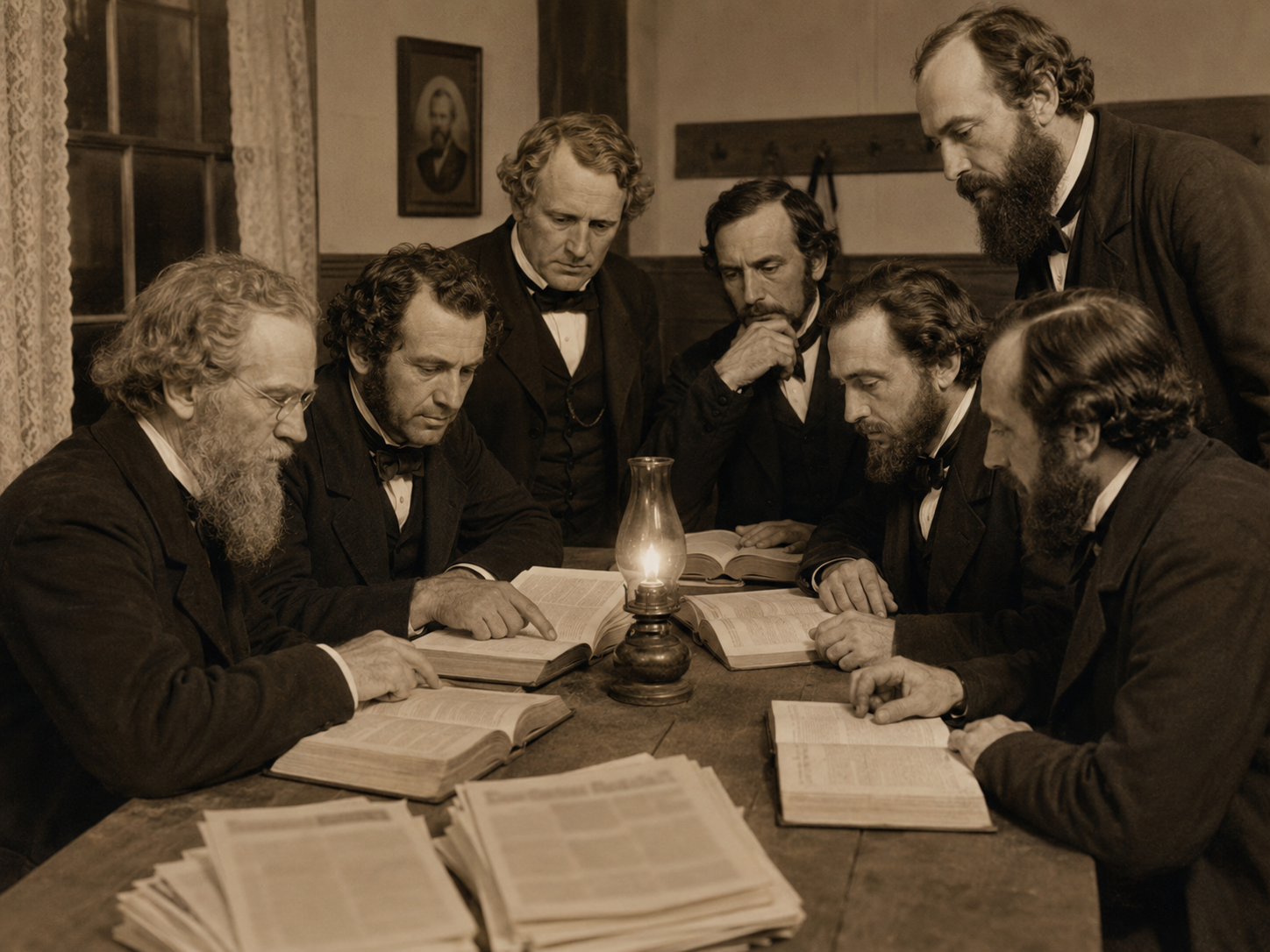
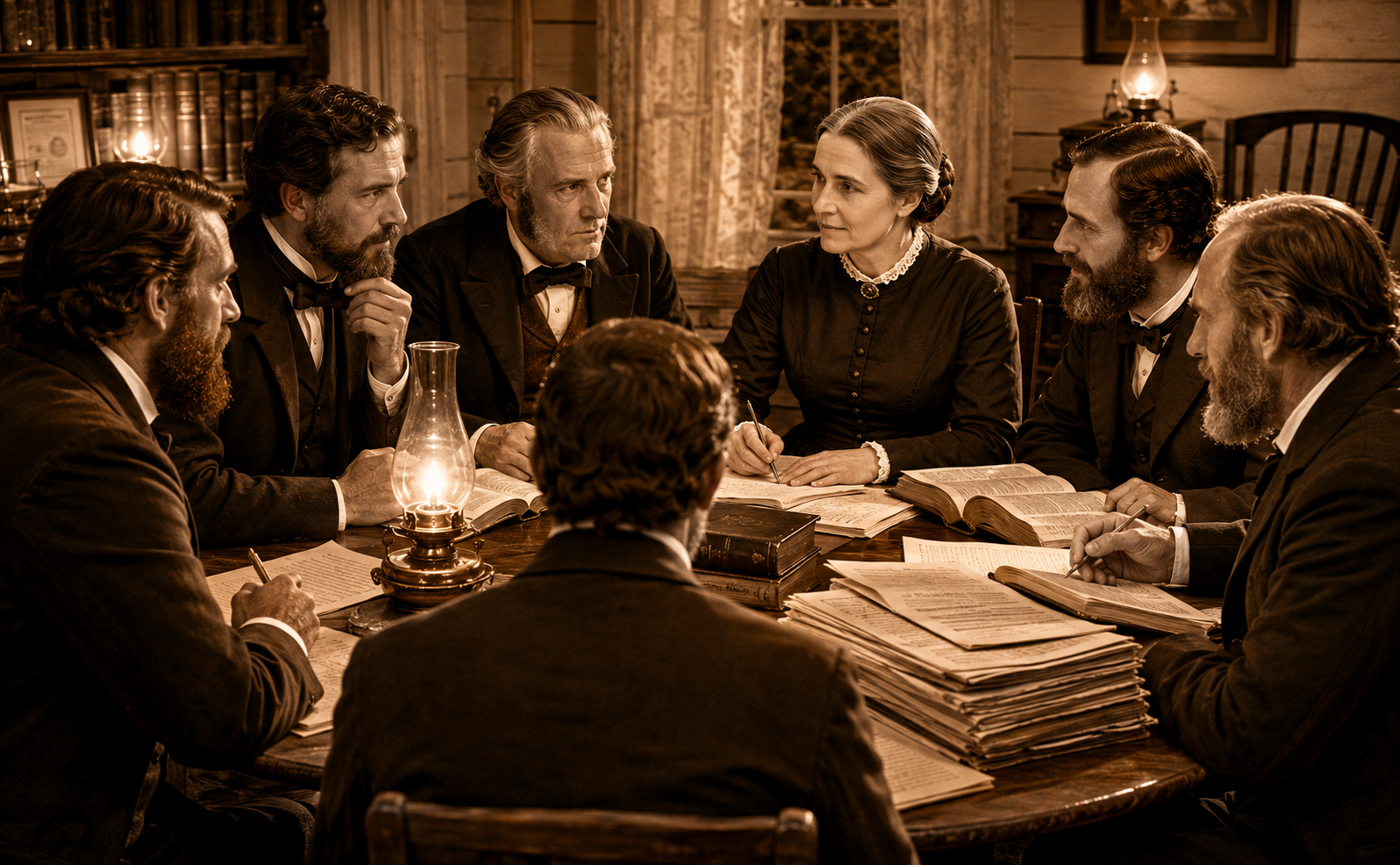

The objection in front of us this lesson is that Ellen White quietly stood apart from the men who founded the movement — that the pioneers rejected the Trinity but she did not stand with them. So let the pioneers speak. We will read them by name, in their own words, on the three questions that matter — the Trinity, the begotten Son, and the Holy Spirit — and we will be candid about where they differed among themselves. Then we will ask the one question that settles the matter of whether she broke with them: in half a century of labor beside them, did she ever once correct them for it?
Question 01
What did the Adventist founders say about the Trinity?
Answer
They rejected it — openly, repeatedly, and in print. This was not a fringe opinion held by one or two; it was the settled, published position of the men who built the church. Begin with the chief founder. James White listed the Trinity among the errors Protestants had carried over from Rome:
As fundamental errors, we might class with this counterfeit sabbath other errors which Protestants have brought away from the Catholic church, such as sprinkling for baptism, the trinity, the consciousness of the dead and eternal life in misery.
Twenty-three years later he had not softened. His objection was that the creed could not be explained because it could not be understood:
The inexplicable Trinity that makes the Godhead three in one and one in three, is bad enough; but that ultra Unitarianism that makes Christ inferior to the Father is worse.
Read that line carefully, because it carries the whole pioneer balance in a single sentence: the Trinity is rejected, and so is the opposite error of a merely-inferior Christ. The pioneers held neither — they held a truly begotten Son who is truly divine. J. N. Andrews struck at the creed’s origin and its effect on the persons of God:
The doctrine of the Trinity which was established in the church by the council of Nice, A.D. 325. This doctrine destroys the personality of God, and his Son Jesus Christ our Lord. The infamous measures by which it was forced upon the church... might well cause every believer in that doctrine to blush.
Joseph Bates put it as plain personal testimony — he simply could not believe a Father and a Son were one and the same being:
Respecting the trinity, I concluded that it was an impossibility for me to believe that the Lord Jesus Christ, the Son of the Father, was also the Almighty God, the Father, one and the same being.
And J. N. Loughborough gave the most structured answer of all when a reader asked what objection there could be to the doctrine:
There are many objections which we might urge... 1. It is contrary to common sense. 2. It is contrary to scripture. 3. Its origin is Pagan and fabulous... The word Trinity nowhere occurs in the Scriptures.
This is the consensus, stated by the men whose names are on the movement’s earliest masthead. The Adventist church was not built on the Trinity; it was built by men who named the Trinity an error.
Question 02
What did the pioneers teach about the begotten Son?
Answer
Having rejected the Trinity, they did not fall into the opposite ditch of denying Christ’s divinity. They taught a Son who is truly begotten of the Father — not made, not created — and therefore truly God by nature. The cleanest statement of it came from E. J. Waggoner, in the very book Ellen White endorsed:
The angels are sons of God, as was Adam, by creation; Christians are the sons of God by adoption, but Christ is the Son of God by birth... He is begotten, not created... since He is the only-begotten son of God, He is of the very substance and nature of God and possesses by birth all the attributes of God.
That is the whole framework in one breath: angels by creation, believers by adoption, Christ by birth — and therefore fully divine. Compare it now with Ellen White’s own words, and notice they are not merely similar but the same doctrine in the same three categories:
“God so loved the world, that he gave his only-begotten Son,”—not a son by creation, as were the angels, nor a son by adoption, as is the forgiven sinner, but a Son begotten in the express image of the Father’s person, and in all the brightness of his majesty and glory, one equal with God in authority, dignity, and divine perfection.
She did not break with the pioneers on the Son; she taught exactly what they taught. The same note sounds across the roster. John Matteson made the literal sonship the ground of Christ’s deity:
Christ is the only literal son of God. “The only begotten of the Father.” John 1:14. He is God because he is the Son of God; not by virtue of His resurrection. If Christ is the only begotten of the Father, then we cannot be begotten of the Father in a literal sense.
James White anchored the same truth in the language of derivation — equal because everything was received, the Father greater only in being first:
The Father was greater than the Son in that he was first. The Son was equal with the Father in that he had received all things from the Father.
And S. N. Haskell set the begetting back before time and before any other being:
Back in the ages, which finite mind cannot fathom, the Father and Son were alone in the universe. Christ was the first begotten of the Father.
Begotten, not created; divine by birth, not by adoption; before all worlds. That is the pioneer Christ — and it is Ellen White’s Christ.
Question 03
What did they teach about the Holy Spirit?
Answer
Here we must be careful and honest, because the pioneers were of one mind on the Father and the Son but less uniform on the Spirit (we will weigh that variation directly in the next question). Their dominant teaching was that the Holy Spirit is the very Spirit and presence of the Father and the Son reaching out through all the universe — not a third, separate divine Person to be prayed to in His own right. Uriah Smith, in his mature work, put it plainly:
This Spirit is the Spirit of God, and the Spirit of Christ... the Bible uses expressions which cannot be harmonized with the idea that it is a person like the Father and the Son. Rather it is shown to be a divine influence from them both, the medium which represents their presence... We never read of the seven Gods or the seven Christs.
J. N. Loughborough described the Spirit the same way — as God’s representative, the agency through which He works and is present:
The Spirit of God is spoken of in the Scriptures as God’s representative — the power by which he works, the agency by which all things are upheld... when we speak of the Spirit of God we are really speaking of his presence and power.
This is the same understanding the site holds today: the Holy Spirit is God’s own presence and power — fully divine because it proceeds from divinity — yet not a separate third Being. It rests on Scripture’s own interchange of terms:
But ye are not in the flesh, but in the Spirit, if so be that the Spirit of God dwell in you. Now if any man have not the Spirit of Christ, he is none of his.
One Spirit, called both “the Spirit of God” and “the Spirit of Christ” in a single verse — the presence of the Father and the Son in the believer.
Question 04
Where did the pioneers differ among themselves?
Answer
This course will not pretend the founders marched in lockstep on every point, because they did not — and saying so plainly only strengthens the case, since it shows we are reading the record rather than polishing it. There are two honest qualifications to make.
First, Uriah Smith changed his mind — for the better. In his earliest writing Smith described Christ as a created being. He did not stay there. He revised his understanding and, in his later books, deleted the “created” language and replaced it with a clear begotten-not-created statement. We cite his mature position, and we name the change openly:
The Scriptures nowhere speak of Christ as a created being, but on the contrary plainly state that he was begotten of the Father... while as the Son he does not possess a coeternity of past existence with the Father, the beginning of his existence, as the begotten of the Father, antedates the entire work of creation.
His beginning was not like that of any other being in the universe... by some divine impulse or process, not creation, known only to Omniscience, and possible only to Omnipotence, the Son of God appeared.
The honest reading is not “Smith always taught the begotten Son” — it is that he came to it and corrected what he had written. That is exactly how doctrine settles among honest students, and it is the position the pioneers landed on together.
Second, they were not unanimous on the Spirit’s personhood. The strong, near-universal pioneer consensus ran on two points — that the Father is the one true God, and that Christ is the literally begotten, fully divine Son. On the precise nature of the Holy Spirit there was more variation. Most, like Smith and Loughborough above, treated the Spirit as the presence and power of the Father and the Son rather than a separate Person. But not every voice in the early movement spoke in exactly those terms, and we will not claim a unanimity that the record does not show. What is uniform is the rejection of the creedal three-co-equal-Persons Trinity; what varied was how each man framed the Spirit within that rejection.
Notice what this candor does for the larger argument. If the case depended on pretending the pioneers never disagreed and never grew, a single counter-example would break it. It does not depend on that. It depends on the documented fact that the founders, as a body, rejected the Trinity and confessed a begotten Son — and that fact stands even with Smith’s correction and the Spirit-variation fully admitted.
Question 05
Did Ellen White ever rebuke them for rejecting the Trinity?
Answer
No. And this is the quiet fact that dismantles the objection more completely than any single quotation could. Ellen White lived and labored among these men for roughly fifty years. She read their articles; the Review and Herald carried her writing in the same columns as theirs. She was given, on her own testimony, light to correct error in the church — and she used it, sharply, on many subjects. Yet across all those decades, while James White called the Trinity an “inexplicable” error, while Andrews said it “destroys the personality of God,” while Loughborough called it contrary to Scripture and pagan in origin, she never once published a word of rebuke to them for it.
Weigh how loud that silence is. A prophet who watched the founders of the movement reject the central doctrine of historic Christendom — and said nothing in correction for half a century — was not secretly holding the opposite view. The far more natural reading, and the one the rest of her writings confirm, is that she agreed with them. Indeed she did more than refrain from rebuke: she endorsed the very book in which E. J. Waggoner wrote “He is begotten, not created,” saying it harmonized with the light God had given her for forty-five years.
So the third form of the claim — that she broke with the pioneers — fails on the simplest possible test. She did not stand apart from them. She stood with them, wrote with them, and confirmed their faith in her own hand. The begotten-Son, one-true-God position was not a wing of the early church she declined to join; it was the church’s faith, and it was hers.
Personal response
Read the founders for yourself before you accept anyone’s summary of them — including this one. Their words are public and dated; you can check every line. As you do, hold the honest qualifications in view: men grow, and they did not agree on every detail. But ask whether the heart of their faith — the one true God and His truly begotten Son — is the faith you have received, and the faith the prophet who labored beside them confirmed rather than corrected.
Foundational text
And this is life eternal, that they might know thee the only true God, and Jesus Christ, whom thou hast sent.