We have spent this course letting Scripture speak for itself about the Father, His Son, and His Spirit. One question remains, and it is a historical one: if the Bible never uses the word, where did the doctrine of the Trinity come from? The answer is not hidden. It is written into the records of the church councils, the decrees of Roman emperors, and the open admissions of the church that claims to have formulated it. This lesson follows that documented trail — carefully, fairly, and without sneering — and then calls us home to the faith that was once delivered to the saints.
Question 01
Is the doctrine of the Trinity actually in the Bible?
Answer
The word itself is not. Search the whole of Scripture, in any translation, and you will not find the term Trinity, nor the phrases “God the Son,” “God the Holy Spirit,” “co-equal,” “co-eternal,” or “three persons in one God.” This is not a controversial claim; it is simply a fact about the text. What Scripture gives us instead is a Father, His only begotten Son, and the Spirit that proceeds from Them — spoken of in the plain language of relationship, never as a single triune Being of one substance. The technical vocabulary that defines the Trinity — substance, essence, consubstantial — comes not from the prophets and apostles but from a later age, and from a different source. To find where it came from, we have to leave the Bible and open the history books.
Question 02
What did the church believe before Nicaea?
Answer
For the first three centuries the church confessed no formal doctrine of the Trinity, because none had yet been composed. The common understanding, as the surviving writers attest, was that there is one unbegotten Father, without beginning, and one Son truly begotten of Him before all creation — divine, but derived from and subordinate to the Father. The Holy Spirit appears in the early creeds only as a brief confession (“and in one Holy Ghost”), not yet defined as a co-equal third person. Justin Martyr called the Son the Offspring “begotten by the Father before all things created”; Origen wrote that He was “born of the Father before all creatures”; Novatian named Him “a second person after the Father, but not taking away… that God is one.” These men were not Trinitarians in the later sense. They confessed a begotten, divine Son — the very picture the apostles drew. The idea that the Father and the Son were both unbegotten, and of one undivided substance, was not the ancient faith. It was new.
Question 03
What happened at the Council of Nicaea in 325?
Answer
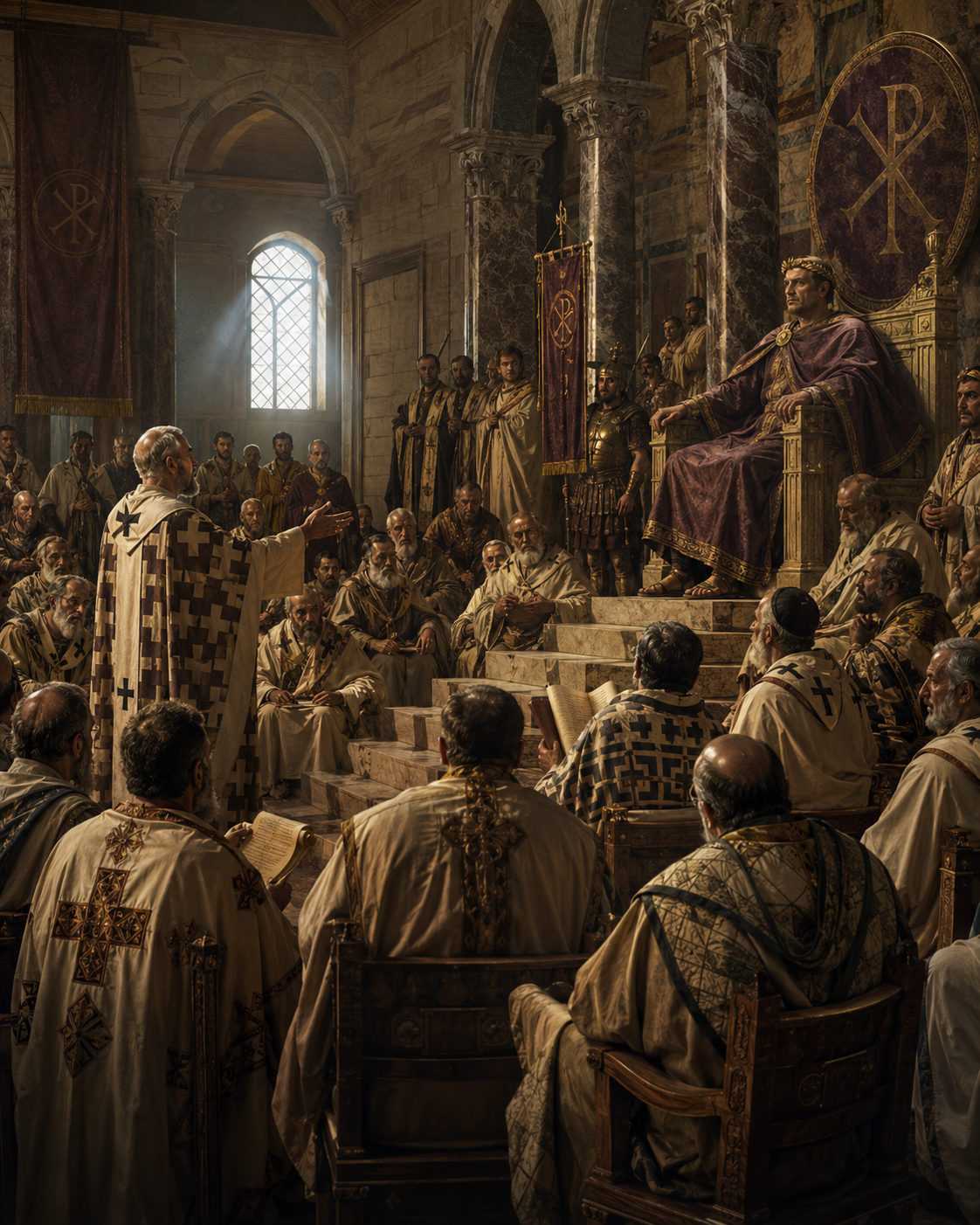
Early in the fourth century a dispute broke out in Alexandria between the bishop Alexander and a presbyter named Arius over the relationship of the Son to the Father. To settle it — and to unify his empire — the Roman emperor Constantine summoned bishops to Nicaea in A.D. 325. This is the decisive point to grasp: it was a Roman emperor, not yet baptized, who called the council, presided over its politics, and pressed for its conclusion. The majority party, determined (in the historian Stanley’s phrase) “to find some form of words which no Arian could receive,” fastened upon a single non-biblical term — homoousios, “of one substance.” The word is not found in Scripture; even one of its later defenders, Athanasius, was said by Gibbon to confess that the more he meditated on it, the less he comprehended it. Constantine himself ordered the disputed word inserted and made himself its “patron and interpreter.” The faith of the church was now to be measured by a term the Bible never uses, settled by the will of an emperor.
Question 04
What happened in the long struggle that followed?
Answer
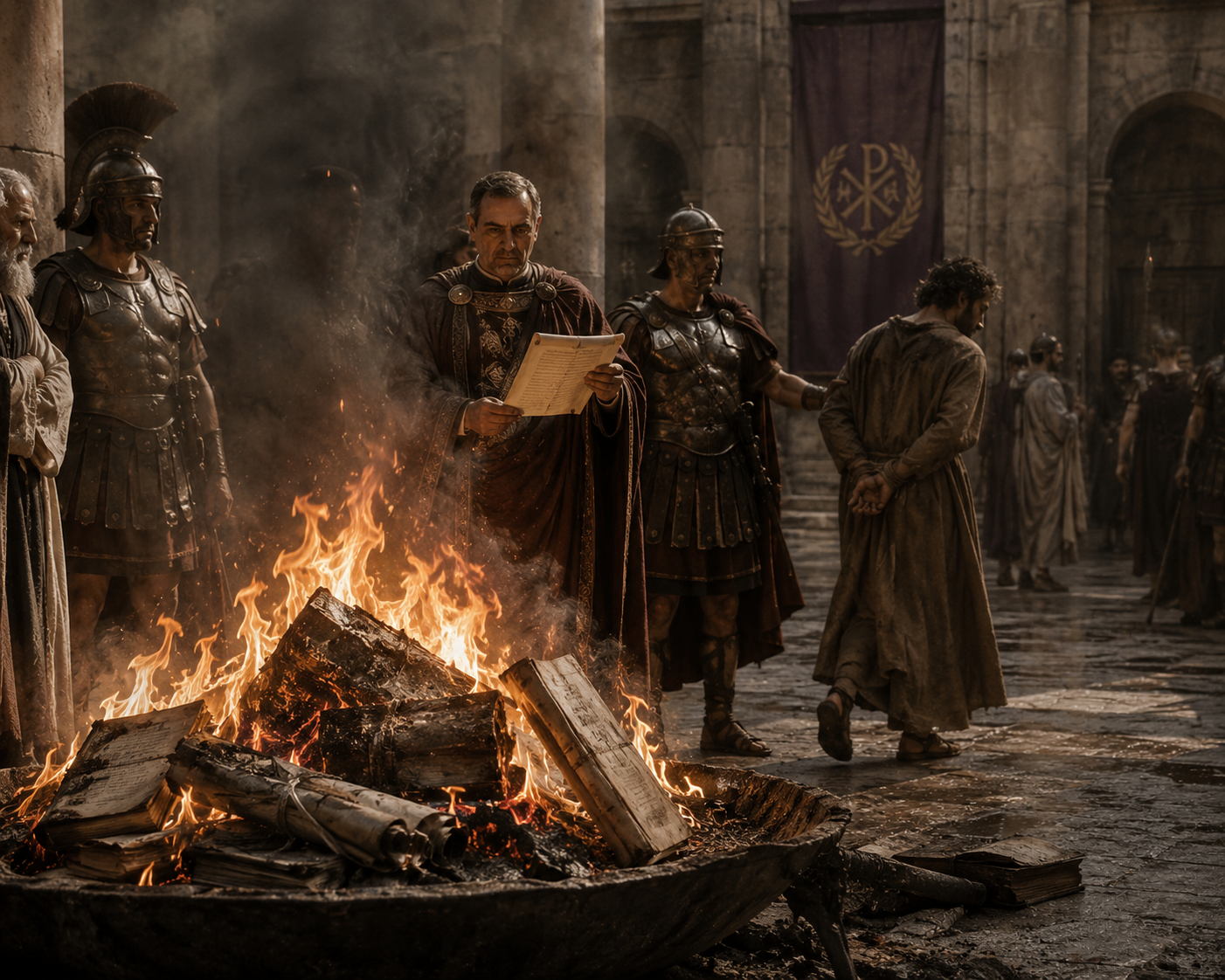
Nicaea did not end the matter; it began a sixty-year struggle conducted, on every side, by the power of the state. When seventeen bishops at first refused to sign, Constantine threatened them with banishment, and all but a few yielded. By the emperor’s edict the writings of Arius were ordered burned, his followers branded with a slur, and — by the historians’ account — anyone caught concealing his books was to suffer death.
…consigned to the flames… [and concealment punishable by] capital punishment…
This is one of the best-attested and most sobering facts of the whole history: a doctrine of God enforced by exile and fire. And the wheel turned. Within a generation the so-called Arians regained the upper hand; Athanasius was exiled five times; and under the emperor Constantius the councils reversed course, set the word substance aside as unscriptural, and — by the imperial confession of A.D. 360 — made the opposite position the orthodoxy of the empire. For a time, by the historian Bower’s reckoning, scarcely an orthodox bishop was left standing in the whole East. Whatever else this proves, it shows that the creed of the church was being decided by whichever emperor held the throne — not by the plain word of God.
Question 05
What was decided at Constantinople in 381?
Answer
The Trinity as we know it was completed not at Nicaea but later. The emperor Theodosius, baptized into the Catholic faith, issued an edict in A.D. 380 commanding belief in “the sole deity of the Father, the Son, and the Holy Ghost… and a pious Trinity.” By the historians’ account this is the first appearance of the word “Trinity” in any creed or edict — more than three centuries after the apostles. The following year the Council of Constantinople (A.D. 381) took the final step that Nicaea had not: it defined the Holy Spirit as a distinct divine person — “the Lord and Life-giver, who proceedeth from the Father; who with the Father and the Son together is worshipped and glorified.” Only here, at the close of the fourth century, was the full three-person doctrine of the Trinity first set forth in a creed. The timeline is therefore documented and clear: 325 for the Son’s consubstantiality, 380 for the word, 381 for the third person. The apostolic age knew none of it.
Where, then, did the framework come from, if not from Scripture? Here we must be careful and honest. Many have argued that the threefold scheme was drawn from the philosophy of the pagan world — that, as one nineteenth-century French dictionary put it, “the Platonic trinity, itself merely a rearrangement of older trinities dating back to earlier peoples,” lay behind “the three hypostases or divine persons taught by the Christian churches.” That is a real claim, made by serious writers, and it is worth weighing. But in fairness it rests on limited citation, and we present it as an argument rather than a proven fact. What does not depend on it — what stands on its own — is the documented record above: the word is fourth-century, the terms are non-biblical, and the dogma was enforced by the power of the state.
Question 06
Was “Arian” really a denial of Christ’s divinity?
Answer
This is where a careful reader must resist the caricature. The popular story is that Arius taught Christ to be a mere creature, and that Nicaea rose to defend His deity. The history is not so simple. Arius’s own writings were burned, so much of what we “know” of him reaches us through the hands of his opponents. Yet even on that hostile record, historians have doubted the charge. As one history of these dissenting churches observes:
It is doubtful if many believed Christ to be a created being. Generally, those evangelical bodies who opposed the papacy and who were branded as Arians confessed both the divinity of Christ and that He was begotten, not created, by the Father.
Read carefully, the great body of those labeled “Arian” affirmed exactly what this course has affirmed: that the Son is divine, and that He is begotten, not created. “Arian” became, over time, a catch-all brand pinned on anyone who would not sign the non-biblical creed — and it carried the false implication that such people denied Christ’s Godhead. That charge is, for the most part, a later slander. Our own position is not the caricature of Arianism, and it is not the creature-Christology that genuinely would empty the gospel. It is the older confession the apostles and the early church held: one unbegotten Father, and His true, divine, begotten Son.
Question 07
What faith did the faithful keep — and where does that leave us?
Answer
It leaves us with a question every reader must answer for themselves. The church that formulated the Trinity does not deny her authorship of it; she affirms it openly. One Catholic catechetical handbook states it plainly:
The mystery of the Trinity is the central doctrine of the Catholic Faith. Upon it are based all the other teachings of the Church… after four centuries of clarification, decided to state the doctrine in this way: in the unity of the Godhead there are three Persons…
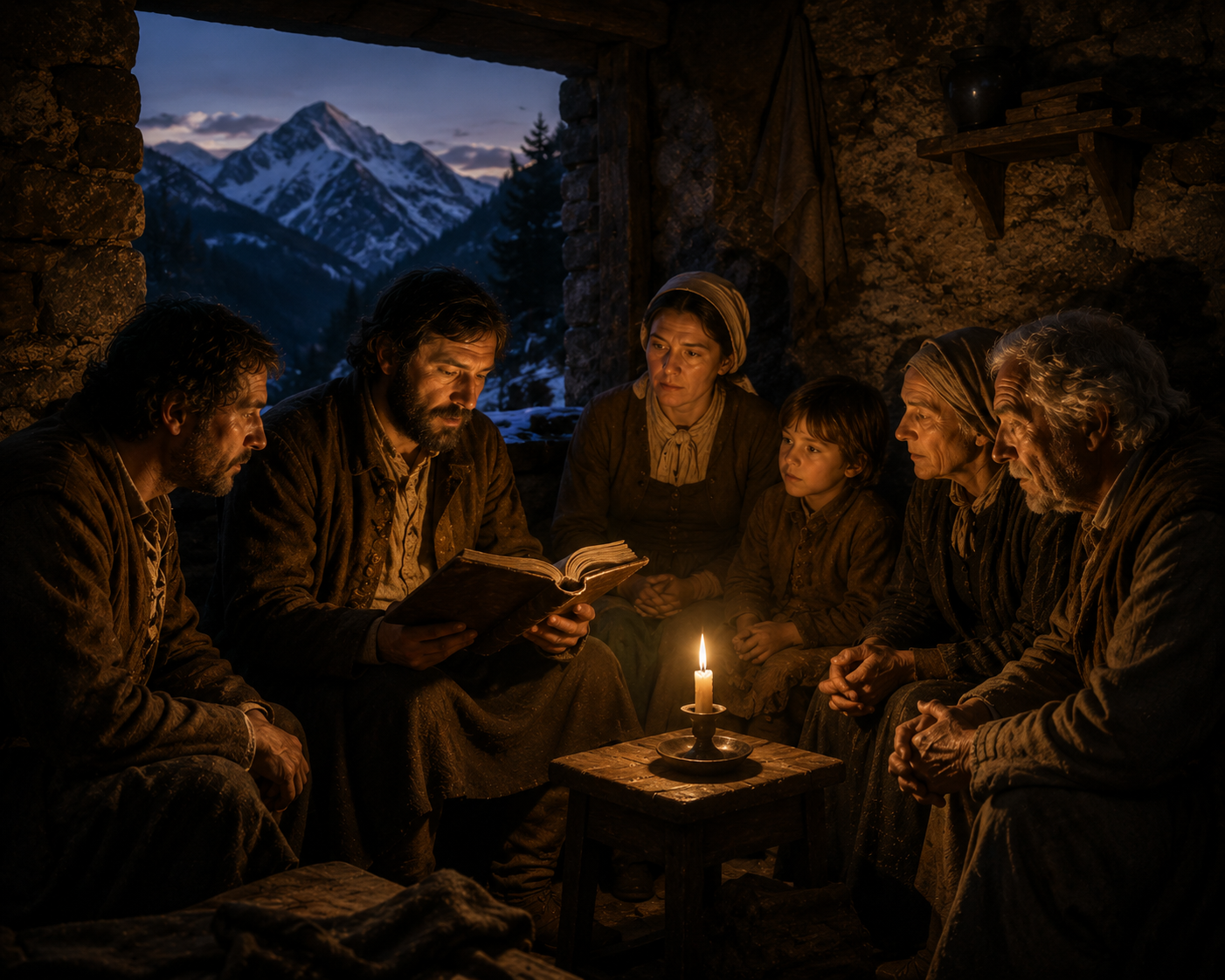
Four centuries of clarification, by the Church’s own admission — not a truth received from the apostles, but a doctrine “decided” and “stated” by councils. And through all those centuries the older faith did not die. The Waldenses in their Alpine valleys, and other dissenting churches scattered through the long medieval night, kept confessing the Father unbegotten and His begotten Son, paying for that confession with persecution. The faith we hold is not a novelty. It is the faith that was already old when the councils were young — the one delivered to the saints.
…it was needful for me to write unto you, and exhort you that ye should earnestly contend for the faith which was once delivered unto the saints.
So where does the trail end? Not at a creed, and not at a council, but where this course began — at the words of Christ Himself, who defined eternal life as knowing “the only true God, and Jesus Christ, whom thou hast sent” (John 17:3). We are not called home to a formula hammered out by emperors and bishops, but to a Person — the living Father — and to His Son. That is the faith once delivered. That is where we may safely stand.
Personal response
Sit honestly with what the history shows. So much of what we were taught to call “the faith” was, in fact, decided centuries after the apostles — by councils, under emperors, enforced by exile and fire. That should not make us cynical, but it should make us free: free to return to the Father and His begotten Son as Scripture reveals Them, without owing our worship to any creed a council composed. Ask the Father, in His Son’s name, for the courage to earnestly contend for the faith once delivered to the saints — and the humility to be led home, not by the verdict of history, but by His own plain word.
Foundational text
…earnestly contend for the faith which was once delivered unto the saints.