Everything this course has established about the Father and His Son now comes home to the one place it was always meant to reach: the inside of a human life. The Gospel is not finally about a doctrine held at arm’s length, but about a Person received. To see how, we have to follow a thread the Bible itself lays down — from a strange remark John makes about the Spirit, to the day of Pentecost, to the quiet promise of Christ that He would come and live in His own people. Get this, and righteousness by faith stops being a theory and becomes the most personal reality there is.
Question 01
Why was the Spirit “not yet given” before Pentecost?
Answer
John makes a remark that, taken alone, sounds impossible. Describing the Spirit Jesus promised, he writes:
(But this spake he of the Spirit, which they that believe on him should receive: for the Holy Ghost was not yet given; because that Jesus was not yet glorified.)
Yet the same Bible tells us the Spirit was at work long before — the Old Testament prophets spoke by it. Peter calls it, plainly, the Spirit of Christ that was already in them:
Searching what, or what manner of time the Spirit of Christ which was in them did signify…
So how can the Spirit be both present in the prophets and “not yet given”? The answer is that John is not denying the Spirit had ever operated. He is pointing to a particular gift that depended on something that had not yet happened — Jesus being glorified. Whatever that gift is, it was bound up with Christ’s own glorification, and could not be poured out until He had reached it. The rest of the question turns on identifying what, exactly, was new.
Question 02
What is the Divine-Human life Christ now gives?
Answer
The new thing is the life Christ Himself had only recently come to possess: a Divine-Human life — the life of God joined to a real human experience, lived out, tested, and carried through to victory on this earth. On the last night, He prayed in exactly these terms:
I have glorified thee on the earth: I have finished the work which thou gavest me to do. And now, O Father, glorify thou me with thine own self with the glory which I had with thee before the world was.
Notice the order. He first glorified the Father “on the earth” by finishing the work given Him — a life of perfect obedience lived in human flesh — and only then asks to be glorified Himself. That human life had never existed before the incarnation. The eternal Son was always divine, but a tested, victorious human experience was something He forged here, among us. This is why He could say it was actually to our advantage that He leave:
Nevertheless I tell you the truth; It is expedient for you that I go away: for if I go not away, the Comforter will not come unto you; but if I depart, I will send him unto you.
The gift the prophets did not have was not the Spirit in general, but this glorified, Divine-Human life of the Son — a life that could not be poured out until it had been lived to the end and crowned with glory.
Question 03
What actually happened at Pentecost?
Answer
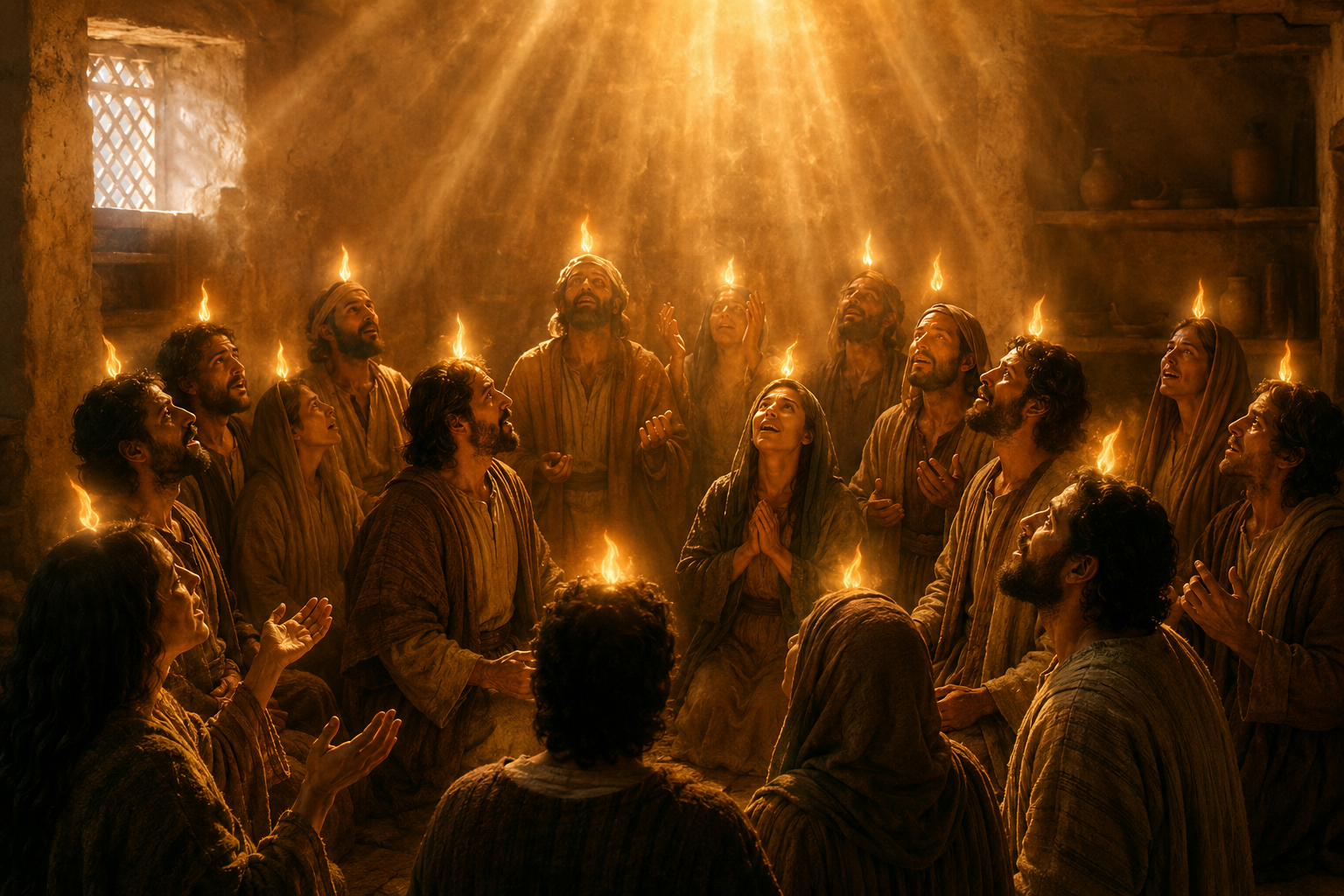
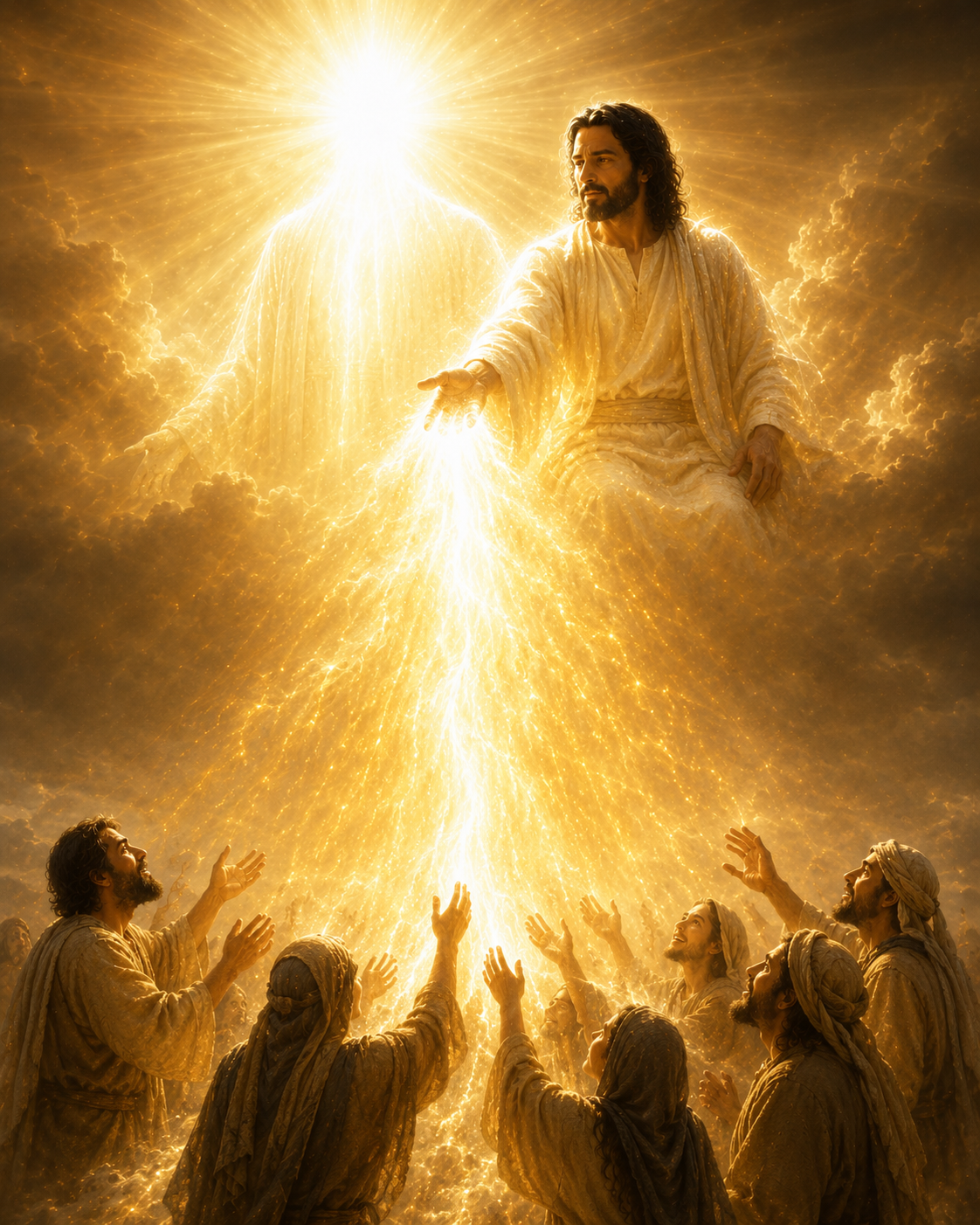
Pentecost was the moment the glorified Christ poured out His own life upon His people. Peter does not describe a third party arriving independently; he describes the risen, exalted Jesus doing the pouring:
This Jesus hath God raised up, whereof we all are witnesses. Therefore being by the right hand of God exalted, and having received of the Father the promise of the Holy Ghost, he hath shed forth this, which ye now see and hear.
Read carefully, the sequence is unmistakable: Jesus is raised, exalted, receives from the Father the promised gift, and then He sheds it forth. The glorification of the Son came first; the outpouring followed from it, exactly as John 7:39 said it must. What the disciples saw and heard that day was the very life of the glorified Christ flowing out to fill them.
Question 04
Is the Spirit received from within, or from without?
Answer
From without — it is an actual gift received, not a quality a person cultivates by enough study or discipline. The disciples already believed, prayed, loved Christ, and knew the Scriptures; yet they were told to wait for something they did not yet have:
…that they should not depart from Jerusalem, but wait for the promise of the Father… ye shall be baptized with the Holy Ghost not many days hence.
If it could be produced from within by effort, there would be nothing to wait for. Instead it is consistently received — “ye shall receive the gift of the Holy Ghost” (Acts 2:38) — and received as a definite event, not a slow self-improvement. In Samaria, believers who had already accepted the word and been baptized still had to receive it as a distinct gift:
…Peter and John… prayed for them, that they might receive the Holy Ghost: (For as yet he was fallen upon none of them: only they were baptized in the name of the Lord Jesus.) Then laid they their hands on them, and they received the Holy Ghost.
We should keep two things distinct here. There is the moment of receiving Christ — the new birth, when His life enters from the outside in — and there is the lifelong work of Christ being formed within us as our character is shaped into His likeness:
My little children, of whom I travail in birth again until Christ be formed in you…
The Galatians had already received the Spirit; what remained was for Christ to be formed in them. Reception comes first and from outside; formation follows from within. The indwelling Saviour precedes the manifested one.
Question 05
How is the Spirit Christ our High Priest “in another form”?
Answer
Scripture gives the Spirit a work we recognize as priestly: intercession. And it locates that intercession within the believer:
Likewise the Spirit also helpeth our infirmities… the Spirit itself maketh intercession for us with groanings which cannot be uttered. And he that searcheth the hearts knoweth what is the mind of the Spirit, because he maketh intercession for the saints according to the will of God.
Interceding is the work of a priest, and the place where it happens is the body of the believer, which Paul calls a temple:
What? know ye not that your body is the temple of the Holy Ghost which is in you, which ye have of God…
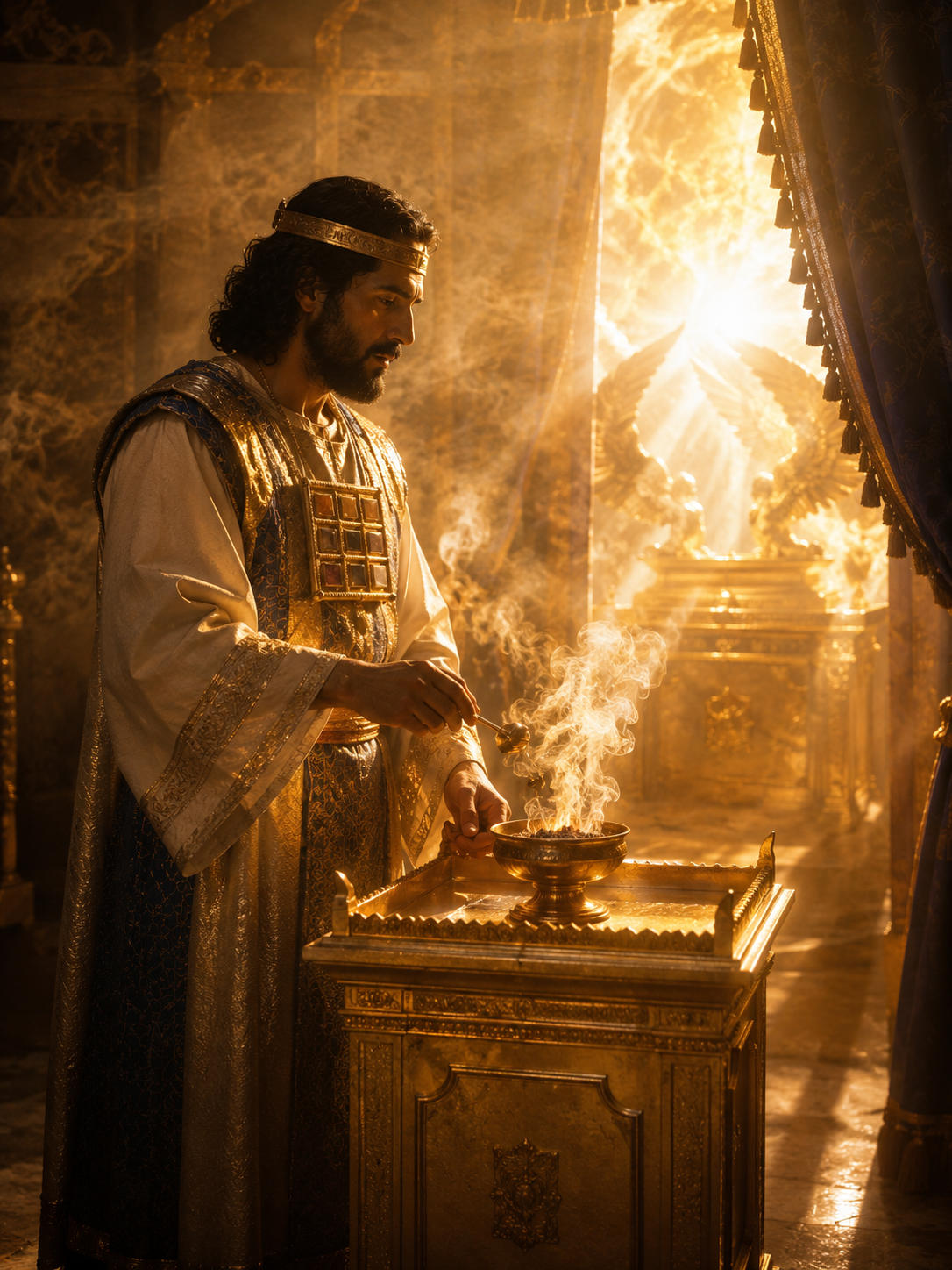
Now hold that beside the heavenly ministry of Christ. We have a High Priest seated in the true sanctuary:
We have such an high priest, who is set on the right hand of the throne of the Majesty in the heavens; a minister of the sanctuary, and of the true tabernacle, which the Lord pitched, and not man.
The same Christ who ministers as High Priest above, in His glorified bodily form, also ministers within His people by His Spirit — “in another form.” We do not need to overclaim or strain the picture: the point is simply that the priestly work of interceding is being done in the heart’s temple, and the Bible elsewhere names that indwelling life as Christ’s own (Galatians 4:6). One Priest, one ministry, reaching us both from the throne above and from within.
Question 06
What does it mean that Christ dwells in us?
Answer
It means exactly what He said, and it is wonderfully literal. Promising the Comforter, Jesus did not point away from Himself to someone else; He pointed to His own return:
I will not leave you comfortless: I will come to you. Yet a little while, and the world seeth me no more; but ye see me: because I live, ye shall live also. At that day ye shall know that I am in my Father, and ye in me, and I in you.
“I will come to you.” “I in you.” The Comforter is not a stranger sent in Christ’s place — He is Christ Himself, present in a new way. And the life He brings is His own: “because I live, ye shall live also.” The believer’s new life is not merely pardon recorded in heaven; it is the living Christ taking up residence and sharing His life with us.
Question 07
Why is this the very heart of righteousness by faith?
Answer
Because once we see that the gift is Christ’s own life living in us, righteousness by faith stops being a self-improvement program and becomes what Scripture always said it was: a Person. Righteousness is not first an achievement; it is a name He bears:
…and this is his name whereby he shall be called, THE LORD OUR RIGHTEOUSNESS.
Paul says the same without flinching: Christ “is made unto us wisdom, and righteousness, and sanctification, and redemption” (1 Corinthians 1:30). Righteousness is not a substance God hands over apart from His Son; it is His Son. So the only way to be righteous is to have Him — His life exchanged for ours:
I am crucified with Christ: nevertheless I live; yet not I, but Christ liveth in me: and the life which I now live in the flesh I live by the faith of the Son of God…
This is why the whole secret of the Gospel can be gathered into four words:
…Christ in you, the hope of glory.
It is an exchange of life, not a modification of life. We do not borrow a little of His help to improve ourselves; we receive Him, and live by the life He lived, tested, and perfected for us. That is the heart of righteousness by faith — and it is why understanding who the Spirit really is matters so much. The One we receive is not a third stranger, but the very life of the Son, our righteousness, come to live in us. (This thread is taken up in full in our companion course on Righteousness by Faith.)
Personal response
Have you been trying to become righteous, or have you received the One who is your righteousness? Sit with the difference. Ask the Father, in His Son’s name, not merely for help to do better, but for the living Christ to dwell in you — His own tested, victorious life exchanged for yours. The Spirit you are promised is not a distant force or a third stranger; it is Christ Himself, come to live in you, the hope of glory. There is nothing better you could open your heart to receive.
Foundational text
I will not leave you comfortless: I will come to you… because I live, ye shall live also… ye in me, and I in you.