Christ was once asked, in plain words, the first commandment of all. He gave a plain answer. The first commandment is the recognition of the one true God. Who that God is, on Christ’s own testimony, is the foundation on which every subsequent commandment, every subsequent doctrine, and every subsequent life rests. This lesson asks Christ’s question and lets Him give His own answer.
The first lesson of this course established that the Bible is the word of God. The second lesson asks the next foundational question: who is that God? Every world religion has an answer. Every Christian tradition has an answer. The question for the honest reader is not what tradition has answered, but what the Bible has answered — and in particular, what Christ Himself answered when He was put on the question.
The institute holds that the Bible answers the question with extraordinary clarity, and that the answer it gives is in some respects different from the answer many readers will have inherited from later church history. This lesson lets the Scriptures speak in their own voice. The reader is invited simply to follow Christ’s own teaching and the apostles’ own confession, and to let those plain texts settle the matter.
Question 01
What is the first commandment, according to Christ Himself?
Answer
And one of the scribes came, and having heard them reasoning together, and perceiving that he had answered them well, asked him, Which is the first commandment of all? And Jesus answered him, The first of all the commandments is, Hear, O Israel; The Lord our God is one Lord: And thou shalt love the Lord thy God with all thy heart, and with all thy soul, and with all thy mind, and with all thy strength: this is the first commandment.
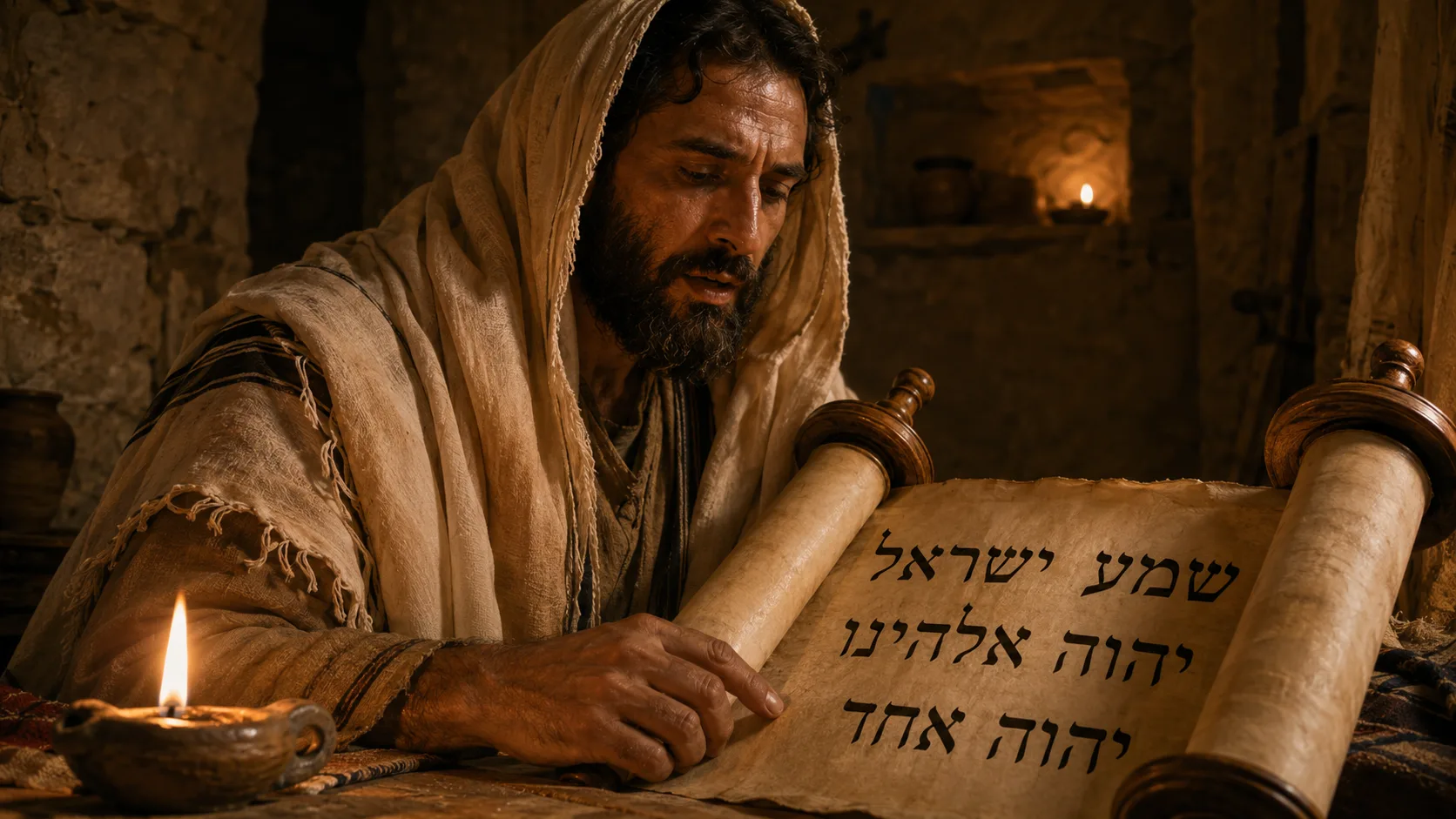
When asked the first of all the commandments — the most foundational truth in the moral universe — Christ did not name a new commandment. He named the ancient confession of Israel, recorded in Deuteronomy 6:4: the Shema. The first commandment of all is the recognition that the Lord our God is one Lord. Whatever else is true about the God of Scripture, this is first true: He is one.
Question 02
Who, by name, did Christ identify as the one true God?
Answer
And this is life eternal, that they might know thee the only true God, and Jesus Christ, whom thou hast sent.
Jesus answered, If I honour myself, my honour is nothing: it is my Father that honoureth me; of whom ye say, that he is your God.
In His high-priestly prayer on the night before His death, Christ addressed His Father as the only true God, and named Himself in the same sentence as the One sent by that God. He did not say we are the only true God. He did not say I and the Father together are the only true God. He addressed the Father, distinctly, as the only true God — and named Himself as the One the only true God had sent. The grammar is unambiguous.
Earlier in the same gospel He had said the same thing in different words: it is my Father that honoureth me; of whom ye say, that he is your God. Christ’s own Father is the God of Israel; Christ Himself stood in relation to that God as Son.
Question 03
Did Christ Himself have a God?
Answer
And about the ninth hour Jesus cried with a loud voice, saying, Eli, Eli, lama sabachthani? that is to say, My God, my God, why hast thou forsaken me?
Jesus saith unto her, Touch me not; for I am not yet ascended to my Father: but go to my brethren, and say unto them, I ascend unto my Father, and your Father; and to my God, and your God.
Him that overcometh will I make a pillar in the temple of my God… and I will write upon him the name of my God, and the name of the city of my God, which is new Jerusalem, which cometh down out of heaven from my God.
From the cross, in the most solemn moment in the history of this earth, Christ addressed the One He was praying to as my God. After the resurrection He sent word to His disciples that He was ascending to my God, and your God. And in the closing book of Scripture — decades after His ascension, in the glorified state at the right hand of His Father — He spoke through John of my God four times in a single verse. The glorified Christ has a God. That God is the Father. The Father stands in relation to Christ as God; Christ stands in relation to the Father as Son.
Question 04
How did the apostles confess God after the resurrection?
Answer
But to us there is but one God, the Father, of whom are all things, and we in him; and one Lord Jesus Christ, by whom are all things, and we by him.
For there is one God, and one mediator between God and men, the man Christ Jesus.
One God and Father of all, who is above all, and through all, and in you all.
The apostolic confession is precise and consistent. Paul, writing to the Corinthians, distinguishes plainly between one God, the Father and one Lord Jesus Christ — one God, one Lord, named in the same sentence, named in distinction from each other. To Timothy he writes the same thing in more compressed form: one God, one mediator, and the mediator named separately from the God. To the Ephesians: one God and Father of all. The apostolic confession after the resurrection is not a retraction of Christ’s teaching in John 17. It is the apostolic reception and transmission of Christ’s teaching in John 17.
Question 05
Is this the same God the Hebrew Scriptures named?
Answer
Hear, O Israel: The Lord our God is one Lord.
Thus saith the Lord the King of Israel, and his redeemer the Lord of hosts; I am the first, and I am the last; and beside me there is no God.
I am the Lord, and there is none else, there is no God beside me: I girded thee, though thou hast not known me.
Have we not all one father? hath not one God created us?
The Old Testament names the God of Israel as one, and as Father. The same God Whom Christ called Father in the gospels is the same God Moses, Isaiah, and Malachi called by the covenant name. There is no second God in the Hebrew Bible alongside the Father — and Christ did not introduce one. He came in the Father’s name (Jn 5:43), to declare the Father’s name (Jn 17:6, 26), to do the Father’s will (Jn 6:38), to bring His people back to the Father (Jn 14:6).
Question 06
Whom did Christ teach His disciples to worship?
Answer
But the hour cometh, and now is, when the true worshippers shall worship the Father in spirit and in truth: for the Father seeketh such to worship him. God is a Spirit: and they that worship him must worship him in spirit and in truth.
Speaking with the Samaritan woman at the well, Christ defined true worship in a single sentence. The true worshippers worship the Father. He did not say the true worshippers worship a triune godhead, or the second person of a divine community, or a divine essence with three subsistences. He named the object of true worship in the simplest possible terms: the Father. The Father seeks such as the true worshippers; the Father is what true worship is directed to.
Question 07
To Whom did Christ teach His disciples to pray?
Answer
After this manner therefore pray ye: Our Father which art in heaven, Hallowed be thy name.
And in that day ye shall ask me nothing. Verily, verily, I say unto you, Whatsoever ye shall ask the Father in my name, he will give it you.
The Lord’s Prayer — the model prayer Christ Himself gave His people — is addressed to the Father. Our Father which art in heaven. Christ does not instruct His disciples to address prayer to Himself, or to a triune object of worship, or to the Spirit. He instructs them to address the Father, in His own name, as the only mediator (1 Tim 2:5) by whom the prayer reaches the throne.
Question 08
Does this leave Christ as something less than God?
Answer
Who being the brightness of his glory, and the express image of his person, and upholding all things by the word of his power.
For in him dwelleth all the fulness of the Godhead bodily.
No. Christ is fully divine. He bears the express image of the Father’s person; all the fulness of the Godhead dwells in Him bodily; He upholds all things by the word of His power. The institute affirms Christ’s full divinity without hesitation and without qualification.
What this lesson establishes is not that Christ is less than divine. What it establishes is that the Father is the one true God, in distinction from the Son — on Christ’s own testimony, in the apostolic confession, and in the unbroken witness of the Hebrew Scriptures. How the Son can be fully divine and still distinct from the Father — how the one God can have a Son Who shares His divine nature — is the question Lesson 3 takes up.
Question 09
What about texts that seem to identify Christ with the Father?
Answer
In the beginning was the Word, and the Word was with God, and the Word was God.
I and my Father are one.
These passages are sometimes read as if they collapsed Christ and the Father into a single person. They do not. John 1:1 is careful: the Word was with God — a preposition of distinction — and the Word was God — a statement of divine nature, not of personal identity. The Word is divine, and the Word is with the Father: two truths held together, neither cancelling the other.
John 10:30 follows the same pattern. Christ said, I and my Father are one — the and is essential. He did not say I am my Father. He said He and His Father are one — one in purpose, in will, in nature, in love. The same unity He elsewhere prayed His disciples would share with Him and the Father: that they all may be one; as thou, Father, art in me, and I in thee, that they also may be one in us (Jn 17:21). The unity is real; the distinction is also real. Christ is one with the Father in the same way He prays His disciples may be one with both.
For a fuller treatment of these texts and the apostolic Father / Son framework over against the inherited post-apostolic formulation, see Come Out of Babylon, which walks the doctrinal history at length.
Question 10
Why does the correct identification of the one true God matter?
Answer
And this is life eternal, that they might know thee the only true God, and Jesus Christ, whom thou hast sent.
Christ Himself defined eternal life as knowing two Persons. Thee — the only true God, the Father. And Jesus Christ, whom thou hast sent — the only-begotten Son, sent by the Father. The eternal-life-giving knowledge is a knowledge of the right Father and of the right Son. If the God we believe in is not the God Scripture names, we are not in eternal life in the sense John 17:3 defines; we are in fellowship with a being other than the One the apostles knew and Christ revealed.
That is why the question of this lesson is foundational. It is not a quibble over technical theology. It is the question on whose answer eternal life, as Christ defines it, hangs. The reader who has accepted the one true God the Father, through His only-begotten Son, has the foundation on which all the remaining lessons of this course will build.
Summary of Lesson 2
- The first commandment of all, on Christ’s own testimony, is the recognition of the one God (Mk 12:28–30; Deut 6:4).
- Christ identified the Father, by name, as the only true God (Jn 17:3; Jn 8:54).
- Christ Himself has a God — the Father — from the cross (Matt 27:46) to the resurrection (Jn 20:17) to the glorified state (Rev 3:12).
- The apostles confessed one God (the Father) and one Lord (Jesus Christ) distinctly named (1 Cor 8:6; 1 Tim 2:5; Eph 4:6).
- The Hebrew Scriptures name the same God: one Lord, one Father, Creator and Redeemer (Deut 6:4; Isa 44:6; 45:5; Mal 2:10).
- Christ taught His disciples to worship the Father (Jn 4:23–24) and to pray to the Father in His name (Matt 6:9; Jn 16:23).
- Affirming the Father as the one true God does not diminish Christ’s full divinity (Heb 1:3; Col 2:9). How both can be true is the subject of Lesson 3.
- Eternal life is knowing the right Father, through the right Son (Jn 17:3).
Personal response
Many honest Christian readers will have inherited a different framing of the Godhead from the one the gospels and the apostolic letters present in their own words. The institute does not commend this lesson as an attack on anyone’s sincerity. It commends it as an invitation to do what the Bereans did when they heard the Apostle Paul: to search the Scriptures daily, whether those things were so (Acts 17:11). If the lesson’s argument can be sustained from Scripture, it ought to be received from Scripture, regardless of which inherited formulation it modifies. If it cannot, it ought to be rejected by Scripture.
For the reader ready to settle the question in the presence of the Father, the institute commends a simple prayer of the kind the Lord’s model prayer would commend:
Father in heaven, the only true God, You sent Your only-begotten Son into the world to declare Your name to Your people. Reveal Yourself to me as the gospels reveal You. Reveal Your Son to me as the apostles declare Him. Where what I have been taught aligns with Your word, confirm it. Where it does not, correct me. I am willing to receive what You have actually said. In the name of Your Son, Jesus Christ. Amen.
From the settled knowledge of the Father, the next lesson asks the next question: who is the Son He sent, and how can the one true God have a Son Who shares His own divine nature? Lesson 3 walks the begotten-Son framework of the apostolic confession — the framework on which Christ’s full divinity, His distinct personhood, and the unity of the Father and Son all rest.
Foundational text
“And this is life eternal, that they might know thee the only true God, and Jesus Christ, whom thou hast sent.”
— John 17:3