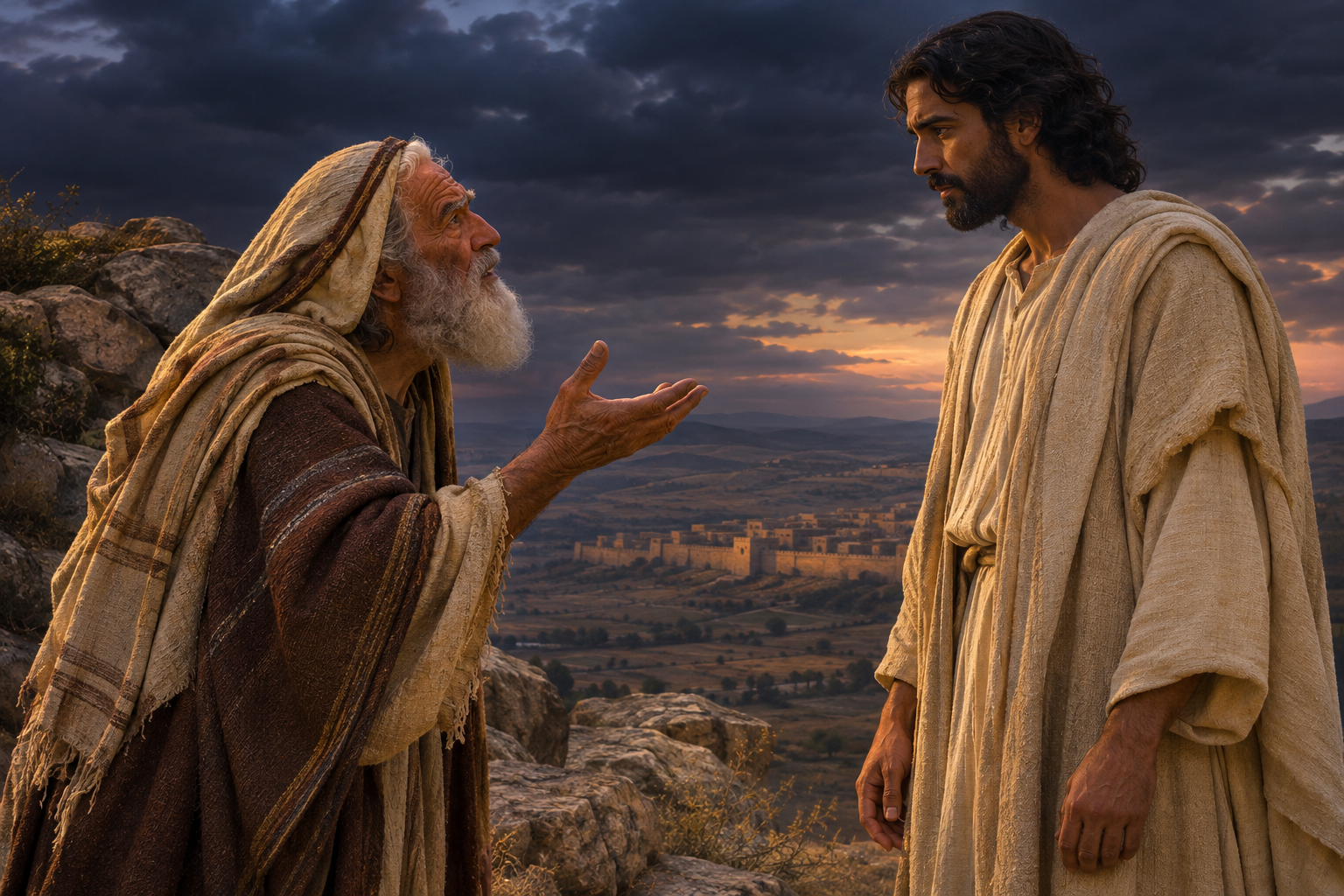

Two bears maul a crowd of youths for mocking a prophet. A law says a master who beats his slave goes unpunished if the slave survives a day or two. An order goes out to destroy a nation, down to the infants. These verses are not hidden. They are in the Bible, and the people who quote them against it have read them correctly. So we will not begin by saying the skeptic has misunderstood. We will begin by hearing the charge.
The charge
It has been made for centuries, and rarely better than by Thomas Paine:
Whenever we read the obscene stories, the voluptuous debaucheries, the cruel and torturous executions, the unrelenting vindictiveness, with which more than half the Bible is filled, it would be more consistent that we called it the word of a demon, than the Word of God.
And in our own time, by Richard Dawkins:
The God of the Old Testament is arguably the most unpleasant character in all fiction: jealous and proud of it; a petty, unjust, unforgiving control-freak; a vindictive, bloodthirsty ethnic cleanser; a misogynistic, homophobic, racist, infanticidal, genocidal, filicidal, pestilential, megalomaniacal, sadomasochistic, capriciously malevolent bully.
Notice what kind of charge this is. It is not that the Bible is dull or out of date. It is that the God of the Bible has a bad character. That should sound familiar to anyone who has read the third chapter of Genesis, because it is the oldest accusation in the book. The first words of the serpent are a question about what God said, and his next words are an attack on why He said it: “For God doth know that in the day ye eat thereof, then your eyes shall be opened” (Genesis 3:5). He is holding out on you. He cannot be trusted.
The Bible says this accuser is real, that he is “a liar, and the father of it” (John 8:44), and that he brings his case against God’s people “day and night” (Revelation 12:10). That does not make every skeptic his agent. Most are honest people, troubled by what they have read, and they are right to be troubled. It does mean the question they are asking is the right one. Scripture itself treats God’s character as the matter in dispute.
Who sets the standard?
Before any single passage, one question has to be settled: by what standard are we judging God? Plato posed the classic form of it twenty-four centuries ago:
The point which I should first wish to understand is whether the pious or holy is beloved by the gods because it is holy, or holy because it is beloved of the gods.
Put in today’s terms: is a thing good because God says so, which makes goodness arbitrary? Or does God say so because it is good, which puts a standard above God? Scripture accepts neither option. The standard is not a rule outside God, and it is not a whim inside Him. God Himself is the standard.
He is the Rock, his work is perfect: for all his ways are judgment: a God of truth and without iniquity, just and right is he.
So what God does is right, and it is right because He is the one doing it. We do not stand above Him holding a ruler. When we measure Him by our own instincts, He has a word for that: “thou thoughtest that I was altogether such an one as thyself” (Psalm 50:21). And He tells us the distance plainly: “my thoughts are not your thoughts, neither are your ways my ways” (Isaiah 55:8).
The skeptic will reply that this is only might makes right, and the reply deserves an answer. Might makes right would mean God could become cruel tomorrow and cruelty would become good. Scripture says the opposite. “I am the LORD, I change not” (Malachi 3:6). He is a God “that cannot lie” (Titus 1:2), and “he cannot deny himself” (2 Timothy 2:13). His commands come out of a fixed character, and that character has a known shape: “merciful and gracious, longsuffering, and abundant in goodness and truth” (Exodus 34:6), Who still “will by no means clear the guilty” (34:7). Critics answer that this only moves the question back a step, since we must still ask why that character counts as good. But every moral system has to stop somewhere. Ours stops at a Person. And the skeptic has a harder version of the same problem: the outrage in Paine’s sentence needs a real standard of right and wrong to stand on. That is the point of the study below.
The companion studyThe Epicurean Paradox and the Problem of EvilThis article takes the hard verses. That one takes the big question behind them: how a good and all-powerful God can allow evil at all, and why the outrage itself points back to Him.There is also the matter of ownership. A stranger who walks into your house and carries out your furniture is a thief. The same act by the owner of the furniture is moving day. Scripture says life belongs to the One Who gave it: “I kill, and I make alive; I wound, and I heal” (Deuteronomy 32:39). That is why a command God gave once for a particular judgment gives no one else permission to do the same. It belongs to the Owner of life, and to no one else.
A God Who opens the books
If that were all Scripture said, it would be true, and it would still leave the watching universe with nothing but God’s word for it. But here is the surprise. The God Who answers to no one has chosen to let His character be examined. Abraham, pleading for Sodom, says to His face: “Shall not the Judge of all the earth do right?” (Genesis 18:25). God does not rebuke him. He keeps answering, all the way down to ten righteous men (18:32). Paul goes further:
Yea, let God be true, but every man a liar; as it is written, That thou mightest be justified in thy sayings, and mightest overcome when thou art judged.
When thou art judged. A company with something to hide keeps its auditors out. This one hands over the books. That is the meaning of the long history we call the great controversy: a charge was laid against God’s government, and He answers it not by crushing the accuser at once, but by letting the record build in full view. Paul says the apostles themselves were made “a spectacle unto the world, and to angels, and to men” (1 Corinthians 4:9). It is also why the Bible keeps these stories in. A book written to flatter its God would have cut them. This one prints them, and asks to be read.
So we hold both truths together. God is the standard, and He owes us no explanation. And God has given a great deal of explanation anyway, because He wants trust that is won, not trust that is forced.
Two ways judgment falls
Believers sometimes argue over whether God ever destroys directly, or whether He only withdraws and lets sin and Satan do the rest. Scripture shows both, and an honest reader needs both.
Sometimes He withdraws. Satan himself complains about the protection: “Hast not thou made an hedge about him” (Job 1:10). When that hedge is lifted, the destroyer goes to work. When a people persist in refusing Him, the language is of letting go: “God also gave them up” (Romans 1:24), and you can hear what it costs Him in “How shall I give thee up, Ephraim?” (Hosea 11:8).
Sometimes He acts. There is no reading the Flood as mere withdrawal when God says, “behold, I, even I, do bring a flood of waters upon the earth” (Genesis 6:17). To rewrite verses like that in order to protect God is to stop believing what He says about Himself. But notice what He calls this work:
…that he may do his work, his strange work; and bring to pass his act, his strange act.
Judgment is real, and it is foreign to His heart. “I have no pleasure in the death of the wicked” (Ezekiel 33:11). A God Who loves destruction would not need to call it strange.
Five questions to ask of any hard passage
- 1Does the Bible command this, or only record it?Scripture reports much that it does not approve. The horrors at the end of Judges close with a verdict on the whole period: “every man did that which was right in his own eyes” (Judges 21:25).
- 2What reason does the text itself give?Skeptics’ lists usually print the sentence and leave out the reason. Read the verses around it before deciding what it means.
- 3How long did God wait, and who was warned?Judgment in Scripture nearly always comes after a long, documented window of mercy, and often with a way out.
- 4Whose hand is at work?Sometimes God acts as Judge. Sometimes He lifts His protection and the destroyer does what the destroyer does. The text usually tells you which.
- 5What does the cross say about this God?A hard passage is one frame. The cross is the fullest view we have of His character, and every other picture of Him has to be read beside it.
These questions will not make every passage comfortable, and they are not meant to. Some of what follows we can explain well. Some of it we can only partly explain, and we will say so: “The secret things belong unto the LORD our God: but those things which are revealed belong unto us” (Deuteronomy 29:29). Now to the passages themselves.
1 · The tree and the serpent
The objection: God set a trap. He planted a forbidden tree, let a serpent in to tempt them, and then punished everyone for the result.
Start with what the text does not say. It never says God sent the serpent to tempt them, and James rules that out: “God cannot be tempted with evil, neither tempteth he any man” (James 1:13). Scripture identifies the voice behind the animal as “that old serpent, called the Devil, and Satan” (Revelation 12:9), a rebel already. And look at the terms of the supposed trap. Of every tree in the garden they might freely eat, except one, and they were told in advance exactly what it would cost (Genesis 2:16–17).
Why have the tree at all? Because a creature who cannot say no cannot really say yes. A door that only opens one way is a wall. Love requires a real choice, and the one tree was the smallest possible test of it, with everything else on offer. Could God have kept Satan out of the garden? He could. But a garden sealed off from every question would have left the charge unanswered, and left Adam and Eve as pets rather than free people. Why do the rest of us suffer for it? Because they did not merely break a rule. They handed over their world, and we were born into what followed. And from that same chapter God begins to promise the way back (Genesis 3:15).
2 · Job
The objection: God gambled with a good man’s life to win a bet with the devil. His children died for it.
The book opens the curtain that Job himself never sees. Satan’s charge is the same one he made in Eden, now aimed at a human being: “Doth Job fear God for nought?” (Job 1:9). Does anyone love God for who He is, or only for what He pays? God sets the limits (1:12; 2:6), and Satan does the damage. The raiders, the fire, the wind and the boils are all the enemy’s work.
But we should not make this too easy, because the book does not. God says to Satan, “thou movedst me against him, to destroy him without cause” (2:3), and the closing chapter speaks of “all the evil that the LORD had brought upon him” (42:11). God does not hide behind the devil. He takes responsibility for what He permits. And He never gives Job the explanation. He gives Job Himself, and at the end He says Job’s friends, with all their tidy theology, had “not spoken of me the thing that is right, as my servant Job hath” (42:7). The man who argued with God in anguish was commended over the men who defended God with easy answers. That should shape how we talk about every passage in this study.
3 · The Flood
The objection: God drowned nearly everyone on earth, children included.
He did, and He says He did. The text also gives the reason: “the earth is filled with violence through them” (Genesis 6:13), and “every imagination of the thoughts of his heart was only evil continually” (6:5). This was not a bad patch. By the end, God found one righteous man in that generation (7:1). It also came with notice. Noah was “a preacher of righteousness” (2 Peter 2:5) while “the longsuffering of God waited” (1 Peter 3:20) during the building of the ark, and God had set a limit of a hundred and twenty years (Genesis 6:3). Anyone could have walked aboard.
What about the children? We do not have a neat answer that removes the grief of it, and we distrust anyone who claims to. But one thing changes the picture entirely. The Bible does not teach that the dead are suffering now. Death, in Scripture, is a sleep, and “all that are in the graves shall hear his voice” (John 5:28). The God Who took those lives has not lost track of a single one, and He has not finished with them. Those children are not in torment, because no one is being tormented forever. Much of the horror people feel at these passages comes from a tradition that added endless conscious torture to them. The Bible did not.
4 · Canaan and Amalek
The objection: this is genocide, commanded by God. “Thou shalt save alive nothing that breatheth” (Deuteronomy 20:16). “Slay both man and woman, infant and suckling” (1 Samuel 15:3).
The commands say what they say, and softening them does no one any good. So ask the questions. Was the reason ethnic? God says no, and He says it to Israel, to their discomfort: “Not for thy righteousness, or for the uprightness of thine heart, dost thou go to possess their land: but for the wickedness of these nations” (Deuteronomy 9:5). The same God warned Israel that the land would vomit them out too if they did the same things (Leviticus 18:24–28), and in time it did. What was the wickedness? Deuteronomy names it: “even their sons and their daughters they have burnt in the fire to their gods” (12:31). A skeptic who is rightly horrified by dead children should include those children in the count.
Did they have time? God told Abraham the land could not be given yet, four centuries ahead of time, because “the iniquity of the Amorites is not yet full” (Genesis 15:16). His own people served as slaves in Egypt through that wait, while Canaan was given more time. Did they know? Rahab of Jericho says her city had heard about the Red Sea, by then forty years in the past, and she drew the conclusion: “the LORD your God, he is God in heaven above, and in earth beneath” (Joshua 2:11). And what happened when one of them acted on it? She and her household lived, and “she dwelleth in Israel even unto this day” (Joshua 6:25). She is in the family line of Jesus (Matthew 1:5). The same with Amalek, a people who had ambushed the “feeble” stragglers of a column of freed slaves (Deuteronomy 25:18) and who were judged some four centuries later. Before the blow, the Kenites living among them were told to get clear (1 Samuel 15:6).
That leaves the infants, and it is the hardest line in this study. Here is what we can say. Life is God’s to give and to take, and every child in every age dies under His permission, in war, disease or famine. The command was for specific nations at a specific moment, and it gives no license to anyone today. Those infants did not go to any place of torture. They sleep, and their case rests with the Judge of all the earth, Who has “no pleasure” in any death. Scripture does not spell out their final state, and we will not fill it in. What we will not do is tell you this passage is easy. What we can tell you is who gave the order, and what He did about death in the end.
5 · Elisha’s bears
The objection: a bald man was teased by some children, and God sent bears to tear forty-two of them apart (2 Kings 2:23–24). It is the skeptic’s favorite, because it looks so petty.
Begin with the Hebrew, and be careful with it. The KJV’s “little children” in verse 23 is ne’arim qetannim. The first word, na’ar, does not fix an age. It describes Joseph at seventeen (Genesis 37:2) and in his later prison years (41:12), when he was close to thirty, and the same word covers soldiers in battle (1 Kings 20:14–15). The word for “children” in verse 24 is yeladim, used of Rehoboam’s companions, “the young men that were grown up with him” (1 Kings 12:8), when Rehoboam was forty-one (14:21).
So the words alone do not require small children. But honesty requires the other half. The added word qatan means small or young, and it pulls the phrase younger. Solomon uses the same pair of words of himself as a king (1 Kings 3:7), but he is being humble, and elsewhere the pairing usually means someone truly young. Commentators range from young boys to about twenty. The text gives no ages, and anyone who gives you an exact one is guessing. What we can say is that these were not toddlers at play.
The stronger points lie elsewhere. Look at where this happens. Bethel was one of the two places where Jeroboam had set up his golden calves (1 Kings 12:28–29), the headquarters of the rival religion. And look at the numbers: “forty and two children of them.” The Hebrew says of them, so the crowd was larger still. That is a mob, out of the city, confronting the prophet of the living God on the road, as he came to take up Elijah’s work. Many read “Go up” as a sneer at Elijah’s recent ascent (2:11), though others hear it only as a contemptuous “move along.” Either way, this was a public rejection of God’s messenger by a city given over to idols, at the start of that messenger’s ministry. It was never about baldness.
Does that make it comfortable? No. The text does not even say that all forty-two died, only that the bears “tare” them, though many readers take it that way. It is a severe judgment, and Scripture does not apologize for it. But it is a very different story from the one on the skeptic’s list.
6 · The slave laws
The objection: the Bible allows people to own people. Israel could buy foreign slaves as “your possession” for life and pass them to their children (Leviticus 25:44–46). And a master who beat a slave went unpunished if the slave lingered a day or two: “for he is his money” (Exodus 21:21).
Those laws exist, and we will not pretend the Hebrew says something gentler. But now read all of them, against the world they were given to. The founding event of the nation was God freeing slaves: “I am the LORD thy God, which have brought thee out of the land of Egypt, out of the house of bondage” (Exodus 20:2). And compare the law of Moses to the most famous law code of the ancient Near East:
| The question | Code of Hammurabi | Law of Moses |
|---|---|---|
| A runaway slave | Death for harboring one; two shekels for returning one (§15–20) | “Thou shalt not deliver unto his master the servant which is escaped” (Deut 23:15) |
| A slave’s injured eye | The one who did it pays the owner “one-half of its value” (§199) | The master must “let him go free for his eye’s sake,” or even for a tooth (Exod 21:26–27) |
| A slave beaten to death | A payment to the owner when someone else causes a slave’s death, such as one-third of a mina (§252). The surviving text lists no penalty for a master killing his own slave. | The Hebrew says he shall be avenged, the word in the KJV margin (Exod 21:20) |
Kidnapping a man and selling him carried the death penalty (Exodus 21:16), which alone would have condemned the Atlantic slave trade. A fellow Israelite in debt served as a hired worker and went free at the jubilee, because “they are my servants” (Leviticus 25:42). Job, long before Paul, gives the reason underneath it all: “Did not he that made me in the womb make him?” (Job 31:15).
Why not simply ban it? Jesus gives us a principle, speaking about divorce: “Moses because of the hardness of your hearts suffered you to put away your wives: but from the beginning it was not so” (Matthew 19:8). Some Mosaic law was a restraint placed on a hard people, not a portrait of God’s ideal. Applying that principle to slavery is our inference, but it fits the direction of the whole Bible. Eden had no slaves. The New Testament says “there is neither bond nor free” (Galatians 3:28), and Paul sends Onesimus back to his master as “not now as a servant, but above a servant, a brother beloved” (Philemon 1:16). Christians later used that logic to fight slavery, and other Christians shamefully used these same laws to defend it. The laws do not read like our ideals. They read like a God working with the people He had, in the world as it was, and steadily pointing them home.
7 · Abraham and Isaac
The objection: God ordered a father to kill his son. What kind of God tests love that way?
Read it through to the end, because the point of the story is that God stops it. “Lay not thine hand upon the lad” (Genesis 22:12). In a world where the nations around burned their children to their gods, this God, when it came to the moment, refused the child and provided a ram. He later says of child sacrifice, “which I commanded them not, neither came it into my heart” (Jeremiah 7:31). Abraham also did not walk up that mountain expecting a final goodbye. He told his servants, in the plural, “I and the lad will go yonder and worship, and come again to you” (Genesis 22:5), and Hebrews explains why: “Accounting that God was able to raise him up, even from the dead” (Hebrews 11:19). God had promised a future through Isaac, and Abraham had come to trust that promise more than he trusted death.
Then see what the story is really pointing at. Listen to how God says it: “thy son, thine only son Isaac, whom thou lovest” (22:2). Two thousand years later, on that same stretch of hills, a Father would give “his only begotten Son” (John 3:16). And this time no voice from heaven stopped it. God spared Abraham that moment, and He “spared not his own Son” (Romans 8:32).
The verdict at the cross
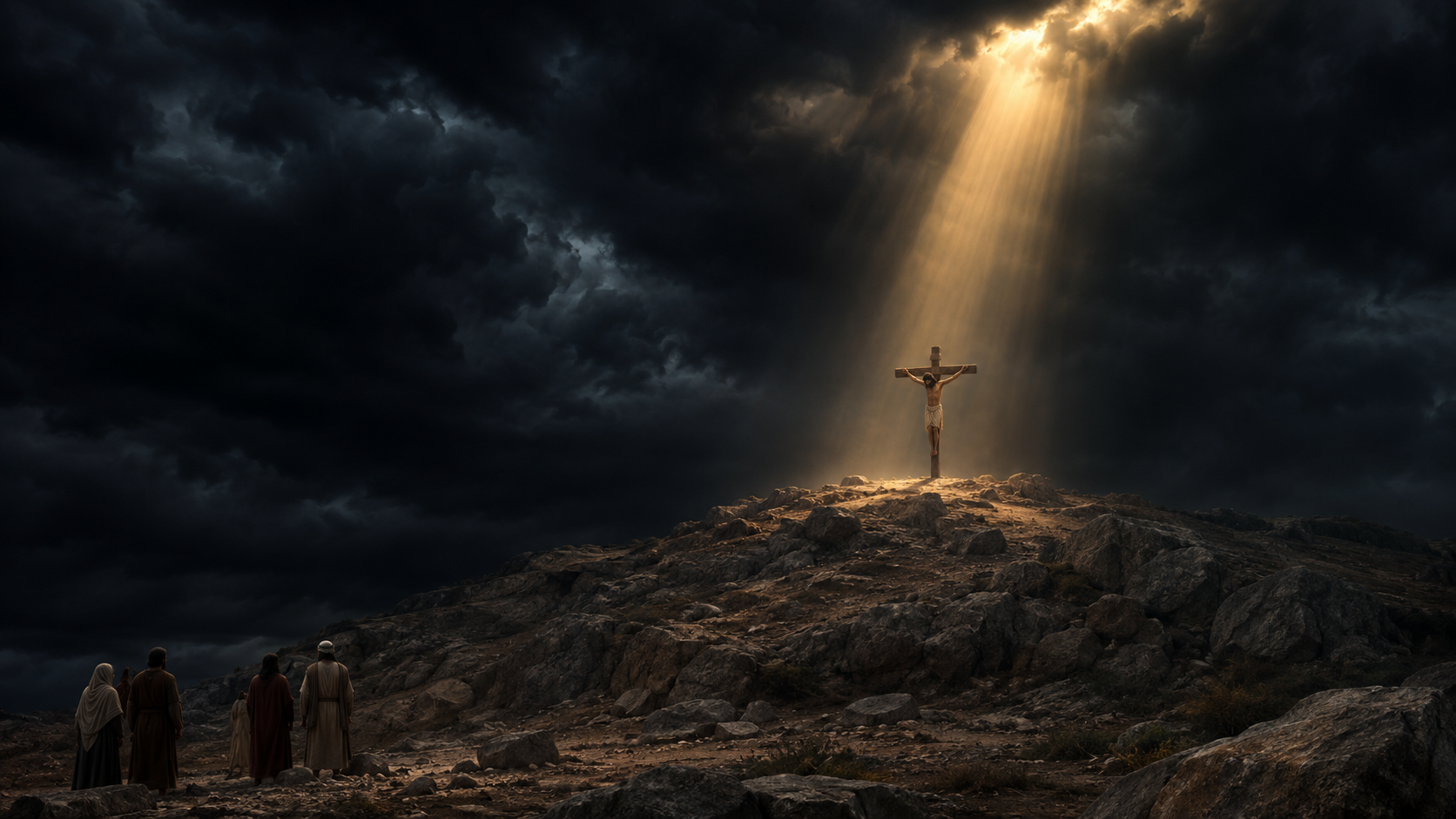
That brings us to where every one of these passages finally has to be read. The accusation was that God is harsh, that He takes and does not give, that He rules by force and cares for Himself. So how did He answer? He sent His Son into the worst of what the charge could describe. And notice how Paul explains the cross. He does not only say it saves sinners. He says it settles a question about God:
Whom God hath set forth to be a propitiation through faith in his blood, to declare his righteousness for the remission of sins that are past, through the forbearance of God; To declare, I say, at this time his righteousness: that he might be just, and the justifier of him which believeth in Jesus.
To declare His righteousness. The cross is God’s own evidence, entered into the record. Jesus said as much in the week He died: “Now is the judgment of this world: now shall the prince of this world be cast out” (John 12:31). The Judge Who sent the Flood is the One Who gave His Son. The God Who ordered the judgment of Canaan let His Son be wounded for our transgressions. Nobody can say that He asks of His creatures a suffering He has not borne in what was dearest to Him.
And the trial has an ending. It will not end by force. It ends with those who have seen the whole record, every hard passage included, singing about it:
Great and marvellous are thy works, Lord God Almighty; just and true are thy ways, thou King of saints.
If you came to this page as a skeptic, we do not ask you to pretend these verses are pleasant. We ask you to keep reading the same book, all the way to the place where the accused took the nails. Then decide whether this is the character Paine and Dawkins described. And if you came as a believer who has been handed these verses and did not know what to say, you do not need to win every argument. You need only tell the truth about what the text says, say “I don’t know” when you don’t, and point to the cross. The One Who wept at a grave and then opened it (John 11:35) can be trusted with what we cannot yet explain.
Further reading
The field guide
The Hard Passages Cheat Sheet
86 objections from the skeptics’ own lists, answered briefly and searchable by verse.
The whole story
The Great Controversy
The war behind all of history, from the rebellion in heaven to the restoration.
The tradition
Hell: What the Bible Really Teaches
Why the God of Scripture does not torment anyone forever.
For the skeptic
A Letter to Our Atheist Friends
The evidence-first companion: the code in the cell, the moral law, the resurrection.