

How to use this sheet
These are the verses skeptics actually publish, gathered from their own lists and answered briefly with the texts to open. For the reasoning behind the answers, read The Hard Passages first. Three things hold throughout. God Himself is the standard, and He has chosen to let His character be examined. Judgment in Scripture comes both by His direct act and by His withdrawing, so we say which the text says. And we do not pretend: where a passage is hard, the answer says so, and where we do not know, we say that too.
Be ready always to give an answer to every man that asketh you a reason of the hope that is in you with meekness and fear.
Find an answer fast
Part I · Judgment & violence
Judgment & violence · Objection 1
“God drowned nearly the whole world, children included. That is genocide.”
God says He did it: “I, even I, do bring a flood of waters upon the earth” (Genesis 6:17). The text gives the reason, “the earth is filled with violence through them” (6:13), and it records long notice, with Noah “a preacher of righteousness” (2 Peter 2:5). The children are the hardest part, and no answer removes the grief. But they are not suffering now. The dead sleep, and “all that are in the graves shall hear his voice” (John 5:28). See the fuller answer.
Refs · Gen 6:3, 5, 13, 17 · 2 Pet 2:5 · 1 Pet 3:20 · John 5:28
Judgment & violence · Objection 2
“God killed every firstborn in Egypt, even a prisoner’s child, to make a point.”
Start where the story starts. An earlier Pharaoh had ordered, “Every son that is born ye shall cast into the river” (Exodus 1:22). God warned the king of Moses’ day before the plagues began: “Let my son go… if thou refuse to let him go, behold, I will slay thy son” (4:23). Nine plagues came first, and the tenth was announced in advance (11:4–6). Anyone could shelter under the blood, and a “mixed multitude” left with Israel (12:38). The text uses both ways of speaking: “the LORD will pass through to smite,” and He “will not suffer the destroyer to come in” (12:23). It is still a terrible night, and Scripture calls it that.
Refs · Exod 1:22; 4:22-23; 11:4-6; 12:13, 23, 38
Judgment & violence · Objection 3
“God ordered the Canaanites wiped out: ‘Thou shalt save alive nothing that breatheth.’”
The command says that, and softening it does not help. But the reason was moral, not ethnic: “for the wickedness of these nations” (Deuteronomy 9:5), including that “even their sons and their daughters they have burnt in the fire” (12:31). God waited about four centuries, because “the iniquity of the Amorites is not yet full” (Genesis 15:16). He warned Israel the land would “spue” them out for the same sins (Leviticus 18:28). And Rahab, who turned to Him, lived (Joshua 6:25). It was one judgment by the Owner of life and gives no one permission today. See the fuller answer.
Refs · Deut 20:16-18; 9:4-5; 12:31 · Gen 15:16 · Lev 18:24-28 · Josh 2:9-11; 6:25
Judgment & violence · Objection 4
“God told Saul to kill Amalek’s infants and sucklings.”
He did, and this is among the hardest lines in the Bible. Amalek had preyed on the “feeble” at the rear of a column of freed slaves (Deuteronomy 25:18), and judgment came about four centuries later. The Kenites living among them were warned to leave first (1 Samuel 15:6). As for the infants, we can say this much: they are not in torment, they sleep, and their case rests with a God Who has “no pleasure in the death of the wicked” (Ezekiel 33:11). Scripture does not tell us their final state, and we will not guess.
Refs · 1 Sam 15:2-3, 6 · Exod 17:8 · Deut 25:17-18 · Ezek 33:11
Judgment & violence · Objection 5
“Two bears mauled forty-two children for teasing a bald man.”
The Hebrew words can cover youths and even grown men, but qatan (“little”) pulls the phrase younger, and the text gives no ages (see the side note). The stronger points are these. Bethel was a center of Jeroboam’s calf worship (1 Kings 12:28–29). The bears tore “forty and two children of them,” so the crowd was larger still. This was a mob from an idolatrous city confronting God’s prophet, not a playground. It is a severe judgment, and the text does not apologize for it. It was never about baldness. See the fuller answer.
Refs · 2 Kgs 2:11, 23-24 · 1 Kgs 12:8, 28-29; 14:21; 20:14-15 · Gen 41:12
Judgment & violence · Objection 6
“God killed Uzzah for steadying the ark, and struck down men just for looking in it.”
The rule was public and specific: “they shall not touch any holy thing, lest they die” (Numbers 4:15), and they were not even to look (4:20). The ark should have been carried by Levites, not hauled on a cart. So these were not accidents of ignorance, even if Uzzah’s motive looks kind. The text calls it his “error” (2 Samuel 6:7). The lesson is that God’s holiness is not safe to handle casually, and the hard edge of that remains. David himself was upset by it (6:8), so you are in good company if you are too.
Refs · 2 Sam 6:6-7 · Num 4:15, 20 · 1 Sam 6:19
Judgment & violence · Objection 7
“A man was killed by a lion just for refusing to hit a prophet.”
The request came “in the word of the LORD” (1 Kings 20:35), and the man was told so. The blow was needed to stage an acted parable against King Ahab (20:37–42). The story turns on obeying a plain word from God, even when it makes no sense to you. That is a real theme of Kings, and the same chapter turns on Ahab refusing to do so. The text gives no further explanation, and we will not invent one.
Refs · 1 Kgs 20:35-36, 42
Judgment & violence · Objection 8
“Achan stole, and his whole family was stoned for it.”
The law was plain that “the children” were not to die for a father’s sin (Deuteronomy 24:16), so readers have long asked whether the family died at all, or were present as witnesses. The text says his sons and daughters were brought to the valley, and that Israel “stoned him with stones, and burned them with fire” (Joshua 7:25). It may mean they were executed, possibly because the plunder hidden under the tent floor could not have been hidden from them. We cannot settle it, and should not claim to.
Refs · Josh 7:15, 24-25 · Deut 24:16
Judgment & violence · Objection 9
“Moses ordered the Levites to slaughter their own brothers over a golden calf.”
Israel had just sworn the covenant and broken it within weeks. Moses first offered a way out: “Who is on the LORD’s side? let him come unto me” (Exodus 32:26). About three thousand fell, out of a nation of hundreds of thousands, so this was not everyone who had been near the calf. It was a judgment on an open revolt that was still going on. It is a command to Israel under direct rule by God, not a pattern for anyone since. See the note on Israel’s law.
Refs · Exod 32:26-29
Judgment & violence · Objection 10
“Elijah butchered the prophets of Baal.”
They were the state-backed clergy of a cult under whose queen the Lord’s prophets were being killed (1 Kings 18:4), and they lost a fair public contest. Israel’s law set death for prophets who led the nation to other gods (Deuteronomy 13:5). When two disciples later wanted to call fire down in Elijah’s manner, Jesus “rebuked them” (Luke 9:55). That is the model for us: no sword for religion, ever.
Refs · 1 Kgs 18:21, 36-40 · Deut 13:1-5 · Luke 9:54-56
Judgment & violence · Objection 11
“David sinned with a census, and God killed 70,000 other people for it.”
The account opens by saying God’s anger “was kindled against Israel” (2 Samuel 24:1), so the people were not bystanders. David makes your objection himself: “as for these sheep, what have they done?” (1 Chronicles 21:17), and he asks that it fall on him. The text also shows God stopping it early: “It is enough, stay now thine hand” (21:15). The Bible does not hide the question. It does not give a full answer to it either.
Refs · 1 Chr 21:1, 13-17 · 2 Sam 24:1
Judgment & violence · Objection 12
“God killed David’s baby and gave his wives to another man to punish David.”
The second part was fulfilled when Absalom, in rebellion, did it publicly (2 Samuel 16:22). God foretold and permitted it, in the language Scripture uses for what He allows, and David’s own sin had opened that door. The child is the harder case: “the child also that is born unto thee shall surely die” (12:14). David’s own response holds the only comfort the text gives: “I shall go to him, but he shall not return to me” (12:23).
Refs · 2 Sam 12:11-14, 23; 16:22
Judgment & violence · Objection 13
“Ananias and Sapphira dropped dead just for keeping back some money.”
Keeping the money was not the issue. Peter says so: “Whiles it remained, was it not thine own?” (Acts 5:4). The sin was the lie: “thou hast not lied unto men, but unto God.” It was a calculated deception, at the very start of the church, and it would have poisoned a community that depended on trust. The text says Ananias fell down; it does not say Peter called for his death.
Refs · Acts 5:3-5, 9
Judgment & violence · Objection 14
“An angel killed 185,000 Assyrians in a night. What kind of God does that?”
An army that had come to destroy Jerusalem, and whose king had openly mocked the living God (2 Kings 19:22). A God Who never stopped an invading army would draw the opposite complaint. Skeptics ask why God does not stop such things. Here He did.
Refs · 2 Kgs 19:20-22, 35
Judgment & violence · Objection 15
“Phinehas speared a couple, and God rewarded him for it.”
This was not a private act of rage over a romance. Israel had been drawn deliberately, by Balaam’s counsel (Numbers 31:16), into the sex rites of Baal-peor, and “bowed down to their gods” (25:2). A plague was already killing thousands, and the couple were flaunting it in sight of the mourners (25:6). As with other commands to Israel, it gives no warrant for violence today.
Refs · Num 25:1-9; 31:16
Part II · Children in judgment
Children in judgment · Objection 1
“The Bible says happy is he who dashes babies against the stones.”
Psalm 137 is a song of exiles who had watched Babylon do these very things to them: “happy shall he be, that rewardeth thee as thou hast served us” (137:8). It is not a command, and God does not say it. It is a raw human cry preserved honestly. The Bible lets its people pray their rage rather than act on it. The instruction for us is elsewhere: “Vengeance is mine; I will repay, saith the Lord” (Romans 12:19).
Refs · Ps 137:1, 8-9 · Rom 12:19
Children in judgment · Objection 2
“Isaiah and Hosea say God’s judgment means infants dashed to pieces and women ripped open.”
These are prophecies of what invading armies would do, and did: “I will stir up the Medes against them” (Isaiah 13:17). God is warning what follows when a nation refuses Him and His protection is lifted. It is not an instruction to anyone to do it, and it is not approval of those who did. Hosea has God say it plainly: “O Israel, thou hast destroyed thyself; but in me is thine help” (13:9). Still, He speaks of it as His judgment, and we should not deny that.
Refs · Isa 13:16-17 · Hos 9:11-16; 13:9, 16
Children in judgment · Objection 3
“In Ezekiel 9 God commands: slay old and young, little children and women.”
It is a vision of Jerusalem’s coming fall, and the words are stark. Notice two things the skeptic’s list leaves out. First, a mark is placed on “the men that sigh and that cry for all the abominations” (9:4), and no one with it may be touched. Second, it starts with the leaders: “begin at my sanctuary” (9:6). The children in it remain the hard part. The same answers apply as in the case of Amalek.
Refs · Ezek 9:4-6
Children in judgment · Objection 4
“The Bible contradicts itself on punishing children for their fathers’ sins.”
Guilt does not transfer: “The son shall not bear the iniquity of the father” (Ezekiel 18:20). Consequences do. Children really do grow up inside what their parents have built, and Exodus says so “of them that hate me” (20:5), who carry on the same path. Note the proportion too: three or four generations on one side, and mercy “unto thousands” on the other (20:6).
Refs · Exod 20:5-6; 34:7 · Ezek 18:20 · Deut 24:16
Part III · Slavery
Slavery · Objection 1
“The Bible lets you buy foreigners as property and leave them to your children.”
It does: “they shall be your bondmen for ever” (Leviticus 25:46). We will not soften it, and this is one of the hardest laws in Moses. But the same law code killed the kidnapper who sold a man (Exodus 21:16) and forbade returning a runaway (Deuteronomy 23:15). Jesus said of another law that Moses allowed it “because of the hardness of your hearts… but from the beginning it was not so” (Matthew 19:8). Applying that here is our inference, but Eden had no slaves. See the fuller answer.
Refs · Lev 25:39-46 · Exod 21:16, 26-27 · Deut 23:15-16 · Matt 19:8
Slavery · Objection 2
“You can beat your slave, and it’s fine if he survives a day or two: ‘he is his money.’”
Read both verses. If the slave dies, “he shall be surely punished” (Exodus 21:20), and the Hebrew, as the KJV margin notes, is avenged. That was unusual: the Code of Hammurabi lists no such penalty for killing your own slave. If the slave lingers, the law treats it as a loss to the master and not a killing. Those words are hard, and we do not defend them as an ideal. The very next lines free a slave who loses so much as a tooth (21:27). This law restrained masters in a brutal world. It did not bless what they did.
Refs · Exod 21:20-21, 26-27
Slavery · Objection 3
“A slave’s wife and kids stay with the master, so he must become a slave for life to keep them.”
That is what the law says in the case of a wife given to him during his service (Exodus 21:4). If he came in already married, “his wife shall go out with him” (21:3). This is a debt-service arrangement, limited to six years, and it is still hard to read. The likely logic is that the woman had her own unfinished term of service. The text does not state that, so we hold it loosely. It is a good case of a law that regulates a broken situation rather than showing God’s ideal.
Refs · Exod 21:2-6
Slavery · Objection 4
“Exodus lets a father sell his daughter as a sex slave.”
The law covers a daughter given in a marriage-like arrangement, usually out of poverty, and every clause protects her. She may not be sold “unto a strange nation” (21:8). If he gives her to his son she is treated as a daughter (21:9). If he takes another wife, her “food, her raiment, and her duty of marriage” cannot be reduced (21:10), and if they are, she shall “go out free without money” (21:11). A father selling a daughter at all is grim, and the Bible does not present it as good. But the law is limiting the man, not licensing him.
Refs · Exod 21:7-11
Slavery · Objection 5
“The New Testament tells slaves to obey their masters. Paul never condemned slavery.”
It does tell them to obey, because Christians then had no power to end Roman slavery, and a slave revolt would have meant crucifixions. But look at what Paul says next, to masters: “do the same things unto them, forbearing threatening… neither is there respect of persons with him” (Ephesians 6:9). He lists “menstealers” among the lawless (1 Timothy 1:10) and asks that Onesimus be received “not now as a servant, but above a servant, a brother beloved” (Philemon 1:16). That is teaching that eats away at slavery from within, though we admit it is not a direct ban.
Refs · Eph 6:5, 9 · Col 4:1 · 1 Tim 1:10; 6:1-2 · Gal 3:28 · Phlm 1:16
Slavery · Objection 6
“Jesus approved of beating slaves, even ones who didn’t know any better.”
It is a parable about accountability, not a rule for households. Its point is the last line: “unto whomsoever much is given, of him shall be much required” (12:48). Jesus uses a familiar picture from His hearers’ world, as He uses a dishonest steward and an unjust judge, without approving of either. And what it teaches is that God judges according to what people actually knew, which is the opposite of cruelty.
Refs · Luke 12:47-48
Part IV · Women & captives
Women & captives · Objection 1
“Moses told the soldiers to kill the boys and keep the virgins for themselves.”
The command is in the text, and it is hard: “keep alive for yourselves” (Numbers 31:18). The reason given is that these women had drawn Israel into the rites of Peor on Balaam’s counsel (31:16). The line appears to fall at those old enough to have taken part. The text does not mention sexual use. What Israel’s law did allow a soldier was marriage on strict terms (see the next entry). The killing of the boys has no easy explanation, and we offer none.
Refs · Num 25:1-3; 31:16-18 · Deut 21:10-14
Women & captives · Objection 2
“God approves of taking women as spoils of war, and of rape.”
The law on captive women is Deuteronomy 21. She is not to be touched for a full month while she may “bewail her father and her mother” (21:13). Then she becomes a wife, not a slave. If he tires of her, “thou shalt not sell her at all for money” (21:14). In the ancient world this was a sharp restriction on what soldiers did. It is still a hard law, since she had no say, and the text itself admits he “humbled her.” And distant cities were first offered peace (20:10). Judges 5:30 is the mother of an enemy general speaking, not God.
Refs · Deut 20:10-14; 21:10-14 · Judg 5:30
Women & captives · Objection 3
“Deuteronomy 22 forces a rape victim to marry her rapist.”
Compare the laws. Where a man “force” a betrothed woman, he dies (22:25). Verse 28 uses a different verb, “lay hold on,” and adds “they be found,” which some take as a seduction case like Exodus 22:16. That difference is real but not decisive, because the verb often means “seize,” and verse 29 says he “humbled her.” What protects her either way: Exodus has her father able to “utterly refuse” (22:17), and the man can never divorce her, in a world where an unmarried, non-virgin woman had almost no future. Do not claim this law is comfortable. Do not claim the Hebrew settles it.
Refs · Deut 22:25-29 · Exod 22:16-17
Women & captives · Objection 4
“A woman raped in a city gets stoned because she didn’t scream loud enough.”
The law is about telling apart adultery from assault, with no modern forensics. In the city, with neighbors in earshot, the text treats the lack of any cry as evidence of consent (22:24). In the field it gives her the full benefit of the doubt: she “cried, and there was none to save her” (22:27), even though no one heard. It says of her, “there is in the damsel no sin worthy of death”, and likens the man to a murderer (22:26). The law’s starting point is that a forced woman is innocent.
Refs · Deut 22:23-27
Women & captives · Objection 5
“A bride who wasn’t a virgin gets stoned, but nothing happens to the man.”
The penalty is severe, and it belongs to Israel’s covenant law (see the note). The same passage also protects her from slander: a husband who falsely accuses her is punished, fined a hundred shekels, and can never divorce her (22:18–19). And men were not exempt from the sexual laws. In adultery, “they shall both of them die” (22:22). When Jesus met such a case, He protected the woman (John 8:7).
Refs · Deut 22:13-22 · Lev 20:10 · John 8:7
Women & captives · Objection 6
“The Israelites massacred a town and kidnapped girls at a festival to get wives.”
This is the clearest case of record versus approval. God does not command it. The book closes on it with its own verdict: “every man did that which was right in his own eyes” (Judges 21:25). The end of Judges shows how far a people fall without God. It is not an example, and the Bible never says it is.
Refs · Judg 21:11-12, 25
Women & captives · Objection 7
“Genesis curses women with pain in childbirth and puts them under men.”
Genesis 3 describes the world after the fall, not God’s design. The design comes first: “male and female created he them,” both in His image (1:27). “He shall rule over thee” (3:16) is a sentence on what sin did to the marriage, and every age of history has shown it to be true. The gospel moves back toward the start: “there is neither male nor female: for ye are all one in Christ Jesus” (Galatians 3:28).
Refs · Gen 1:27; 3:16 · Gal 3:28
Women & captives · Objection 8
“Cut off a woman’s hand for grabbing a man’s genitals in a fight?”
Yes, that is the law, and it is a strange one. It appears to be the only mutilation Moses sets as a penalty, beyond the principle of eye for eye. Some think the concern was his ability to father children, since the law just before it (25:5–10) is about keeping a family line alive, but the text does not explain it. We can say that this was a law for ancient Israel. We cannot tell you exactly why it says what it says.
Refs · Deut 25:11-12
Women & captives · Objection 9
“Paul says women must keep silent and can’t teach.”
“Let the woman learn” (1 Timothy 2:11) was itself a step up in Paul’s day. Whatever verse 12 means in church life, and believers read it differently, it cannot mean God does not speak through women. Deborah “judged Israel” (Judges 4:4), Philip’s daughters “did prophesy” (Acts 21:9), and Priscilla, named first, helped teach Apollos (18:26). Women funded and followed Jesus (Luke 8:3), and women were the first witnesses of His resurrection.
Refs · 1 Tim 2:11-12 · Judg 4:4 · Acts 18:26; 21:9 · Luke 8:1-3
Women & captives · Objection 10
“‘Wives, submit’ makes women second-class.”
Read to the end of the sentence that matters: “Husbands, love your wives, even as Christ also loved the church, and gave himself for it” (Ephesians 5:25). The standard for the husband is a man who dies for her. Any man who uses verse 22 as a weapon has skipped verse 25, and God sees it: “the LORD hath been witness between thee and the wife of thy youth” (Malachi 2:14).
Refs · Eph 5:22-25 · Mal 2:14
Part V · Sacrifice & hard commands
Sacrifice & hard commands · Objection 1
“God told Abraham to kill his son. That’s evil, even if He stopped it.”
God stopped it, and that is the point: “Lay not thine hand upon the lad” (Genesis 22:12). Of child sacrifice He later says, “which I commanded them not, neither came it into my heart” (Jeremiah 7:31). Abraham expected to return with Isaac (22:5), “accounting that God was able to raise him up” (Hebrews 11:19). And the Father then did what He spared Abraham: He “spared not his own Son” (Romans 8:32). See the fuller answer.
Refs · Gen 22:1-2, 5, 12 · Heb 11:19 · Jer 7:31 · John 3:16 · Rom 8:32
Sacrifice & hard commands · Objection 2
“Jephthah burned his daughter, and God let him.”
God never asked for this vow, and His law forbids what it may have led to (Leviticus 18:21). Scholars disagree about what happened. Some, noting the KJV margin’s or at 11:31 and the words “she knew no man” (11:39), hold that she was dedicated to lifelong service. Others say the Hebrew means what it first appears to mean, that she died. Do not claim the Hebrew plainly settles it. Either way, the Bible records a rash vow in a dark period and never praises it. Hebrews honors Jephthah’s faith in battle (11:32), not this.
Refs · Judg 11:29-31, 39-40 · Lev 18:21 · Heb 11:32
Sacrifice & hard commands · Objection 3
“Leviticus 27 says people devoted to God must be put to death: human sacrifice.”
The word here means “devoted to destruction,” the same word used of judged enemies. It is about people already under a sentence, such as Canaanite cities or idolaters, who could not be bought out of it. The Bible does not present them as offerings, and it condemns human sacrifice repeatedly (Deuteronomy 12:31). This is a law about no ransom from a judgment, not a rite.
Refs · Lev 27:28-29
Sacrifice & hard commands · Objection 4
“God hardened Pharaoh’s heart and then punished him for it. That’s rigged.”
Both are in the text, and we should not flatten it. God foretells it at Exodus 4:21. Then Pharaoh acts: “he hardened his heart” (8:15, 32). Not until 9:12 does the narrative say “the LORD hardened the heart of Pharaoh” as something that has happened. Here was a king who ruled a nation that had drowned Hebrew children, and who refused repeated warnings. The same sun melts wax and hardens clay: more evidence pushes a refusing man further in his refusal. God gave him over to what he had chosen, and used it so “that my name may be declared throughout all the earth” (9:16).
Refs · Exod 3:19; 4:21; 8:15, 32; 9:12, 16 · Rom 9:17-18
Sacrifice & hard commands · Objection 5
“Josiah slaughtered priests and burned bones on altars, and the Bible praises him.”
The bones were burned to defile the altars of the rival cult, so they could never be used again. That was foretold three centuries earlier (1 Kings 13:2). The word “offer” there is grim irony: this was an execution and a defilement, not a rite to God. The priests served the high places where Israel had been led into idolatry, under a law that made that a capital crime (Deuteronomy 13). It belongs to Israel’s covenant law, and the church has been given no such sword (John 18:36).
Refs · 2 Kgs 23:16, 20 · 1 Kgs 13:1-2
Part VI · Eden, evil & God’s character
Eden, evil & God’s character · Objection 1
“God withheld knowledge and set up a forbidden tree. He wanted them to fail.”
They could freely eat of “every tree of the garden” but one, and they were told the cost beforehand (Genesis 2:16–17). A being who cannot say no cannot truly say yes, and that one tree was the smallest possible test of love. Saying God was withholding something good is exactly the serpent’s argument (3:5). The objection repeats the accusation. It does not discover anything new. See the fuller answer.
Refs · Gen 2:16-17; 3:5
Eden, evil & God’s character · Objection 2
“God put the serpent in the garden to tempt them.”
The text never says that, and James rules it out: “neither tempteth he any man” (James 1:13). The voice was “that old serpent, called the Devil, and Satan” (Revelation 12:9), who was “perfect” until iniquity was found in him (Ezekiel 28:15). God did not keep the question away from them. He warned them and let them choose. If He had kept them sealed off from any challenge, they could never have been free.
Refs · James 1:13 · Rev 12:9 · Gen 3:1 · Ezek 28:15
Eden, evil & God’s character · Objection 3
“Why should all of us suffer because Adam ate a piece of fruit?”
We do not inherit Adam’s guilt: “The son shall not bear the iniquity of the father” (Ezekiel 18:20). We inherit his world, as children inherit a house their father lost. Death passed to all “for that all have sinned” (Romans 5:12). And the math runs both ways: “by the righteousness of one the free gift came upon all men” (5:18). If one man can ruin the race, one Man can rescue it.
Refs · Rom 5:12, 18 · Ezek 18:20
Eden, evil & God’s character · Objection 4
“God made humans, then got angry that they were wicked. That’s His own fault.”
He made them “very good” (Genesis 1:31). “God hath made man upright; but they have sought out many inventions” (Ecclesiastes 7:29). To make a person who could love was to make a person who could refuse. A parent who has a child is not the author of that child’s crimes, and God warned us far better than any parent can.
Refs · Gen 1:31; 6:5 · Eccl 7:29
Eden, evil & God’s character · Objection 5
“Thorns, sweat, cursed ground: why punish the entire planet?”
“Cursed is the ground for thy sake” (Genesis 3:17): the text frames even this as serving humans, perhaps because an unbroken, idle life in a fallen race would be worse. It is also temporary. Creation was subjected “in hope” and “shall be delivered” (Romans 8:20–21). See After Eden for how the natural world came to be as it is.
Refs · Gen 3:17-19 · Rom 8:20-21
Eden, evil & God’s character · Objection 6
“God let Satan destroy Job’s life and kill his children, over a bet.”
It was not a game. It was a test of a real charge: “Doth Job fear God for nought?” (Job 1:9). Satan did the harm, within limits God set (1:12; 2:6). Yet the book does not let God off the hook by hiding behind him: “thou movedst me against him” (2:3), and “all the evil that the LORD had brought upon him” (42:11). God then commends Job’s anguished honesty over his friends’ tidy answers (42:7). See the fuller answer.
Refs · Job 1:9-12, 21; 2:3-6; 42:7, 11
Eden, evil & God’s character · Objection 7
“God says He creates evil.”
Look at the pairing: “I make peace, and create evil” (Isaiah 45:7). The opposite of peace is calamity, and the Hebrew ra’ covers calamity as well as moral evil. God brings judgment and disaster, and He says so. He is not the author of sin: “a God of truth and without iniquity” (Deuteronomy 32:4).
Refs · Isa 45:7 · James 1:13 · Deut 32:4
Eden, evil & God’s character · Objection 8
“‘A jealous God’ is an insecure, petty God.”
Think of a husband. One who feels nothing when his wife leaves for another man is not secure. He does not love her. Paul uses the very picture: “I am jealous over you with godly jealousy: for I have espoused you to one husband” (2 Corinthians 11:2). God’s jealousy is the jealousy of a covenant love, not envy of anything we have.
Refs · Exod 20:5 · 2 Cor 11:2 · Hos 2:19-20
Eden, evil & God’s character · Objection 9
“God ‘repented,’ so He made a mistake. So much for all-knowing.”
The Hebrew word nacham includes being sorry and grieved, and Genesis says as much: “it grieved him at his heart” (6:6). This is grief at what people did, not an admission of error. The same chapter in Samuel that says He repented also says He “will not lie nor repent: for he is not a man” (1 Samuel 15:29). So He changes His response when people change, while His character does not.
Refs · Gen 6:6 · Num 23:19 · 1 Sam 15:11, 29
Eden, evil & God’s character · Objection 10
“God sends lying spirits and strong delusions. So He lies.”
Read 1 Kings 22 closely. God’s own prophet tells King Ahab the whole plan to his face: “the LORD hath put a lying spirit in the mouth of all these thy prophets” (22:23). Ahab was told the truth and chose the lie anyway. Paul describes the same pattern: delusion comes to those who “received not the love of the truth” (2 Thessalonians 2:10). It is a judgment of letting go, on people who had already refused the truth.
Refs · 1 Kgs 22:19-23 · 2 Thess 2:10-11 · Titus 1:2
Part VII · Death-penalty laws
Death-penalty laws · Objection 1
“The Bible says to stone rebellious children.”
Not children. The charge is “he is a glutton, and a drunkard,” so this is a grown or nearly grown son. It requires both parents to agree and to bring the case to public elders (21:19), which took the power of life and death out of a father’s private hands. Scripture records no case of it being carried out. It belongs to Israel’s covenant law (see the note).
Refs · Deut 21:18-21
Death-penalty laws · Objection 2
“Death for cursing your parents? Really?”
“He that smiteth his father, or his mother, shall be surely put to death” (Exodus 21:15). This was covenant law in a society where parents were the whole of old-age care, and where honoring them is in the Ten Commandments. It is severe, and it applied to Israel as a nation under God’s direct rule. The principle stands today. The penalty is not ours to carry out.
Refs · Exod 21:15 · Lev 20:9
Death-penalty laws · Objection 3
“A man was stoned just for picking up sticks on Saturday.”
It comes right after a passage on sinning “presumptuously” (Numbers 15:30), with the KJV margin reading “with an high hand.” It is placed as an example of open defiance, not an honest slip, under a covenant the nation had just sworn. The penalty ended with Israel’s national government. The Sabbath stands as a gift, not as something any state should enforce. See the Sabbath Cheat Sheet.
Refs · Num 15:30, 32-36 · Exod 31:14-15 · Luke 9:55-56
Death-penalty laws · Objection 4
“‘Thou shalt not suffer a witch to live’ caused the witch trials.”
The law addressed Israel’s nation, not Christians in Salem or Europe. People who burned witches took a law given to one covenant nation and took up a sword Jesus never gave His church: “My kingdom is not of this world” (John 18:36). Those trials are a stain on the people who ran them. The warning against spiritism still stands, because contact with spirits is not harmless. The penalty does not.
Refs · Exod 22:18 · Lev 20:27 · John 18:36
Death-penalty laws · Objection 5
“The Bible says to kill gay people. That’s hate.”
Leviticus 20:13 is in the Bible, within Israel’s national law, alongside the same penalty for adultery (20:10). No Christian has any warrant to harm anyone, and anyone who uses these verses for contempt or violence is sinning against God. Scripture does teach that God’s design for marriage is a man and a woman (Matthew 19:4–5) and that homosexual acts fall short of it (Romans 1:26–27). It sets them in a list with theft, greed and drunkenness, and adds: “such were some of you: but ye are washed” (1 Corinthians 6:11). Those who struggle here stand on the same ground as the rest of us, and they are as welcome. Jesus’ way is in one sentence: “Neither do I condemn thee: go, and sin no more” (John 8:11).
Refs · Lev 20:10, 13 · Rom 1:26-27 · 1 Cor 6:9-11 · Matt 19:4-5 · John 8:7, 11
Death-penalty laws · Objection 6
“The Bible says to kill anyone who follows another religion, even whole towns.”
These were laws for Israel, whose God was also its King, so idolatry there was treason. The law required careful inquiry first: “enquire, and make search, and ask diligently” (Deuteronomy 13:14). It never applied to other nations, and it does not apply to anyone today. Jesus refused to call fire down on a town that rejected Him (Luke 9:54–56). Forcing faith is what the persecuting powers of prophecy do, not what Christ does.
Refs · Deut 13:1-5, 12-15 · John 18:36 · Luke 9:54-56
Death-penalty laws · Objection 7
“A priest’s daughter who sins gets burned alive.”
The law held the priestly family to a higher standard: “she profaneth her father” (Leviticus 21:9). Elsewhere burning follows execution (Joshua 7:25), and many read this one the same way, though the verse does not state it. It is a hard law for a covenant nation, and it was never given to the church. Jesus shows us how He treats such a woman (John 8:11).
Refs · Lev 21:9 · Josh 7:25
Part VIII · Strange laws & science
Strange laws & science · Objection 1
“Shellfish, mixed fabrics, trimmed beards, a kid in its mother’s milk. Who could take this seriously?”
These are not all the same kind of law. The clean-and-unclean distinction is older than Moses (Genesis 7:2), and we still treat it as sound health guidance (see The Health Message). The beard rule sits right beside a ban on cuttings “for the dead” (Leviticus 19:28), so it seems aimed at pagan mourning rites. Mixed fabrics and mixed seed appear to have taught Israel to be set apart, and their purpose has passed. The Exodus rule on milk gives no reason, and any reason we offer is a guess.
Refs · Lev 11:9-12; 19:19, 27-28 · Gen 7:2 · Exod 23:19 · Heb 10:1
Strange laws & science · Objection 2
“God bans the blind, the lame and the castrated. That’s bigotry.”
Leviticus 21 limits one job, offering at the altar, and the same man “shall eat the bread of his God, both of the most holy, and of the holy” (21:22). The sanctuary was a picture of perfection to come, not a ranking of human worth. Deuteronomy 23:1 is harder, yet Isaiah answers it: to eunuchs God promises “a place and a name better than of sons and of daughters” (56:5). Then the first African convert we meet in Acts is a eunuch, baptized on the road (Acts 8:38). And Jesus spent His days touching the very people this objection names.
Refs · Lev 21:17-22 · Deut 23:1 · Isa 56:3-5 · Acts 8:27, 38
Strange laws & science · Objection 3
“Insects don’t have four legs, and mustard isn’t the smallest seed.”
“Goeth upon all four” is an everyday description of walking on the ground, like saying an animal is “on all fours,” and the text itself goes on to add the jumping legs (Leviticus 11:21). So it was never counting legs. In Matthew, Jesus is speaking of seed a man “sowed in his field” (13:31), using a common picture for a tiny beginning. Teachers speak the language of their hearers, and no one takes it as a botany claim.
Refs · Lev 11:21-23 · Matt 13:31-32
Strange laws & science · Objection 4
“Women are ‘unclean’ for having periods. How degrading.”
The same chapter makes men unclean for a discharge too (Leviticus 15:16). Unclean here is a ritual category for handling bodily fluids near the sanctuary, not a moral judgment, and it is not a sin. When a woman with a long-running issue of blood touched Jesus, He did not recoil. He called her “Daughter” (Mark 5:34).
Refs · Lev 15:16-20 · Mark 5:34
Part IX · Jesus & the New Testament
Jesus & the New Testament · Objection 1
“Jesus says you must hate your family.”
Matthew reports the same teaching in plain words: “He that loveth father or mother more than me is not worthy of me” (10:37). Hate here is a Semitic way of saying “love less.” You can see it in Genesis, where Jacob “loved also Rachel more than Leah” and the next verse says “Leah was hated” (29:30–31). Jesus also commanded people to honor their parents (Matthew 15:4).
Refs · Luke 14:26 · Matt 10:37 · Gen 29:30-31
Jesus & the New Testament · Objection 2
“Jesus said He came to bring division, not peace.”
He is describing what would happen, not what He wants. A man who follows Him will find some of his household against him, and many Christians have found exactly that. The same Jesus said, “Blessed are the peacemakers” (Matthew 5:9). The sword here is the cost of following Him, one that falls on His followers. He never told them to pick one up (26:52).
Refs · Luke 12:49-53 · Matt 5:9; 10:34
Jesus & the New Testament · Objection 3
“Jesus killed a fig tree for not having figs out of season. Tantrum.”
It was an acted parable. A tree in full leaf advertises fruit it does not have, and it happened right around the cleansing of the temple. Jesus had already told a parable about a barren fig tree given extra time (Luke 13:6–9). Nearly all His miracles heal. Here He cursed a tree rather than a person, to warn a nation before its fall.
Refs · Matt 21:18-22 · Mark 11:13 · Luke 13:6-9
Jesus & the New Testament · Objection 4
“Jesus used parables to keep people from being forgiven.”
He is quoting Isaiah, and Matthew gives the rest: “their eyes they have closed” (13:15). The closing came from them first. Those who asked Him what the parables meant were told (Mark 4:10–11). Parables give truth to those who want it and do not force it on those who have already refused. Anyone could step closer and ask.
Refs · Mark 4:10-12 · Matt 13:13-15 · Isa 6:9-10
Jesus & the New Testament · Objection 5
“Believe or be damned. That’s a threat, not love.”
John states the reason: “God sent not his Son into the world to condemn the world” (3:17). Condemnation is what happens when light comes and “men loved darkness rather than light” (3:19). It is a warning about refusing the only source of life, not a threat of torture. And those who never heard are not judged for what they never heard (Romans 2:14–16). God “winked at” times of ignorance (Acts 17:30).
Refs · Mark 16:16 · John 3:17-19, 36 · Rom 2:14-16 · Acts 17:30
Jesus & the New Testament · Objection 6
“Jesus told people to castrate themselves.”
He said no such thing. In answer to a question on marriage, He says some people give up marriage “for the kingdom of heaven’s sake,” and adds that this is only for “he that is able to receive it” (Matthew 19:12). It is a figure of speech for a life of celibacy, and it is voluntary. If anything, it is a word of honor for those who were excluded.
Refs · Matt 19:12 · Isa 56:3-5
Jesus & the New Testament · Objection 7
“Jesus said not one tittle of the law will fail. So why don’t you stone people?”
Fair question. The moral law stands: not one tittle of it fails. The sacrificial system was “a shadow of good things to come” (Hebrews 10:1) and has met its substance. The penalties belonged to Israel as a nation under God’s rule, and Hebrews speaks of them in the past tense (10:28). Jesus said His kingdom is “not of this world” (John 18:36), so it has no courts or executioners. See the note on Israel’s law.
Refs · Luke 16:17 · Heb 10:1, 28 · John 18:36
Part X · Alleged contradictions
Alleged contradictions · Objection 1
“Who moved David to take the census: God or Satan?”
Both verses are about one event, seen from two sides. Satan did it, and God permitted it in judgment, and Scripture will describe what God allows as His own act. Job shows the same pattern: Satan strikes, and God says, “thou movedst me against him” (Job 2:3). This is exactly how a world under a controversy would be described.
Refs · 2 Sam 24:1 · 1 Chr 21:1 · Job 2:3
Alleged contradictions · Objection 2
“Did Judas hang himself, or fall and burst open?”
Both can be true, since a hanged body can later fall, especially one left unattended during Passover and a Sabbath. The text does not say so, so this is a reasonable harmony and not a claim of the text. Acts, written by a careful historian, also says the field was bought with his money, as Matthew explains: the priests did it on his behalf (27:7).
Refs · Matt 27:5 · Acts 1:18
Alleged contradictions · Objection 3
“Who killed Goliath: David or Elhanan?”
Chronicles gives the plain statement: “Elhanan the son of Jair slew Lahmi the brother of Goliath” (1 Chronicles 20:5). In 2 Samuel 21:19 the words “the brother of” are in italics in the KJV, because the Hebrew there lacks them, and most scholars see a copying error in that verse. Admit it openly. It is a small scribal slip in one copy, and the parallel account lets us correct it.
Refs · 1 Sam 17 · 2 Sam 21:19 · 1 Chr 20:5
Alleged contradictions · Objection 4
“Matthew and Luke give different family trees for Jesus.”
They do. Matthew gives Joseph’s line, and Luke says Jesus was “as was supposed” the son of Joseph (3:23). A common explanation is that Luke follows Mary’s family, while another is that one tree is legal and the other natural. We cannot prove either. What we can say is that both writers knew Jewish records, their readers could check them, and no one in antiquity who had those records appears to have treated it as fatal.
Refs · Matt 1:16 · Luke 3:23
Alleged contradictions · Objection 5
“The resurrection accounts contradict each other.”
The differences are real, and they are what you would expect of independent witnesses. Mark says of the women as they fled, “neither said they any thing to any man” (16:8), while Luke reports they later told the eleven (24:9). Matthew mentions the angel who spoke, and Luke mentions two who stood by. A story made up in collusion would match better. On the central fact there is no disagreement, and Paul appeals to “above five hundred brethren at once” (1 Corinthians 15:6), most still alive to ask.
Refs · Mark 16:8 · Luke 24:4, 9 · Matt 28:2, 8 · 1 Cor 15:6
Alleged contradictions · Objection 6
“Genesis 1 and 2 give different creation orders.”
Genesis 1 is the sequence of the six days. Genesis 2 zooms in on one garden and one couple, and arranges its detail around them. Verse 19 in the KJV reads as if the animals came after Adam, while many read it as “had formed,” since the Hebrew allows that. A writer putting these side by side knew what he had just written, and he did not think he had contradicted himself.
Refs · Gen 1 · Gen 2:5, 19
Alleged contradictions · Objection 7
“Did Saul kill himself, or did an Amalekite kill him?”
1 Samuel gives the narrator’s account: “Saul took a sword, and fell upon it” (31:4). 2 Samuel 1 records a young man’s story, told to David, with Saul’s crown in hand for a reward. David later says that he had thought he was bringing good news (2 Samuel 4:10). Scripture accurately reports what someone said, including when he is lying.
Refs · 1 Sam 31:4 · 2 Sam 1:10; 4:10
Alleged contradictions · Objection 8
“Who spoke from the bush: God or an angel?”
Both, and it is not a slip. The “angel of the LORD” (Exodus 3:2) is the One Who says, “I am the God of thy father” (3:6). “Angel” means messenger, and this Messenger speaks as God because He is the Father’s own Son. Jesus later takes up the same claim: “Before Abraham was, I am” (John 8:58).
Refs · Exod 3:2, 4, 6 · Acts 7:35 · John 8:58
Alleged contradictions · Objection 9
“Two of every animal, or seven? Genesis can’t decide.”
Genesis 6:19 gives the general instruction: two of every sort, male and female. Genesis 7:2, given as the time drew near, adds the detail: clean animals “by sevens,” which would be needed for sacrifice afterward. Instructions getting more specific is not a contradiction.
Refs · Gen 6:19; 7:2
Alleged contradictions · Objection 10
“Luke’s census under Quirinius doesn’t fit the date of Jesus’s birth.”
This is a real historical puzzle. The known census under Quirinius came around AD 6, about a decade after Herod’s death, and Luke knows about that one too (Acts 5:37). Luke says this taxing was “first made” (2:2), which may mean an earlier registration, and some read the Greek as “before.” We do not have a settled answer. Our knowledge of the period has gaps, and Luke has proven reliable on many other details, so we hold the question open.
Refs · Luke 2:2 · Acts 5:37
Part XI · Tradition, not Scripture
Some of the strongest attacks hit things the Bible never taught. On these we agree with the skeptic about the problem, and show that it comes from tradition.
Tradition, not Scripture · Objection 1
“A God Who tortures people forever is a monster.”
We agree: that would be monstrous, and the Bible does not teach it. The wicked are destroyed: “it shall leave them neither root nor branch” (Malachi 4:1). See Hell: What the Bible Really Teaches.
Refs · Mal 4:1 · Rev 20:9 · Rom 6:23
Tradition, not Scripture · Objection 2
“Three gods who are one god? That’s irrational.”
Scripture does not ask you to believe that. “To us there is but one God, the Father… and one Lord Jesus Christ” (1 Corinthians 8:6). The trinity came from later creeds. See The Godhead and How the Trinity Crept Into Christianity.
Refs · 1 Cor 8:6 · John 17:3
Tradition, not Scripture · Objection 3
“Science shows there’s no immortal soul.”
So does the Bible. “The dead know not any thing” (Ecclesiastes 9:5), and God “only hath immortality” (1 Timothy 6:16). Our hope is the resurrection, not a soul that cannot die. See the State of the Dead & Hell Cheat Sheet.
Refs · Eccl 9:5 · 1 Tim 6:16 · Gen 2:7
Tradition, not Scripture · Objection 4
“Christianity gave us the Crusades and the Inquisition.”
They happened, and they are a disgrace. Jesus had said, “all they that take the sword shall perish with the sword” (Matthew 26:52). The Bible does not defend those who did it. It predicted them: a power that would “wear out the saints” (Daniel 7:25), and a woman “drunken with the blood of the saints” (Revelation 17:6). See the Daniel 7 study.
Refs · Matt 26:52 · John 18:36 · Dan 7:25 · Rev 17:6
Tradition, not Scripture · Objection 5
“Evolution and an old earth disproved Genesis.”
We take Genesis as written: six days, about six thousand years ago, with death entering after sin (Romans 5:12). The evidence is more contested than the textbooks suggest. See Genesis vs Deep Time.
Refs · Gen 1:31 · Exod 20:11 · Rom 5:12
Tradition, not Scripture · Objection 6
“The Bible has a firmament and a flat earth, so it’s scientifically absurd.”
We do not run from this. We take the Bible’s description of the earth and the firmament as true, and we question the modern model rather than the text. See The Shape of the Earth.
Refs · Gen 1:6-8
Tradition, not Scripture · Objection 7
“Prayer doesn’t work. Millions of unanswered prayers prove it.”
Prayer is not a vending machine, and the Bible never says it is. Jesus Himself prayed “let this cup pass from me: nevertheless not as I will” (Matthew 26:39), and the answer was no. Paul asked three times and was told, “My grace is sufficient for thee” (2 Corinthians 12:9). Daniel shows us a side we cannot see: his prayer was heard the first day, and the answer was opposed for “one and twenty days” (Daniel 10:13). A war is on. We do not know why every prayer goes as it does, and we keep praying.
Refs · Matt 26:39 · 2 Cor 12:8-9 · James 4:3 · Dan 10:12-13
Tradition, not Scripture · Objection 8
“The virgin birth and resurrection were borrowed from pagan myths.”
Ask for the primary source of any parallel. Many popular claims fall apart once you check them, while Isaiah wrote centuries before Christ (7:14). Luke says he worked from eyewitnesses (1:2), Paul names living witnesses (1 Corinthians 15:6), and he stakes everything on it: “if Christ be not risen, then is our preaching vain” (15:14). See A Letter to Our Atheist Friends.
Refs · Isa 7:14 · Luke 1:1-4 · 1 Cor 15:6, 14
Part XII · Side notes
Side note · 1
Five questions to ask of any hard passage
Does the Bible command this, or only record it? What reason does the text itself give? How long did God wait, and who was warned? Whose hand is at work, God’s or the destroyer’s? What does the cross say about this God? The anchor study explains each one.
Refs · Judg 21:25 · Deut 29:29
Side note · 2
The bears: what the Hebrew does and doesn’t say
Verse 23 has ne’arim qetannim, and verse 24 has yeladim. Na’ar describes Joseph at seventeen (Genesis 37:2) and looking back to his prison years, when he was close to thirty (41:12), and soldiers in battle (1 Kings 20:14–15). Yeled describes Rehoboam’s companions (1 Kings 12:8) when he was forty-one (14:21). But qatan means small or young, and the pairing usually means someone truly young, as with Hadad (11:17) and Naaman’s restored skin (2 Kings 5:14). Solomon uses it of himself as king, in humility (1 Kings 3:7).
So say this: the words do not require small children, they allow youths or young men, and they do not give an age. Commentators range from small boys to about twenty. Do not give a specific age. No source supports one.
Refs · 2 Kgs 2:23-24 · Gen 37:2; 41:12 · 1 Kgs 3:7; 11:17; 12:8; 14:21; 20:14-15 · 2 Kgs 5:14 · 2 Chr 13:7
Side note · 3
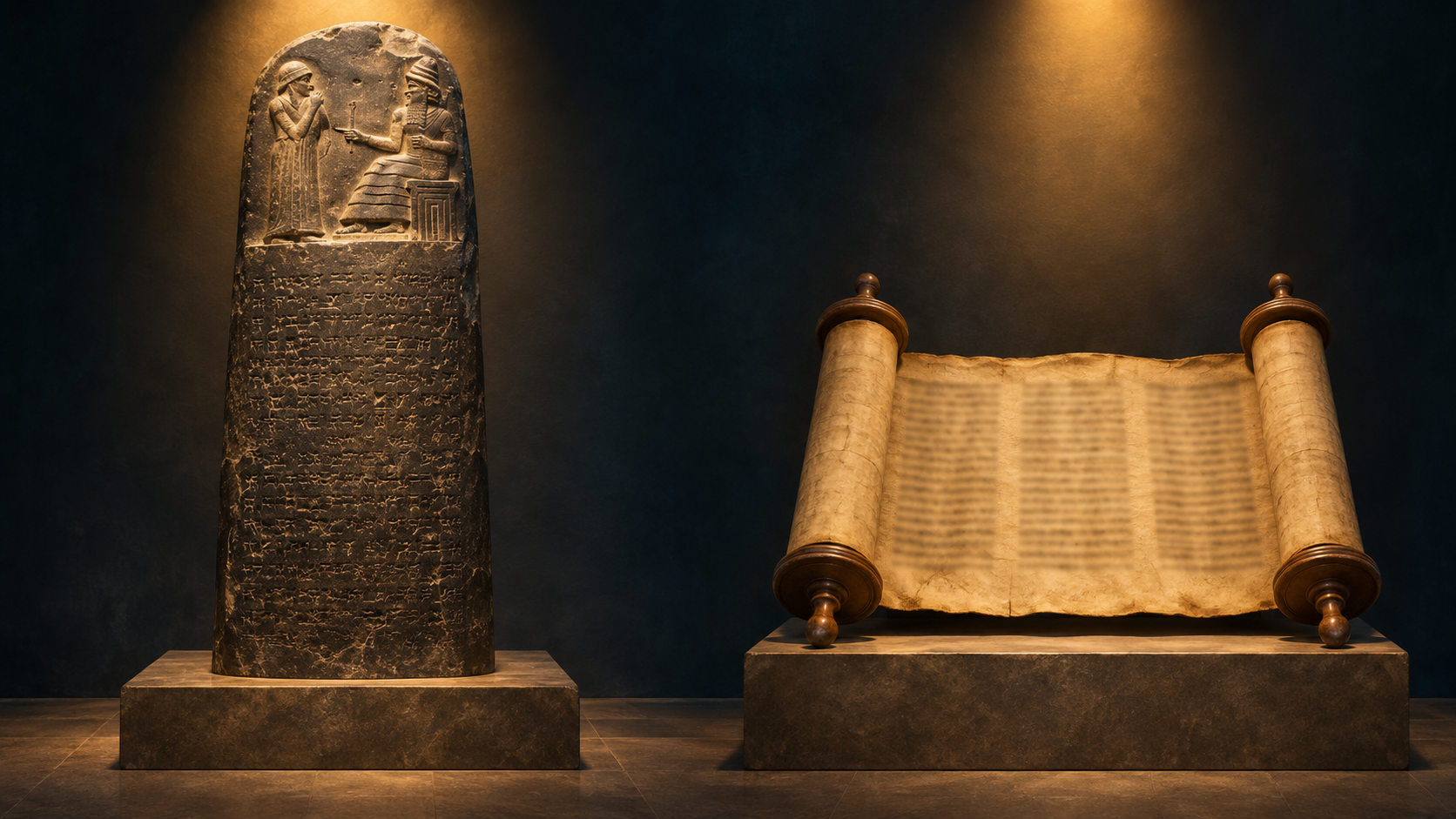
Moses beside Hammurabi on slaves
Under the Code of Hammurabi (L. W. King translation), harboring a runaway slave meant death (§16), and returning one earned two shekels (§17). Putting out the eye of another man’s slave cost one-half of its value, paid to the owner (§199). The surviving text lists no penalty for a master killing his own slave. Moses forbids returning a runaway (Deuteronomy 23:15), frees a slave for an eye or tooth (Exodus 21:26–27), and says a slave killed by a master shall be avenged (21:20). The scope of Deuteronomy 23 is debated, so do not overstate it. Moses is not abolition, but the difference is real.
Refs · Exod 21:16, 20, 26-27 · Deut 23:15-16
Side note · 4
Why do the prophets use such shocking language?
Ezekiel 23:20 is a verse skeptics love to read aloud, and it is crude on purpose. The chapter is an extended picture of Samaria and Jerusalem as unfaithful wives (23:4), written to shock people who had grown numb to their own idolatry. God’s prophets did not use nice words for what the nation was doing. A polite version would not have been honest.
Refs · Ezek 23:2-4, 20
Side note · 5
Does God act, or only withdraw? Both
Some Adventists argue that God never judges directly. Scripture will not let us go that far (Genesis 6:17), and Ellen White does not either:
To our merciful God the act of punishment is a strange act. … While He does not delight in vengeance, He will execute judgment upon the transgressors of His law. He is forced to do this, to preserve the inhabitants of the earth from utter depravity and ruin. In order to save some He must cut off those who have become hardened in sin.
On that same page she writes of Amalek that this was neither a war of gain nor a judgment without mercy:
But while inflicting judgment, God remembered mercy. The Amalekites were to be destroyed, but the Kenites, who dwelt among them, were spared. … The expedition was not to be entered upon for the purpose of self-aggrandizement; the Israelites were not to receive either the honor of the conquest or the spoils of their enemies. They were to engage in the war solely as an act of obedience to God, for the purpose of executing His judgment upon the Amalekites.
Refs · Gen 6:17 · Isa 28:21 · Job 1:10 · Rom 1:24 · Ezek 33:11
Side note · 6
What Ellen White says about the bears
She reads the mob as youths mocking Elijah’s ascension, and gives a reason for the severity:
The awful judgment that followed was of God. … Had Elisha allowed the mockery to pass unnoticed, he would have continued to be ridiculed and reviled by the rabble, and his mission to instruct and save in a time of grave national peril might have been defeated. This one instance of terrible severity was sufficient to command respect throughout his life.
Other commentators put the force of the taunt on “bald head.” Don’t present the ascension reading as what the text states.
Refs · 2 Kgs 2:23-24
Side note · 7
Why didn’t God just destroy Satan at the start?
Because force could not answer the charge. Scripture shows God allowing it to be examined (Romans 3:4). Ellen White puts it this way:
Had he been immediately blotted from existence, they would have served God from fear, rather than from love. … Evil must be permitted to come to maturity.
God could have destroyed Satan and his sympathizers as easily as one can cast a pebble to the earth; but He did not do this. Rebellion was not to be overcome by force. … His authority rests upon goodness, mercy, and love.
Refs · Rom 3:4 · Nah 1:9 · Rev 15:3
Side note · 8
Arguments to avoid
These are common and they backfire. Do not say the bear victims were in their twenties, or that “little children” is a mistranslation. Do not say the Hebrew of Judges 11:31 clearly means “or.” Do not use the verb in Deuteronomy 22:28 as proof that the act was consensual. Do not say simply that Pharaoh hardened his own heart first, since God foretold it. Do not say God never destroys anyone. A skeptic with a concordance will catch each of these, and you will lose the conversation.
Refs · 2 Kgs 2:23 · Judg 11:31 · Deut 22:28 · Exod 4:21; 8:15
Side note · 9
Israel’s law is not a pattern for modern states
Many hard laws were given to one nation in a covenant with God as its direct King, in which He spoke and judged in ways He does not now. Israel’s civil penalties ended with that government. The moral law behind them still tells us what is right, but no church has been given the sword: “My kingdom is not of this world” (John 18:36). When any group uses these laws to justify force against unbelievers, it is not following Christ. It is doing what prophecy warned about.
Refs · Heb 10:28 · John 18:36 · Luke 9:54-56 · Matt 26:52
Side note · 10
It’s fine to say “I don’t know”
“The secret things belong unto the LORD our God” (Deuteronomy 29:29). You do not need an answer to every verse, and Job’s friends had one for everything, and were rebuked (Job 42:7). A straight “I don’t fully understand that one, and here is why I still trust Him” will do more good than a clever answer that does not hold up.
Refs · Deut 29:29 · Job 42:7 · Isa 55:8-9
A pastoral note
Many people who bring these verses have been hurt, by a church, by a parent, or by a sorrow nobody could explain. Some are testing whether you will be honest. Listen first. You are not there to win. Answer what they actually asked, admit what is hard, and be slow to give an answer to grief. Then point them to the place where God’s character is shown most clearly: the Father Who gave His only begotten Son, and the Son Who went to the cross for the people who were accusing Him.
Great and marvellous are thy works, Lord God Almighty; just and true are thy ways, thou King of saints.