The Bible makes a claim no other religious book in the world dares to make. In Isaiah 46:9–10 the LORD says: “I am God, and there is none else; I am God, and there is none like me, declaring the end from the beginning, and from ancient times the things that are not yet done.” Two cities in the historical record stand as concrete tests of that claim. Tyre, the Phoenician trading capital, was the subject of an extraordinarily specific prophecy in Ezekiel 26 — a prophecy whose details took 250 years and two separate world conquerors to fulfil. Petra, the rock-hewn capital of Edom and the Nabataeans, was the subject of the prophecy in Obadiah and Jeremiah 49. Both prophecies have been fulfilled in detail, and both sites can be visited today as physical evidence of the fulfilment.
The argument from fulfilled prophecy is one of the oldest and most direct arguments for the divine origin of Scripture. The Bible records specific predictions about specific cities, made in specific centuries, naming specific outcomes. Where the prophecies have been subsequently fulfilled in the historical record — and where the fulfilments are verifiable in ground-observable form — the conclusion is simple: either the predictions were inspired by a Being Who knew the future, or they were extraordinarily lucky guesses. The cases of Tyre and Petra make the “lucky guess” reading impossible.
This article walks both cases in detail. Parts II through IV treat Tyre: the prophecy of Ezekiel 26, its historical fulfilment in two stages by Nebuchadnezzar and Alexander the Great, and the state of the site today. Parts V through VII treat Petra: the prophecy of Obadiah and Jeremiah, the city itself, and the long historical process of its abandonment. Part VIII addresses the spiritual context — the worship practised in these cities that explains why the prophecies were given. Part IX draws out the pattern. Part X states the implication for the prophecies that remain yet to be fulfilled.
Part I — The Bible’s prophetic challenge
A claim no other religious book makes
Set the world’s major religious texts side by side and one feature distinguishes the Hebrew and Christian Scriptures from the others as decisively as any feature could. The Hebrew prophets and the apostolic writers repeatedly stake their authority on the explicit claim that the God Who inspires them knows and declares the future, in advance and in detail, and that the subsequent historical fulfilment will demonstrate that they spoke for Him.
Remember the former things of old: for I am God, and there is none else; I am God, and there is none like me, Declaring the end from the beginning, and from ancient times the things that are not yet done, saying, My counsel shall stand, and I will do all my pleasure.
Behold, the former things are come to pass, and new things do I declare: before they spring forth I tell you of them.
The challenge is explicit. The LORD invites the reader to test His authority by the test of fulfilled prediction. The former things have come to pass — that is the retrospective half of the test. The new things are declared in advance — that is the prospective half. The Bible is unique among the religious literature of the world in offering this kind of test. The Q’uran does not offer it. The Vedas do not. The Buddhist canon does not. The Hindu scriptures do not. Only the Hebrew and Christian Scriptures stake their credibility on the falsifiable claim that the God Who speaks in them tells the future.
Why specific cities are the strongest test
Many of the most important prophecies of Scripture are general in scope — the coming of the Messiah, the gathering of the gospel to all nations, the close of the age, the new earth. These are decisive when fulfilled, but the criteria for their fulfilment are often debated. The strongest tests of the prophetic claim are those in which the prediction names a specific city, gives specific details about what will happen to it, and can be checked against the subsequent archaeological and historical record by anyone willing to read the accounts and visit the sites.
Three such cases are particularly well attested: Tyre, treated in this article; Petra, treated in this article; and Babylon, treated in the companion article Babylon and the Prophecy. The three cases together constitute, on any honest reading, an extraordinarily strong evidential argument for the Bible’s claim to inspired authorship.
Part II — Tyre: the prophecy
Background: who Tyre was
Tyre was, for some five centuries before the Babylonian conquest, the wealthiest and most important maritime power of the eastern Mediterranean. The city was built on the mainland coast of what is today Lebanon, opposite a small rocky island about half a mile offshore. The Phoenician inhabitants were the great merchant seafarers of the ancient world. Their ships traded across the Mediterranean basin from Carthage in North Africa (itself a Phoenician colony) to Spain, the Greek islands, and even, by ancient report, to Cornwall in Britain for tin. Tyrian purple dye, extracted from murex sea snails on a scale only this city could mount, was so expensive it was reserved for the robes of kings and emperors. The wealth of Tyre, in its heyday, was without peer.
Tyre’s relationship with Israel had been longstanding and complex. King Hiram of Tyre had supplied cedar and craftsmen for David’s palace and Solomon’s temple (2 Sam 5:11; 1 Kings 5). Centuries later, when Babylon under Nebuchadnezzar laid siege to Jerusalem, Tyre celebrated — expecting the fall of Jerusalem to redirect trade through her own markets. It was this celebration over the destruction of God’s city that drew the prophetic word against her.
The prophecy: Ezekiel 26
The prophecy was delivered through Ezekiel in approximately 586 BC — the year Jerusalem fell to Nebuchadnezzar. It runs the entire length of chapter 26, but the core predictions are concentrated in the first fourteen verses. The relevant text, in the KJV:
Therefore thus saith the Lord GOD; Behold, I am against thee, O Tyrus, and will cause many nations to come up against thee, as the sea causeth his waves to come up. And they shall destroy the walls of Tyrus, and break down her towers: I will also scrape her dust from her, and make her like the top of a rock. It shall be a place for the spreading of nets in the midst of the sea: for I have spoken it, saith the Lord GOD.
And they shall make a spoil of thy riches, and make a prey of thy merchandise: and they shall break down thy walls, and destroy thy pleasant houses: and they shall lay thy stones and thy timber and thy dust in the midst of the water.
And I will make thee like the top of a rock: thou shalt be a place to spread nets upon; thou shalt be built no more: for I the LORD have spoken it, saith the Lord GOD.
Six specific predictions are made. Each, on a straightforward reading of the text, is concrete enough to be falsifiable. The full set:
| Prediction | Detail and historical fulfilment |
|---|---|
| 1. Many nations against her | "Behold, I am against thee, O Tyrus, and will cause many nations to come up against thee, as the sea causeth his waves to come up." (Ezek 26:3) — Successive imperial waves: the Babylonians under Nebuchadnezzar (586–573 BC), the Persians under Cyrus and Cambyses (539 BC onward), the Macedonians under Alexander the Great (332 BC), the Seleucids, the Ptolemies, the Romans, the Arab conquest (635 AD), the Crusaders, the Mamluks, and finally the Ottomans. Many nations indeed. |
| 2. Walls and towers destroyed | "And they shall destroy the walls of Tyrus, and break down her towers." (Ezek 26:4) — Fulfilled by Nebuchadnezzar in the 586–573 BC siege. The mainland city was levelled. |
| 3. Scraped of dust; made like the top of a rock | "I will also scrape her dust from her, and make her like the top of a rock." (Ezek 26:4) — Fulfilled by Alexander the Great in 332 BC, when his army literally scraped the rubble of the mainland ruins clean to build the causeway out to the island fortress. The mainland site has been bare rock ever since. |
| 4. Stones, timber, and dust cast into the midst of the sea | "And they shall lay thy stones and thy timber and thy dust in the midst of the water." (Ezek 26:12) — Verbatim description of what Alexander's soldiers did in building the causeway. The stones of mainland Tyre form the foundation of the modern peninsula that now joins the island to the shore. |
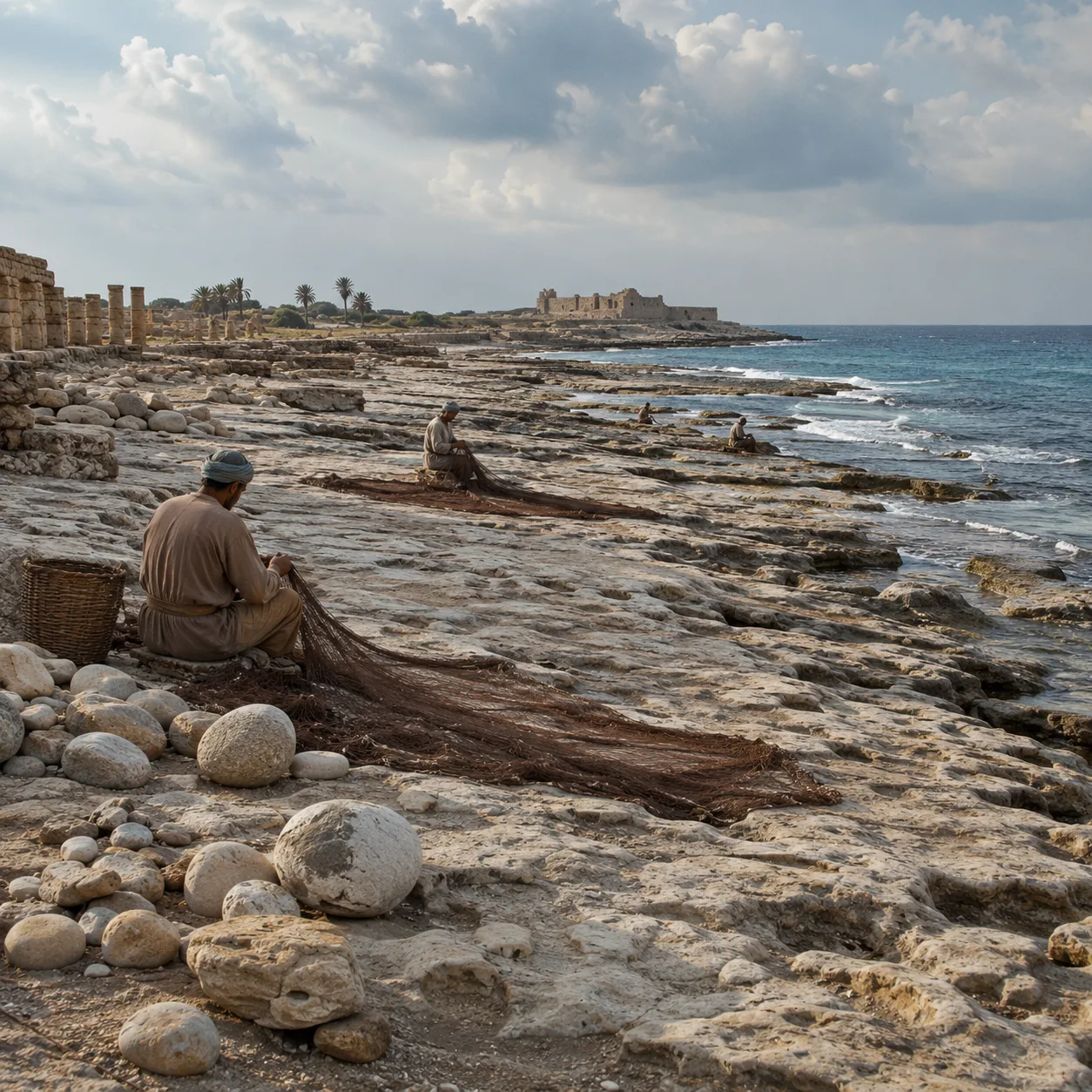
| 5. A place for the spreading of nets | "It shall be a place for the spreading of nets in the midst of the sea." (Ezek 26:5) — Modern fishermen working the waters off the ancient mainland site still spread their drying-nets across the bare rock the prophecy named. The fulfilment is visible on the ground today. |
| 6. Never to be rebuilt | "And I will make thee like the top of a rock: thou shalt be a place to spread nets upon; thou shalt be built no more." (Ezek 26:14) — Modern Tyre exists, but on the silted-in remains of Alexander's causeway and the former island, not on the original mainland site. The original site has been bare for 2,300 years and remains bare. The prophecy of "built no more" applies to a specific location, and the specific location has been left alone. |
Part III — Tyre: the historical fulfilment
Stage one: Nebuchadnezzar (586–573 BC)
The prophecy was uttered, on the dating embedded in the chapter, in 586 BC, almost simultaneously with the fall of Jerusalem. Within months, Nebuchadnezzar of Babylon turned the same army he had used against Jerusalem northward against Tyre. The siege lasted thirteen years — the longest siege recorded in ancient history.
Nebuchadnezzar levelled the mainland city. Its walls and towers were broken down. Its houses were destroyed. Its inhabitants who had not been killed in the siege were transported. The first two of Ezekiel’s predictions — many nations against her, walls and towers destroyed — were fulfilled in this single thirteen-year campaign.
A note worth pausing on: the Babylonians did not take the island. The Tyrians who escaped the mainland during the siege relocated their wealth, their leadership, and their maritime infrastructure to the rocky offshore island half a mile from shore. There they rebuilt as “island Tyre” and continued their Mediterranean trade for the next two and a half centuries. The prophecy specified that the city would eventually be scraped clean and the very stones cast into the sea. The first invader had levelled the mainland but the rubble still sat there. The prophecy waited.
The 254-year interval
From the close of Nebuchadnezzar’s siege in 573 BC to the arrival of the next conqueror, 254 years passed. Throughout this period the ruins of mainland Tyre lay beside the prospering island city. A traveller in 400 BC, standing on the mainland shore and looking out at the wealthy island metropolis half a mile away, might reasonably have concluded that Ezekiel’s further predictions — the scraping clean, the casting of stones into the sea, the never-rebuilt status — would never be fulfilled. The mainland ruins were there. The island was prosperous. No one was about to build a causeway out of one to capture the other. Two and a half centuries on, the predictions still waited.
Stage two: Alexander the Great (332 BC)
In 332 BC Alexander the Great, sweeping eastward from his victory at Issus, arrived at the coast opposite Tyre. He demanded the island city’s surrender. The Tyrians refused, confident that their island fortress was impregnable; no army could cross half a mile of deep water in the face of the Tyrian fleet to attack the walls.
Alexander could not afford to leave a hostile naval power behind him as he advanced into Egypt and Persia. He determined that the island would fall. Without the naval superiority required for a sea assault, he gave the order that would, unwittingly, fulfil the next two predictions of Ezekiel 26. He commanded his army to build a causeway across the half-mile of water from the mainland to the island.
The construction material was the rubble of mainland Tyre. Alexander’s soldiers literally scraped the mainland site clean — stones, fallen timber, the accumulated dust and earth of the two-and-a-half centuries of weathering since Nebuchadnezzar’s siege — and carried it all out into the sea to extend the causeway. The historians Diodorus Siculus, Quintus Curtius Rufus, and Arrian all describe the operation independently. The mainland site, by the time the causeway was complete, had been scraped down to bedrock. Ezekiel’s prediction that the city would be “like the top of a rock” — and that her “stones and timber and dust” would be cast “in the midst of the water” — was fulfilled with the precision of a written construction specification.
Alexander’s causeway took seven months to build. When it was complete, his soldiers crossed it and stormed the island. The city was taken. Six thousand of the defenders were killed; two thousand were crucified on the shore as a warning to other Mediterranean cities considering resistance. Thirty thousand were sold into slavery.
The site after Alexander
After Alexander’s departure, the rebuilt island city — now connected to the mainland by the causeway — would change hands many times over the following two millennia: Ptolemies, Seleucids, Romans, Arabs, Crusaders, Mamluks, Ottomans. But the mainland site itself, scraped clean by Alexander’s soldiers and deprived of its building stone, was never rebuilt. Modern Tyre is a small town on what is now a peninsula — the silted-in remains of Alexander’s causeway, having accumulated sediment for 2,300 years until it now forms continuous land. But the original mainland city site remains bare.
Part IV — Tyre today: the prophecy observable on the ground
The fishermen at the rock
A traveller who stands on the rocky outcrop where ancient mainland Tyre stood, today, will see one thing the prophet Ezekiel named twice in his short prophecy: fishermen. The site is bare rock at the water’s edge. The fishing-craft of the modern Lebanese coast still work these waters. The drying-racks where the men spread their nets between catches occupy the exact bare rock the prophecy specified.
It shall be a place for the spreading of nets in the midst of the sea: for I have spoken it, saith the Lord GOD.
This is not metaphor. It is description. A photograph of a Lebanese fisherman in 2024 spreading his net across the bare ancient stones of mainland Tyre is a photograph of Ezekiel 26:5 being honoured by the same routine of daily life that has worked these waters for centuries. The prediction was made twenty-six hundred years ago. The fulfilment is observable today.
The stones in the water
The other observable feature is what is in the water. Along the seabed off the modern Tyre peninsula, divers and snorkellers regularly photograph the cut stone blocks of ancient mainland Tyre — some of them recognisable as column drums and dressed masonry — which were cast into the sea during Alexander’s causeway construction. These stones lie in clear water a short distance from the modern shoreline, exactly where Ezekiel 26:12 said they would be: “in the midst of the water.” The Lebanese tourism authority has, in recent decades, run organised snorkelling tours of the submerged ruins. The prophecy is verifiable by anyone with a snorkel.
The site that was never rebuilt
The remaining detail is what the original mainland site has done in the 2,300 years since Alexander. It has done nothing. No city has been rebuilt on the rock-stripped mainland location. Modern Tyre occupies what was, in Alexander’s day, the island and (silted in) the causeway. The original mainland site has been left alone. Ezekiel’s prediction that the city would be “built no more” is fulfilled in a precise location-specific sense. The modern town exists; the original location remains bare.
Part V — Petra: the prophecy of Obadiah and Jeremiah
Background: who Edom was
Edom was the nation descended from Esau, Jacob’s elder brother (Gen 25:30; 36:1). The animosity between Esau and Jacob, beginning with the sale of the birthright and the deception over the blessing, ran through their descendants for the next fifteen hundred years. The Edomites occupied the rugged territory south of the Dead Sea between the Arabah valley and the Arabian desert — modern southern Jordan — and controlled the strategic north-south trade route known as the King’s Highway. They refused Israel passage during the Exodus journey (Num 20:14–21), fought Israel intermittently under the judges and monarchy, and in their most reprehensible action joined the Babylonians in plundering Jerusalem in 586 BC and cutting down the Jewish refugees as they fled.
The cliff-cities of Edom — the principal of which was Sela (later called Petra by the Greeks, from the same Greek word meaning “rock”) — were carved into the red sandstone cliffs of southern Jordan. Their natural defensive position made them, by ancient standards, virtually impregnable. The narrow defile of the Siq, through which the only approach ran, was a half-mile cleft in the rock so narrow that a handful of defenders could hold off an army.
The prophecy: Obadiah
The book of Obadiah, the shortest book of the Old Testament, is a single chapter of twenty-one verses dedicated almost entirely to a prophecy against Edom. The dating is uncertain but most evangelical scholars place it shortly after 586 BC, in response to Edom’s participation in the destruction of Jerusalem. The opening verses lay out the prediction:
Behold, I have made thee small among the heathen: thou art greatly despised. The pride of thine heart hath deceived thee, thou that dwellest in the clefts of the rock, whose habitation is high; that saith in his heart, Who shall bring me down to the ground? Though thou exalt thyself as the eagle, and though thou set thy nest among the stars, thence will I bring thee down, saith the LORD.
Jeremiah, writing in the same general period, gives a parallel prophecy in chapter 49 of his book:
Thy terribleness hath deceived thee, and the pride of thine heart, O thou that dwellest in the clefts of the rock, that holdest the height of the hill: though thou shouldest make thy nest as high as the eagle, I will bring thee down from thence, saith the LORD. Also Edom shall be a desolation: every one that goeth by it shall be astonished, and shall hiss at all the plagues thereof. As in the overthrow of Sodom and Gomorrah and the neighbour cities thereof, saith the LORD, no man shall abide there, neither shall a son of man dwell in it.
The predictions, set out together, are extraordinarily specific for a city whose location was supposed to make it permanent:
| Prediction | Detail and historical fulfilment |
|---|---|
| 1. Made small among the nations | "Behold, I have made thee small among the heathen: thou art greatly despised." (Obad 1:2) — Edom, once a substantial regional power controlling the king's highway from Egypt to Damascus, was reduced over centuries to insignificance and finally to non-existence as a distinct people. |
| 2. The pride of the high cliffs deceived | "The pride of thine heart hath deceived thee, thou that dwellest in the clefts of the rock, whose habitation is high; that saith in his heart, Who shall bring me down to the ground?" (Obad 1:3) — A direct description of Petra: a city built into the clefts of the rock-faces of southern Jordan, whose Nabataean inhabitants believed themselves impregnable behind the narrow defile of the Siq. |
| 3. Brought down from the eagle's height | "Though thou exalt thyself as the eagle, and though thou set thy nest among the stars, thence will I bring thee down, saith the LORD." (Obad 1:4) — Petra was captured by the Roman general Cornelius Palma in AD 106, ending Nabataean independence. The city was progressively abandoned over the following centuries. |
| 4. Edom to be forgotten as a people | "And the wise men shall perish out of Edom, and understanding out of the mount of Esau." (Obad 1:8) — The Edomites as a distinct ethnic group disappear entirely from history during the Roman period. By the third century AD, no one is called "Edomite" any longer; the people are absorbed and forgotten. |
| 5. A desolation, an astonishment, a perpetual waste | "Bozrah shall become a desolation, a reproach, a waste, and a curse; and all the cities thereof shall be perpetual wastes." (Jer 49:13) — The cities of Edom, Petra included, were progressively abandoned. By the early 19th century the site of Petra was so thoroughly lost to Western knowledge that its rediscovery in 1812 was an event of major archaeological significance. |
| 6. None shall dwell there | "No man shall abide there, neither shall a son of man dwell in it." (Jer 49:18) — Petra has been uninhabited as a city for over a thousand years. Bedouin shelter occasionally in the surrounding caves; no settled human community inhabits the city itself. The prophecy is observable in the photographs of every tourist who visits the site. |
Part VI — Petra: the city itself
What Petra looks like
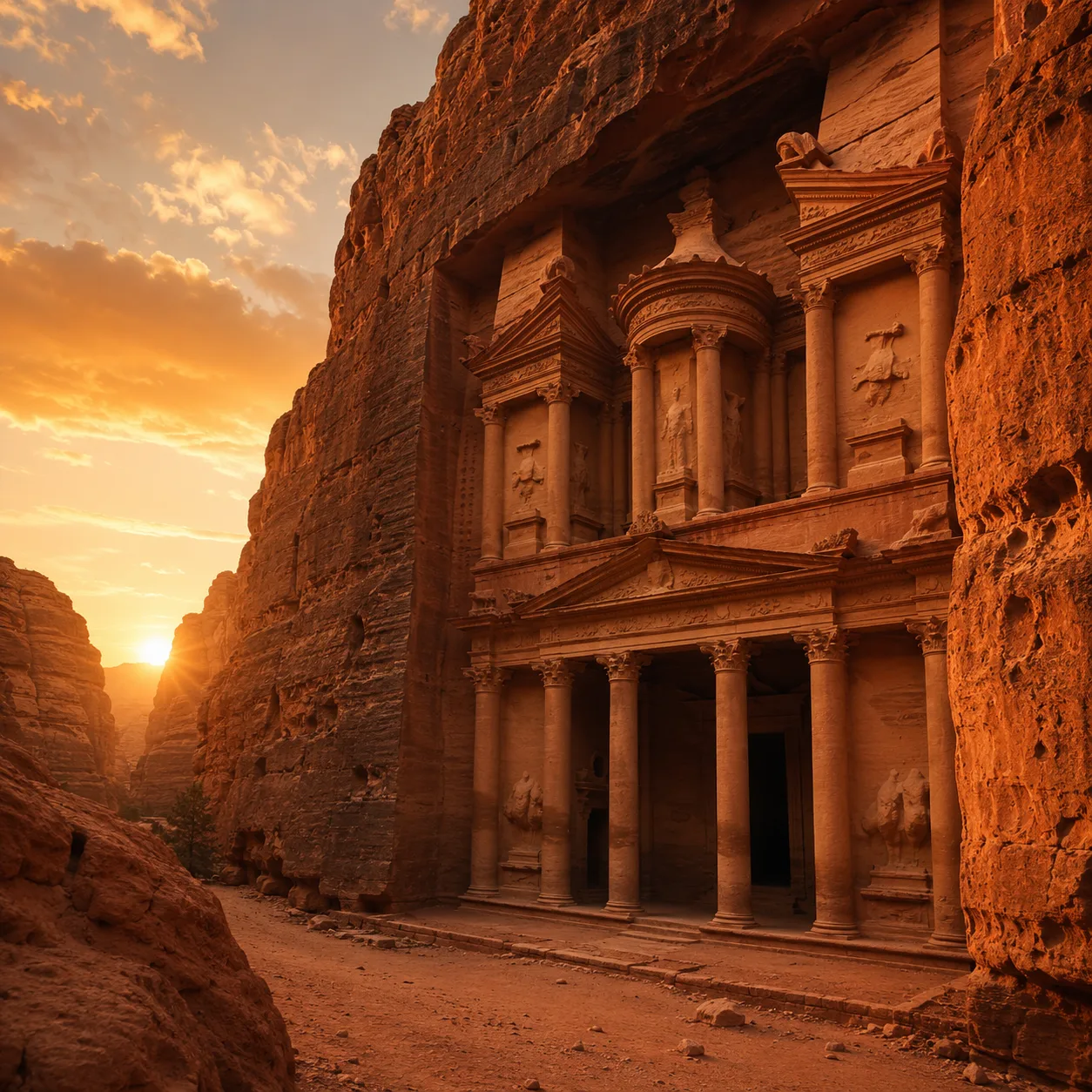
Petra is one of the most extraordinary archaeological sites on earth. The city occupies a natural amphitheatre of cliffs in southern Jordan, accessible from the outside only through the Siq — a narrow serpentine cleft in the rock approximately a mile long and in places only fifteen feet wide. The Siq winds between sandstone walls towering hundreds of feet overhead, opens at last into a sudden vista, and the first sight that greets the visitor is the famous rock-cut facade of El-Khazneh — the Treasury — carved directly into the cliff face opposite the Siq exit.
The rest of the city extends into a series of canyons and open spaces behind the Treasury. The principal buildings — the Monastery (Ad-Deir), the Royal Tombs, the Roman amphitheatre, hundreds of lesser tombs and dwellings — are not built up from quarried stone but carved directly into the rock-faces of the surrounding cliffs. Petra is, in the strict sense, a city of which the buildings are negatives: they exist as space subtracted from rock, rather than as stone added to ground.
The defensive position
The natural advantages of the site explain the Nabataean (and earlier Edomite) confidence the prophecy attacks. The Siq is a single-file approach: a small guard at the entrance could hold off any conventional army indefinitely. The cliffs surrounding the city are unscalable without modern equipment. Water, the critical scarce resource in the desert region, was supplied to the city through a sophisticated system of carved channels and cisterns that captured runoff and stored it for the dry season. Petra at its height was a major trading hub for the spice routes from southern Arabia to Damascus and Gaza, and the wealth of that trade is visible in every carved facade.
The biblical word the prophet uses — “thou that dwellest in the clefts of the rock, whose habitation is high” (Obad 1:3) — is not a generalisation. It is the precise architectural description of Petra. A visitor to the site today, seeing for himself the city carved into the high cliff-faces, can read the prophet’s words against the rock and confirm that the prediction was about this place.
Part VII — Petra: the long fulfilment
The historical sequence
The fulfilment of the prophecy against Petra was not a single decisive event like Alexander’s causeway. It was a multi-century process of decline, conquest, and abandonment. The relevant historical sequence:
~6th century BC — The Edomite kingdom, weakened by the Babylonian invasions of the Levant, begins to collapse. The Nabataean Arabs from the desert progressively occupy the territory, taking over Petra and the trade routes the Edomites had controlled.
~3rd century BC — The Edomites as a distinct ethnic group have largely disappeared from history. Some of the remnant, displaced westward into southern Judaea, become the Idumaeans of the New Testament period — the family from which Herod the Great later emerged, though by then the original Edomite identity was no more than a remembered ancestry.
AD 106 — The Roman general Cornelius Palma, under the emperor Trajan, annexes the Nabataean kingdom and ends Petra’s political independence. The city is reorganised as part of the Roman province of Arabia Petraea.
AD 363 — A major earthquake devastates substantial portions of the city. Many of the carved facades survive; the built structures do not. Recovery is partial.
~7th century AD — The Arab conquest sweeps through the region. The Islamic empire’s economic centre of gravity shifts the trade routes that had sustained Petra. The city, no longer commercially essential, is progressively abandoned.
By ~1100 AD — Petra is largely empty. The Crusaders briefly use parts of the site as a fortress (Al-Wu’ayrah and Al-Habis) but do not inhabit the city proper. After the Crusader period, Petra disappears almost entirely from Western consciousness.
1812 — The Swiss orientalist Johann Ludwig Burckhardt, travelling in disguise as a Bedouin scholar, hears rumours of a great rock-hewn city in the cliffs beyond Wadi Musa. Persuading his local guides to take him there under pretext of sacrificing a goat at the tomb of Aaron (traditionally located on Jebel Harun above the site), he becomes the first Westerner to see Petra in approximately seven hundred years. His account, published in 1822, brings the site back into European knowledge.
Today — Petra is a UNESCO World Heritage Site and a major Jordanian tourist destination. Bedouin guides operate from the surrounding settlements but no one inhabits the city itself. Every night, after the last tour bus leaves, Petra is empty again. The prophecy that “no man shall abide there, neither shall a son of man dwell in it” (Jer 49:18) is the literal description of the site after closing hours.
Part VIII — The high places, and why these prophecies were given
What Petra was used for, beyond trade
A modern tourist visit to Petra will, in the standard itinerary, climb the stairs cut into the cliff above the theatre to one of the most striking and least-discussed features of the site: the high place of sacrifice. The climb is a deliberate ascent of about eight hundred carved steps, ending at a flattened summit prepared as an open-air altar platform. The platform is rectangular, carefully levelled, with channels cut into the rock for the drainage of blood, and a basin at the side for the ritual washing of the sacrificial implements.
Two stone pillars (betyls in the Nabataean terminology) stand at the high point of the platform. The two pillars represent a male and a female deity, named in surviving Nabataean inscriptions as Dushara (Du-Shara, “he of the Shara mountains”) and al-Uzza (“the Mighty”). The arrangement is the standard ancient Near-Eastern paired-deity altar, paralleled at Baal-Asherah sites across Canaan and Phoenicia.
What was sacrificed
The bulk of the sacrificial evidence at Petra’s high places points to animal sacrifice as the routine practice. However, several lines of evidence — the design of the sacrificial channels, the dimensions of the flat platform, the documented practices of related Nabataean and Edomite religious sites, and certain inscriptions — indicate that human sacrifice was practised at the high places on significant occasions. The pattern was the standard Canaanite-derived arrangement: children, usually infants, dedicated to the deity as the supreme offering.
This is the cultural substrate the prophets of Israel were preaching against, throughout the Old Testament period. The denunciations of the high places, the warnings against Baal and Ashtoreth, the constant summons to come out from the worship-systems of the surrounding nations — all of these were aimed at stopping precisely what we now know was being done at places like the high places of Petra.
The reason the prophecies were given
The prophecies against Tyre and Petra were not, in the first instance, demonstrations of God’s ability to predict the future. They were judicial sentences, given publicly, against cities whose worship-systems offended the Lord beyond what could be tolerated indefinitely. The prophecies told these cities, in advance, exactly what was coming, with details specific enough to make the eventual fulfilment unmistakable. They were given as warnings (in the merciful sense) and as evidence (in the legal sense) of the justice of the eventual judgment.
The same God Who judged Tyre and Petra continues to summon the inhabitants of every age out from the worship-systems that offend Him. The companion article on Come Out of Babylon treats the same summons as it sounds in the closing message of the gospel age.
Part IX — The pattern across the prophetic record
Three cities, three predictions, three fulfilments
Tyre, Petra, and Babylon together form the three best-documented cases of city-scale fulfilled prophecy in the biblical record. Each prophecy was made centuries before the fulfilment. Each predicted specific outcomes (not vague misfortunes). Each set of predictions was fulfilled in the historical record in identifiable, verifiable ways. The fulfilments span over a thousand years of historical process. The full Babylon case is set out in the companion article Babylon and the Prophecy.
The pattern of these three is consistent. Each prophecy was given against a city that, at the time of the prediction, looked permanent. Tyre was the wealthiest maritime power of the Mediterranean. Petra was carved into impregnable cliffs. Babylon was the largest and most heavily fortified city in the world. The prophets predicted, in detail, the desolation of each. The subsequent history records the desolation of each, in the specifics the prophets named.
What the pattern cannot be explained by
The pattern is not explicable by any of the standard alternatives to genuine prophetic foresight.
It is not post-factum composition. The texts themselves are dated, by manuscript evidence and internal historical references, to before the fulfilments. Ezekiel 26 was being read in synagogue services for over two centuries before Alexander’s causeway. The Septuagint translation of Ezekiel into Greek was made before the Roman conquest of Petra. The texts cannot have been written after the events to fit them.
It is not generic prediction of decline. The prophecies name specific details — the casting of Tyre’s stones into the sea, the carving of Petra’s habitation into the high rock, the drying-up of Babylon’s Euphrates — that generic predictions of decline cannot account for.
It is not self-fulfilling prophecy. None of the actors who fulfilled the prophecies — Nebuchadnezzar, Alexander, the Romans, the Arabs — knew or cared about the Hebrew prophets. The fulfilments were carried out by parties who had no incentive to make them happen.
The remaining explanation is the one the prophets themselves named in advance: that the God of the Bible knows the future and tells it.
Part X — The implication for the prophecies that remain unfulfilled
If the past prophecies are true
The argument from the past closes simply. If Ezekiel 26 is fulfilled, and Obadiah is fulfilled, and Jeremiah 49 is fulfilled, and the prophecies of Babylon are fulfilled, then the Bible’s claim in Isaiah 46:9–10 — that the LORD declares the end from the beginning and that His counsel shall stand — is confirmed by the historical record. The challenge has been met. The God Who said the stones of mainland Tyre would lie in the midst of the water did make them lie in the midst of the water. The God Who said no son of man would dwell in Petra has, for over a thousand years, kept the city empty.
The same God speaks elsewhere in the same Scriptures about events that have not yet happened. The judgment-hour ministry of Christ in the heavenly sanctuary; the closing controversy over the worship of the true God; the second coming of Christ; the resurrection of the dead; the new heavens and the new earth. These are still future. The reasonable inference is the one that takes the past prophecies as evidence for the future ones. If the prediction about the stones of Tyre was reliable, the prediction about the second coming of Christ is reliable. The same Speaker uttered both.
The institute’s closing-day eschatology, set out at length in The Final Events, and the institute’s account of the judgment-hour framework set out in The Hour of God’s Judgment, rest on the prophetic reliability the stones of Tyre and the cliffs of Petra have demonstrated for two and a half millennia. The historical record bears witness. The future will not behave differently from the past in this respect.
Closing
Two cities in the Middle East stand today as physical witnesses to a claim no other religious book makes. The bare rock of mainland Tyre, scraped clean by the soldiers of Alexander the Great and used as drying-ground for fishermen’s nets exactly as the prophet Ezekiel said it would be. The empty carved facades of Petra, uninhabited as a city for over a millennium exactly as the prophets Obadiah and Jeremiah said they would be. A visitor can fly to Beirut tomorrow, walk down to the waterfront, and watch a Lebanese fisherman fold his nets across the stones the prophet named. A visitor can fly to Amman, drive south, walk down the Siq, and see a city that no son of man inhabits.
The stones speak. They say that the One Who spoke through the prophets is, as He claimed to be, the One Who declares the end from the beginning. They say that His counsel stands and that He does all His pleasure. And they say, by implication, that the still-unfulfilled predictions of the same Scriptures — the judgment-hour ministry of Christ, the closing of human probation, the second coming, the new heavens and the new earth — will arrive in the same orderly and undeniable fashion as the stones of Tyre arrived at the bottom of the Mediterranean Sea, in the year, in the place, and in the manner the prophet foretold.
The witness of Scripture
Remember the former things of old: for I am God, and there is none else; I am God, and there is none like me, Declaring the end from the beginning, and from ancient times the things that are not yet done, saying, My counsel shall stand, and I will do all my pleasure.
Behold, the former things are come to pass, and new things do I declare: before they spring forth I tell you of them.
God is not a man, that he should lie; neither the son of man, that he should repent: hath he said, and shall he not do it? or hath he spoken, and shall he not make it good?
And I will make thee like the top of a rock: thou shalt be a place to spread nets upon; thou shalt be built no more: for I the LORD have spoken it, saith the Lord GOD.
And the house of Jacob shall be a fire, and the house of Joseph a flame, and the house of Esau for stubble, and they shall kindle in them, and devour them; and there shall not be any remaining of the house of Esau; for the LORD hath spoken it.
We have also a more sure word of prophecy; whereunto ye do well that ye take heed, as unto a light that shineth in a dark place, until the day dawn, and the day star arise in your hearts.
Further Reading
- Walter J. Veith. Genesis Conflict, Lecture 108: “A Spade Unearths the Truth.” Amazing Discoveries. The principal source on which the Tyre and Petra cases in this article rest, including the high-place documentation in Part VIII.
- Diodorus Siculus. Bibliotheca Historica, Book XVII, sections 40–46. The ancient Greek historian’s account of Alexander’s siege of Tyre, including the construction of the causeway from mainland rubble.
- Quintus Curtius Rufus. Historiae Alexandri Magni, Book IV. The Roman historian’s parallel account of the same siege.
- Arrian. Anabasis Alexandri, Book II, sections 18–24. The third independent ancient account of Alexander’s siege of Tyre.
- Johann Ludwig Burckhardt. Travels in Syria and the Holy Land. London, 1822. The original Western rediscovery of Petra, written from the explorer’s own notes.
- Companion article: Babylon and the Prophecy — the third great fulfilled prophecy of city-scale judgment, treating the predictions of Isaiah and Jeremiah against Babylon and their fulfilment in the Persian conquest and the subsequent gradual depopulation of the site.
- Companion article: Come Out of Babylon — the closing summons addressed to every age, in the same prophetic line as the judgments against the ancient cities.
- Companion article: The Hour of God’s Judgment — the 2300-day framework that sets the prophetic calendar of the closing age, of which the city prophecies are the historical foundation.
- Companion article: The Final Events — the closing scenes whose prophetic warrant rests on the same prophetic record the Tyre and Petra fulfilments demonstrate.
Foundational text
“And I will make thee like the top of a rock: thou shalt be a place to spread nets upon; thou shalt be built no more: for I the LORD have spoken it, saith the Lord GOD.”
— Ezekiel 26:14