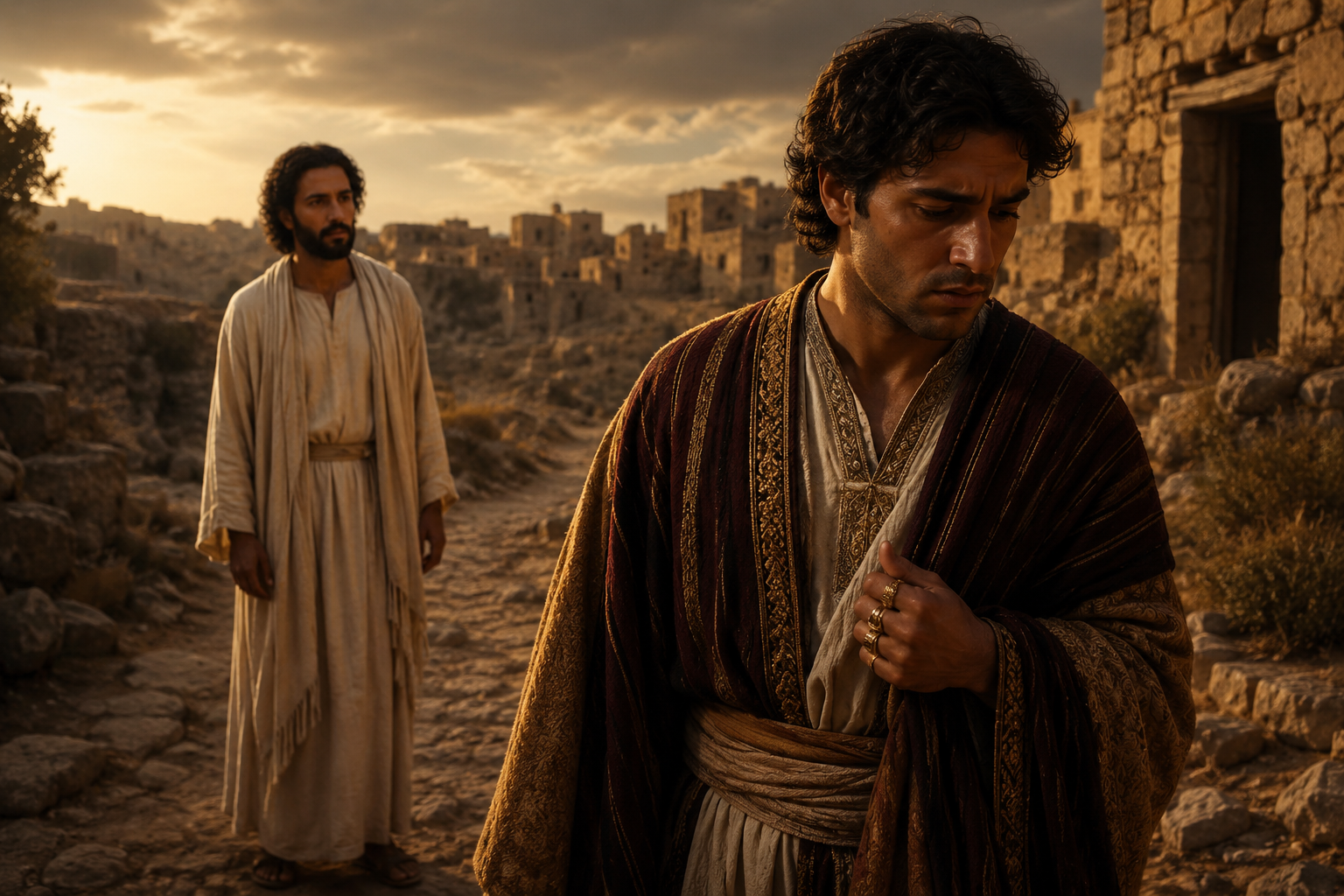


…How hardly shall they that have riches enter into the kingdom of God! And the disciples were astonished at his words. But Jesus answereth again, and saith unto them, Children, how hard is it for them that trust in riches to enter into the kingdom of God!
In a companion piece I made the case that wanting money is not evil — that the God who owns all the gold made His friends rich and never once condemned wealth itself (see Is It Evil to Want Money?). But honesty cuts both ways. Scripture does warn about money — sharply, repeatedly, by the mouth of Christ Himself. So this piece looks those warnings full in the face. And what you find, every time, is that the warning is aimed at one place — and it is never the wallet.
The warnings are about the heart
Read the lead verse again and watch the Lord correct Himself in real time. He first says, “How hardly shall they that have riches enter” — and the disciples are stunned. So He says it again, and this time He defines it: “how hard is it for them that trust in riches to enter.” That second sentence is the key to every money warning in the Bible. The danger was never the having. It was the trusting — leaning your weight on the money instead of on God, letting it sit on the throne where He belongs. Keep that distinction in your hand and the hardest sayings open like a door.
The rich young ruler
The story people reach for first is the rich young ruler — the man Jesus told to sell everything. Surely that proves wealth bars the kingdom? Read it slowly; it proves the opposite. The man arrives sure of himself, and when Jesus points him to the commandments, he answers without a flicker of doubt:
The young man saith unto him, All these things have I kept from my youth up: what lack I yet? Jesus said unto him, If thou wilt be perfect, go and sell that thou hast, and give to the poor, and thou shalt have treasure in heaven: and come and follow me. But when the young man heard that saying, he went away sorrowful: for he had great possessions.
“All these things have I kept.” Myron Golden presses on the honesty of that claim, and he is right to. No man keeps the whole law from his youth up; to say so with a straight face is not righteousness, it is self-righteousness — a man so full of his own record that he has no room to receive a righteousness he did not earn. The young man was rich in two ways at once: rich in money, and richer still in his own goodness. And it was the second wealth, not the first, that Jesus came to relieve him of.
The command was a mirror
Here is the part that turns the whole scene. Look back a verse, at the commandments Jesus had just recited to him. He ended the list with one in particular:
…Honour thy father and thy mother: and, Thou shalt love thy neighbour as thyself.
The man had just claimed to keep that one too — “love thy neighbour as thyself.” So Jesus held up a mirror. You say you love your neighbour as yourself? Then go, sell what you have, and give it to the poor — the neighbours you say you love as you love your own skin — and come follow Me. It was not an arbitrary demand to impoverish him. It was a test of the exact commandment he had just boasted of keeping. And he failed it on the spot: he would not lift a finger of his fortune for the poor he claimed to love as himself. The command was Jesus making him put his money where his mouth was — and the money would not move, because the love was never there. His own refusal exposed that the proud “all these have I kept” was not true. He had not kept the law. He had only never been tested.
So mark what actually sent him away sorrowful. It was not that wealth is wicked. It was that his wealth had become the thing he truly served — the idol on the throne, the proof of his own goodness, the treasure he loved more than God and more than his neighbour. “Ye cannot serve God and mammon” (Matthew 6:24). Golden frames the lack precisely: the man’s security and identity rested on his assets and on his own record, and the one thing he lacked was the willingness to surrender that — to let God, and not the money, be his supreme treasure. The man had answered the question of which he served, and he had not even known he was answering it.
The children — one picture, not two
And now the piece almost everyone misses, because we are taught to read the Gospels in little disconnected boxes. Look at what comes immediately before the rich young ruler — in Matthew, in Mark, and in Luke, the same order in all three. Just before this man runs up, they had been bringing little children to Jesus:
…Suffer the little children to come unto me, and forbid them not: for of such is the kingdom of God. Verily I say unto you, Whosoever shall not receive the kingdom of God as a little child, he shall not enter therein.
These are not two unrelated stories filed next to each other by accident. They are one picture, set side by side on purpose, and the second is the photographic negative of the first. Watch how a little child receives the kingdom. A child has nothing to offer, no résumé, no record, no list of kept commandments. He cannot earn his place; he simply receives, empty-handed, trusting, dependent, holding up open hands to be picked up. That, Jesus says, is the only way anyone enters: not achieved — received, as a gift, by a small one with nothing in his fists.
Then, in the very next breath, a rich man walks up who is the exact opposite of a child. His hands are full — full of money, fuller still of his own righteousness. He does not come to receive the kingdom; he comes to qualify for it, to be told his record is good enough. And Jesus, in love, tells him to do the one thing that would empty his hands — sell it, give it away, come with nothing — so that he could at last receive the kingdom the way the children just had. He would not. He turned and walked back to his full hands. The children entered with empty ones; the ruler was shut out with full ones — and the difference between them was never the money. It was that one came to receive and the other came to earn. Read the children and the ruler as the single lesson they are, and the meaning is unmistakable: the kingdom is for those who come like children — by grace, with open hands — and the trouble with riches is only that they tempt a man to come like the ruler instead.
The camel and the needle
Which sets up the line that has frightened the rich for two thousand years. After the ruler leaves, Jesus turns to the stunned disciples:
It is easier for a camel to go through the eye of a needle, than for a rich man to enter into the kingdom of God. And they were astonished out of measure, saying among themselves, Who then can be saved? And Jesus looking upon them saith, With men it is impossible, but not with God: for with God all things are possible.
Three things settle it. First, it is a deliberate hyperbole — the very largest animal through the very smallest opening — the same way of speaking as straining at a gnat and swallowing a camel. It paints a humanly impossible picture on purpose. (It is not, despite a popular tale, a low gate in Jerusalem called “the needle’s eye”; there is no real evidence such a gate existed, and the verse does not need the legend.) Second, the disciples do not ask “who among the rich can be saved?” — they ask “who then can be saved?”, as in anyone at all. They understood He was not describing a problem unique to the wealthy; He was describing a problem unique to man. Third, His answer is the whole gospel in a sentence: “With men it is impossible, but not with God.” No one — rich or poor — squeezes himself into the kingdom by his own resources, any more than a camel threads a needle by trying harder. Every soul that enters is carried in by God, received like a child. If literal wealth could bar the door, Abraham, Job, and Solomon are on the wrong side of it — and they are not. The needle is not about gold. It is about grace.
The rest of the warnings
Every other money warning in Scripture falls exactly where these two do — on the heart, never the asset. Run through them and watch the target hold steady:
- The love of it: “For the love of money is the root of all evil” (1 Timothy 6:10) — the Greek is philargyria, the love of silver, an appetite of the heart, not the silver in your hand.
- The trust in it: “If riches increase, set not your heart upon them” (Psalm 62:10) — not do not let them increase, but do not set your heart on them.
- The oppression for it: “Behold, the hire of the labourers… which is of you kept back by fraud, crieth” (James 5:4) — the sin is robbing the worker, not owning the field.
- The self-sufficiency from it — Laodicea’s deadly boast: “I am rich, and increased with goods, and have need of nothing; and knowest not that thou art wretched… and poor” (Revelation 3:17). The danger is the heart that has stopped needing God, not the goods in the storehouse.
Not one of these condemns wealth. If they meant to, they would say so. Every single one indicts an attitude of the heart toward the money — and an attitude is precisely the thing a man can repent of while keeping the wealth and turning it to good.
What the warning actually is
So here is the warning, stated plainly, the way the whole Bible states it: do not let your money have you. Have all you can come by honestly; build, earn, increase, and give. But the moment the money moves from your hand to your heart — the moment it becomes your security, your identity, your god, the proof of your own goodness — it has become the rich young ruler’s idol, and it will walk you away from Christ sorrowful with your hands full. The question Scripture keeps asking is never how much do you have? It is what has hold of your heart? A poor man can fail that test as surely as a rich one; the love of money is no respecter of bank balances.
And notice that this is not the opposite of the companion piece — it is its other half. There the point was that wealth is a good gift of God; here the point is that the heart can turn any good gift into an idol. Both are true at once, and holding both is the whole of biblical wisdom about money: “If riches increase, set not your heart upon them.” Let them increase. Keep your heart on God.
How I hold this
I pursue wealth on purpose, and I check the throne of my heart on purpose, and I do not confuse the two activities. The money is a tool I mean to have a great deal of; it is not my security and it is not my righteousness. I try to keep my hands open the way a child’s are — to receive everything from God as a gift rather than a wage, and to give it out again freely, because the surest guard against money owning me is the habit of giving it away. Golden states the stewardship in a line I keep close — when God can trust your heart, He can trust your hands — and it runs both ways: the open heart is the very thing that makes the open hand safe to fill. When I read the rich young ruler I do not hear “stay poor.” I hear a warning I have to answer every single day: am I coming to God like that man — full-handed, sure of my own record — or like one of those children, empty-handed and glad to be carried in?
That is the only safe way to be rich: to want the wealth, work for the wealth, hold the wealth — and want God more, so that if He ever said “sell it and follow Me,” the hands would open without a fight. The ruler’s would not. That, and not the size of his estate, is why he went away sorrowful.
Enter as a child
So do not be afraid of the warnings, and do not twist them either. They are not God forbidding you to prosper; they are God guarding your heart while you do. Want money — and refuse to worship it. Build wealth — and keep it in your hand, never on your throne. Love your neighbour enough that your fortune is always within reach of his need. And come to the kingdom the only way anyone ever has: not as the ruler came, full of himself and his goods, but as the children came — small, trusting, empty-handed, glad to receive what you could never have earned.
Verily I say unto you, Whosoever shall not receive the kingdom of God as a little child, he shall not enter therein.
Sources
On the money warnings and the rich young ruler:
- Myron Golden — biblical wealth teaching (the rich young ruler’s self-righteousness; “love thy neighbour” as the test he failed).
- Companion piece: Is It Evil to Want Money?
Scripture (KJV): Mark 10:13-27; Matthew 19:13-26; Luke 18:15-27; Matthew 19:19; Matthew 6:24; 1 Timothy 6:10; Psalm 62:10; James 5:4; Revelation 3:17.