Daniel 11 is the longest and most detailed prophecy in the Bible — so exact through the Persian, Greek, and Roman eras that skeptical critics have insisted it must have been written after the events, for no one could foretell history in such fine grain. Read instead as what it claims to be — history written in advance — it draws one unbroken line of empires that would tug at God's people, from Persia to the time of the end, framed as a long duel between two thrones: the king of the South and the king of the North.
The kings of the South and the North
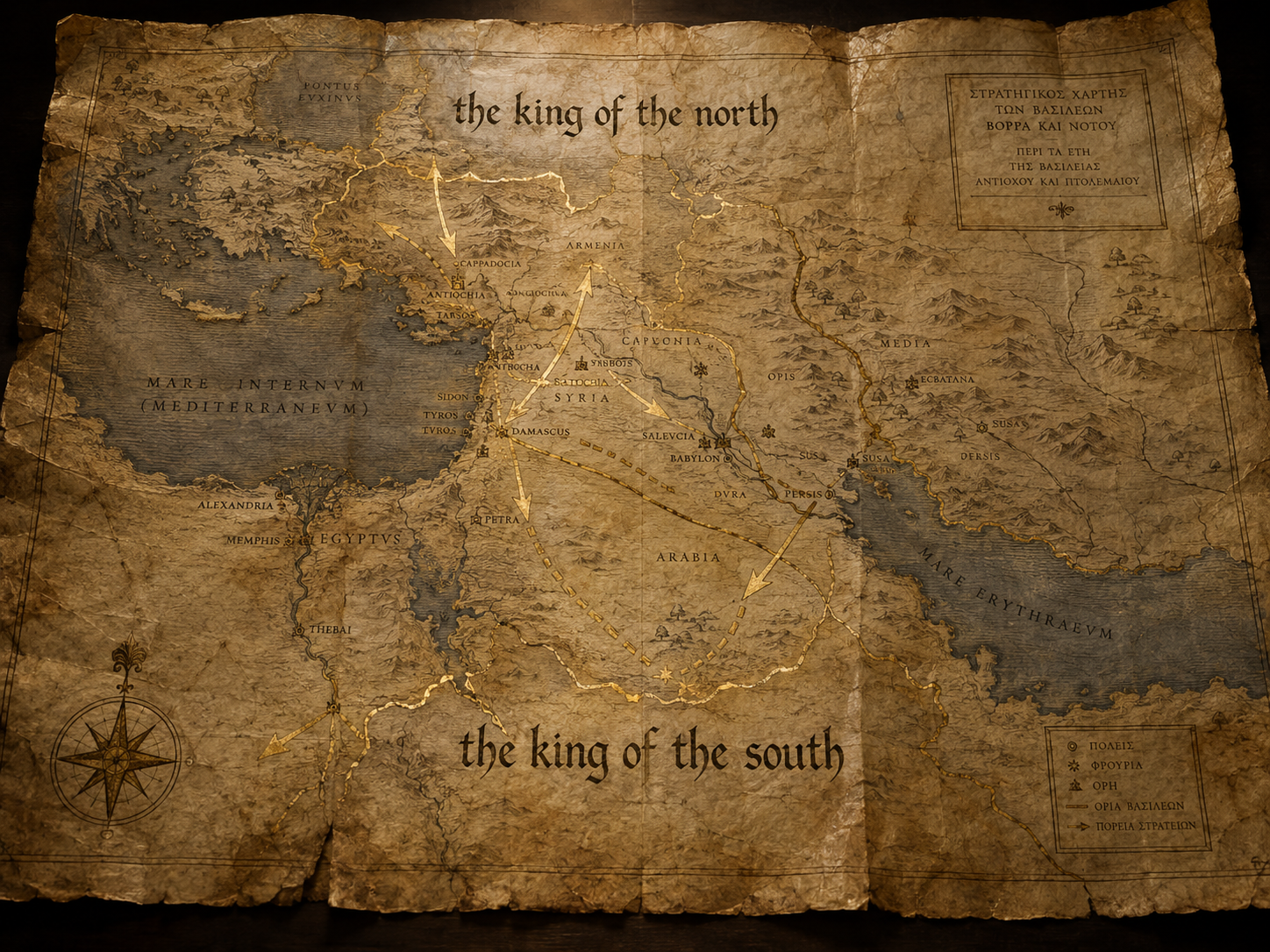
The chapter is a sequel. An angel had just told Daniel he would "shew thee that which is noted in the scripture of truth" (Daniel 10:21), and what follows retraces the same march of empires as Daniel 2, 7, and 8 — now at ground level, war by war. Two powers anchor the drama: after Alexander's empire broke apart, the king of the South was Egypt under the Ptolemies, and the king of the North was Syria under the Seleucids — with the land of God's people, "the glorious land," caught in the middle of their endless campaigns. As the centuries turn, the "North" passes from Syria to Rome, and from pagan Rome to papal Rome — the same power Daniel 7 and 8 had already marked.
History written in advance
The first stretch of the chapter is the part everyone can check against the history books, and it is astonishingly exact:
| Verses | Power | Fulfillment |
|---|---|---|
| Daniel 11:2 | Medo-Persia | Four more kings; the fourth (Xerxes) stirs up all against Greece. |
| 11:3–4 | Greece — Alexander | The "mighty king"; at his death the empire splits four ways, not to his sons. |
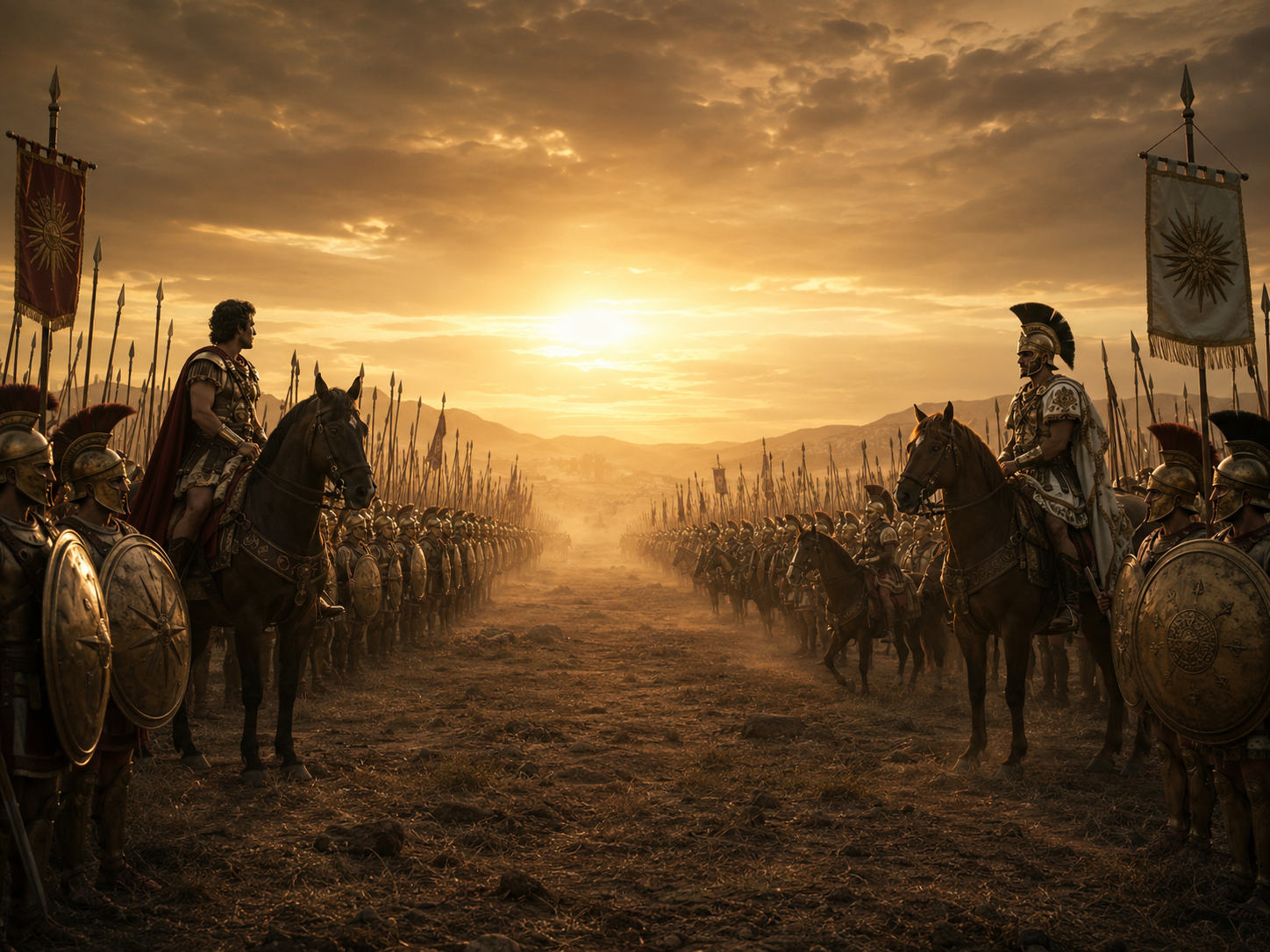
| 11:5–15 | Ptolemies vs Seleucids | Two centuries of war between the king of the South (Egypt) and the North (Syria). |
| 11:16–19 | Rome rising | A new power enters and stands in the "glorious land." |
| 11:20 | Augustus Caesar | "A raiser of taxes" — the decree that sent Joseph and Mary to Bethlehem (Luke 2:1). |
| 11:21–22 | Tiberius · the cross | "The prince of the covenant" broken — the Messiah crucified. |
| 11:30–31 | Papal Rome | Pagan Rome gives way; the "daily" taken away, the desolating power set up. |
| 11:36–39 | The self-exalting king | Magnifies himself above every god; honors "a god whom his fathers knew not." |
| 11:40–45 | The time of the end | A final push of South and North; the power "comes to his end, and none shall help him." |
From the four Persian kings, to Alexander rising and dying young with his realm divided "not to his posterity" (11:4), through the documented marriages, betrayals, and battles of the Ptolemies and Seleucids (11:5–15) — the prophecy reads like a chronicle. That precision is not an embarrassment to faith; it is the point. A God who can lay out the rise and fall of named empires centuries early is a God who holds history in His hand.
Rome, and the Prince of the covenant
As the chapter moves into the Roman era, two verses touch the Gospel itself. First, a ruler is marked by an unusual signature:
Then shall stand up in his estate a raiser of taxes in the glory of the kingdom …
A "raiser of taxes" in the height of the kingdom — Augustus Caesar, in whose reign went out "a decree … that all the world should be taxed" (Luke 2:1), the very census that carried Mary to Bethlehem. Then his successor, Tiberius, in whose reign the deepest event of all takes place:
… and shall be broken; yea, also the prince of the covenant.
The Prince of the covenant — broken. Daniel's war-chronicle pauses, in a single clause, on the crucifixion of the Messiah, the One who confirmed the covenant (compare Daniel 9:27). The God charting the empires did not forget the cross at the center of them.
From pagan Rome to papal Rome
The chapter then traces the same transition Daniel 7 and 8 foretold: imperial pagan Rome gives way to a religious power that wears its crown:
And arms shall stand on his part, and they shall pollute the sanctuary of strength, and shall take away the daily, and they shall place the abomination that maketh desolate.
The "daily" (Hebrew tamid, the continual) removed, a counterfeit system set in the place of the true — the same little-horn power that "thinks to change times and laws" (Daniel 7:25). And the prophecy describes its character in words that fit no mere general:
And the king shall do according to his will; and he shall exalt himself, and magnify himself above every god … neither shall he regard the God of his fathers … nor regard any god: for he shall magnify himself above all.
A power that exalts itself in the place of God, honoring "a god whom his fathers knew not" (11:38) — the self-magnifying religio-political system the earlier visions had already exposed. (Its identity is developed in the Daniel 7 study and the prophetic surface generally; this chapter simply confirms the same figure from another angle.)
The time of the end
Here the chapter reaches forward to the last days — and here we proceed with more humility, because faithful students of prophecy have read the closing verses in more than one way:
And at the time of the end shall the king of the south push at him: and the king of the north shall come against him like a whirlwind …
In the historicist mainstream, the king of the North at the end remains the Roman/papal power that the whole chapter has been tracking, while the king of the South is most often read as the atheistic, God-denying spirit that rose in the French Revolution and secular modernity — "Egypt" being, from the Exodus on, the power that says "who is the LORD?" (Exodus 5:2). The exact mapping of the final campaigns is debated among honest interpreters, and we will not pretend to a precision the text does not yet allow. What is not in doubt is the ending:
… yet he shall come to his end, and none shall help him.
Whatever the precise moves, the persecuting power that has run through the whole vision meets its appointed, helpless end. And the very next verse — for the chapter break is artificial — turns from judgment to deliverance:
And at that time shall Michael stand up, the great Prince which standeth for the children of thy people … and at that time thy people shall be delivered, every one that shall be found written in the book.
Go deeper
- Daniel 7 — the four beasts and the little horn that "changes times and laws."
- Daniel 9 — The Seventy Weeks — the Prince of the covenant, dated and cut off.
- Michael the Archangel — who the great Prince of Daniel 12:1 is.
Why it matters
Daniel 11 is the boldest demonstration in Scripture of a God who, as Isaiah says, declares "the end from the beginning, and from ancient times the things that are not yet done" (Isaiah 46:9–10). Empires that would not exist for centuries are named in their order; the taxing of Augustus and the breaking of the Prince of the covenant are set in their place; and through it all God's people are watched over. The chapter does not end in the triumph of the persecutor but in Michael standing up for His own. The same hand that wrote the history in advance is the hand that holds the last chapter — and it closes, for everyone written in the book, in deliverance.