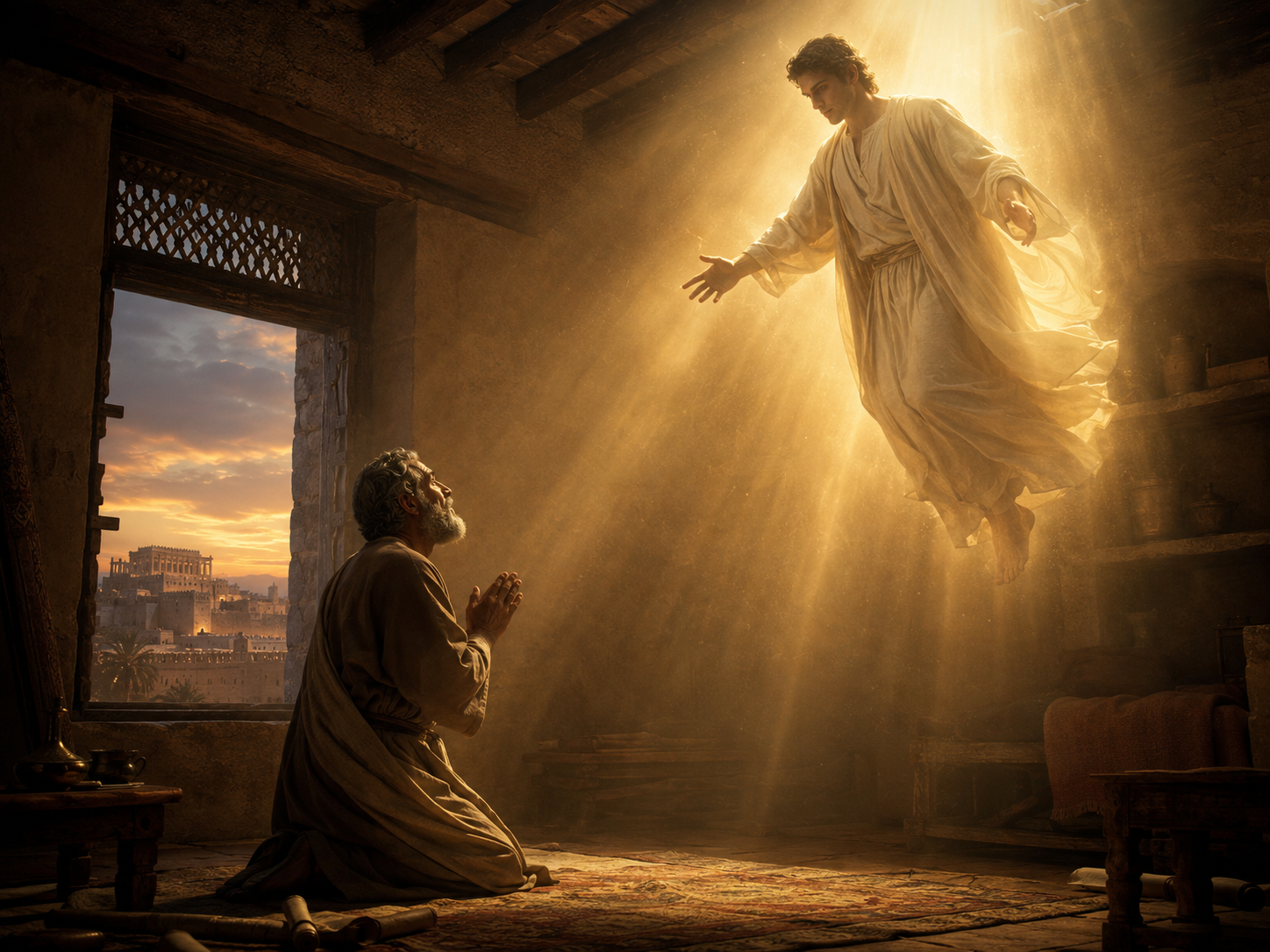
Of all the prophecies in Scripture, one does something none of the others quite dares: it sets a date on the Messiah. Given to Daniel by the angel Gabriel around 538 BC, the prophecy of the seventy weeks names the centuries between a Persian decree and the coming — and the cutting off — of the Anointed One, with a precision that has unsettled readers for two thousand years. It is the historicist key to the whole book, and it is the strongest single piece of evidence that Jesus of Nazareth is who He claimed to be.
“Seventy weeks are determined”
The prophecy opens with a sweep of Messianic purpose:
Seventy weeks are determined upon thy people and upon thy holy city, to finish the transgression, and to make an end of sins, and to make reconciliation for iniquity, and to bring in everlasting righteousness, and to seal up the vision and prophecy, and to anoint the most Holy.
Six goals, every one of them the work of the cross and the Anointed One. The word translated determined is the Hebrew chathak, which means cut off — to sever a piece from something larger. The natural question is: cut off from what? The seventy weeks have just been "determined" for Daniel's people, but the only measure of time in the immediately preceding vision is the great span of Daniel 8: "unto two thousand and three hundred days; then shall the sanctuary be cleansed" (Daniel 8:14). The seventy weeks are a portion cut off from the 2300, and the two periods begin together — a point we return to at the end.
The year-day key
Seventy weeks is 490 days — far too short for a prophecy that reaches from Persia to the Messiah. But Bible prophecy of this kind counts a day for a year, a principle the Scriptures state plainly ("each day for a year," Numbers 14:34; Ezekiel 4:6). On that key, seventy weeks become 490 years — and the dates fall into place. (The year-day principle is set out more fully in the companion study on the historicist method, linked below.)
The starting gun: 457 BC
A prophecy of years needs a fixed beginning, and Gabriel gives one:
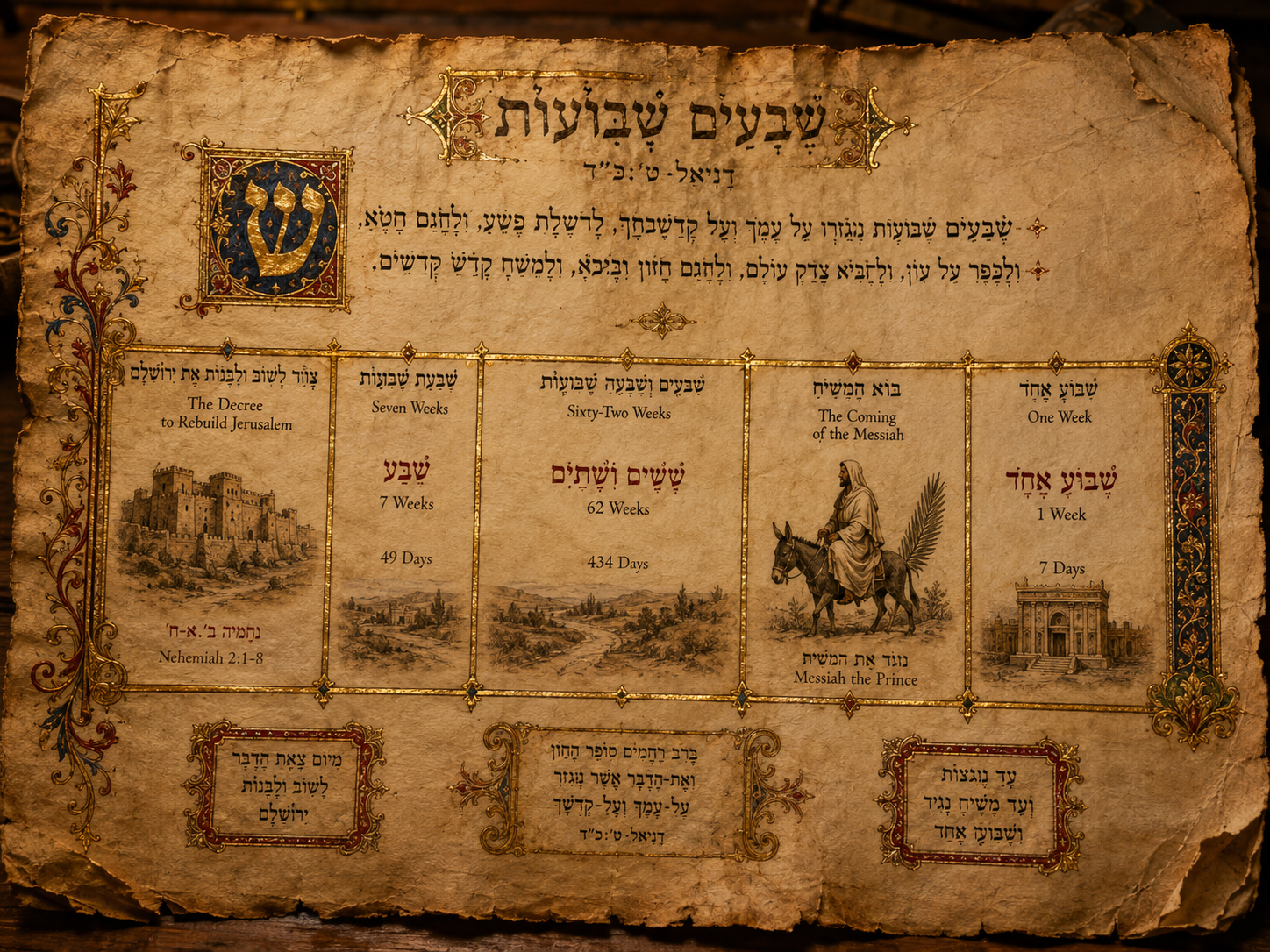
Know therefore and understand, that from the going forth of the commandment to restore and to build Jerusalem unto the Messiah the Prince shall be seven weeks, and threescore and two weeks …
Several Persian decrees touched Jerusalem, but only one restored the city with full civil authority — the decree of Artaxerxes in his seventh year, recorded in Ezra 7, which took effect in 457 BC. From that starting line the whole timetable unrolls:
| Period | Dates | What it marks |
|---|---|---|
| 7 weeks — 49 years | 457–408 BC | Jerusalem restored and rebuilt, "even in troublous times" (Dan 9:25). |
| 62 weeks more — 434 years | 408 BC – AD 27 | The long wait runs out: the clock reaches the Anointed One. |
| ↳ 69 weeks total — 483 years | 457 BC → AD 27 | Messiah the Prince: Jesus anointed by the Spirit at His baptism. |
| Midst of the 70th week | AD 31 | Messiah "cut off" — the cross causes sacrifice and oblation to cease. |
| End of the 70 weeks — 490 years | AD 34 | The covenant confirmed; the gospel turns from Israel to the nations. |
Messiah the Prince — AD 27
Seven weeks plus sixty-two weeks is sixty-nine weeks — 483 years. Count 483 years from 457 BC (remembering there is no year zero between BC and AD) and you arrive at AD 27. And what happened in AD 27? The word Messiah means simply Anointed — and that is the year Jesus was anointed, not with oil but with the Holy Spirit, at His baptism: "God anointed Jesus of Nazareth with the Holy Ghost and with power" (Acts 10:38). From that moment He began to preach with the prophecy on His own lips:
… The time is fulfilled, and the kingdom of God is at hand: repent ye, and believe the gospel.
No other figure in history has been pointed to by name — the Anointed — on a calendar set five centuries in advance, and met the appointment to the year.
Cut off in the midst of the week — AD 31
One week of the seventy remained — the final seven years, AD 27 to 34. Gabriel said the Messiah would be "cut off," and pinpointed when:
And after threescore and two weeks shall Messiah be cut off, but not for himself … And he shall confirm the covenant with many for one week: and in the midst of the week he shall cause the sacrifice and the oblation to cease …
"Cut off" — karath, to be killed. "Not for himself" — for others; the very heart of the gospel. And it falls "in the midst of the week," three and a half years into that final seven — AD 31, when the Messiah was crucified. His death "caused the sacrifice and the oblation to cease": the moment He died, the veil of the temple "was rent in twain from the top to the bottom" (Matthew 27:51), and every lamb laid on every altar afterward was a shadow whose Substance had already come. The true Lamb had been offered.
The covenant confirmed — to AD 34
Three and a half years still remained in the seventieth week. In them the new covenant was "confirmed with many" — the risen Christ's gospel preached first to Israel, by apostles who had walked with Him. The week closed about AD 34, when the stoning of Stephen and the conversion of Saul mark the turning of the gospel outward to the whole world (Acts 7–9). The seventy weeks specially "determined upon thy people" had run their course; the door swung open to the nations.
And the rest of the 2300 — 1844
Now the thread we left hanging. If the seventy weeks (490 years) were cut off from the 2300 days of Daniel 8:14, and both begin at 457 BC, then subtracting the 490 leaves 1810 years still to run after AD 34 — which reaches to 1844, the appointed time for the cleansing of the sanctuary that Daniel 8 foretold. The same starting decree that dates the Messiah dates the beginning of the final work of judgment. That is a study of its own, and we will not re-walk it here — it is opened in full elsewhere:
Go deeper
- The Historicist Method — the year-day principle and how prophecy is read.
- Has the Judgment Already Begun? — the 2300 days and 1844, opened from Scripture.
- The Hour of God's Judgment — Daniel 8:14, the heavenly sanctuary, and the last-day message.
The math no one could fake
Step back and see what is on the table. Centuries before Jesus was born — in a book whose copies among the Dead Sea Scrolls predate Him — a prophecy fixed the year the Messiah would be anointed, the year He would be killed, and the purpose of that death: "to make an end of sins, and to make reconciliation for iniquity." It cannot be written after the fact, and it cannot be coincidence. The seventy weeks are Heaven's own signature on the identity of Jesus Christ — the Anointed who came on time, and was cut off, not for Himself, but for us.