The book’s own first word names what it is — an apokalypsis, an unveiling. Not a sealing, not a riddle reserved for one generation. Revelation 1 supplies what every later chapter of the book assumes: the structural frame, the hermeneutic key for reading it, and a vision of the Christ from Whom the unveiling proceeds.
A book that calls itself a revelation
The Revelation of Jesus Christ, which God gave unto him, to shew unto his servants things which must shortly come to pass … Blessed is he that readeth, and they that hear the words of this prophecy, and keep those things which are written therein: for the time is at hand.
Two facts of the opening lines do work that the rest of the book leans on. First, the source: the revelation belongs to Jesus Christ; God gave it to Him; He sent it by His angel to John. Second, the addressee: the book is given “unto his servants,” not to an esoteric few — and a blessing is attached to reading, hearing, and keeping it. A book that opens this way is not a book to be left closed until the last generation. Every generation between John and the end is one of the servants the verse names.
The salutation and the structural frame
John to the seven churches which are in Asia: Grace be unto you, and peace, from him which is, and which was, and which is to come; and from the seven Spirits which are before his throne; and from Jesus Christ, who is the faithful witness, and the first begotten of the dead, and the prince of the kings of the earth.
The greeting comes from three sources — the Father (the One Who is and was and is to come); the sevenfold Spirit before the throne (seven being the number of completeness, the perfect operation of God’s Spirit through the seven church-eras the book is about to describe); and Jesus Christ, named in His three offices as faithful witness (His first coming), first begotten of the dead (His resurrection), and prince of the kings of the earth (His second coming).
The mention of seven churches is not incidental. They are real congregations along a real postal route in Asia Minor — chapters 2 and 3 will write to them by name. They are also, the historicist tradition reads, seven successive eras of the whole visible church (treated in our Revelation 2–3 page). The seven any-things of this book — seven seals, seven trumpets, seven bowls — are the same structural device: the perfect number of completeness, organising history into one survey delivered from several angles at once.
The Lord’s day
I was in the Spirit on the Lord’s day, and heard behind me a great voice, as of a trumpet.
The phrase “the Lord’s day” has been read across the centuries as a reference to Sunday — but the Bible itself nowhere assigns the title to the first day of the week. The title belongs to a different day:
… the sabbath … the holy of the Lord, honourable …
But the seventh day is the sabbath of the Lord thy God …
Christ Himself names the same: “The Son of man is Lord even of the sabbath day” (Mark 2:28). The day John was in the Spirit is the day Scripture itself calls the Lord’s — the seventh-day Sabbath of creation and the fourth commandment. The vision that follows comes to Him on the day the Creator marked out as His own.
The hermeneutic key
Write the things which thou hast seen, and the things which are, and the things which shall be hereafter.
One verse, three tenses. Past, present, future — all live on the same scroll. Whoever opens this book opens his own moment somewhere on its timeline. The first-century reader read the things which were about Ephesus. The fourth-century reader read about Smyrna. The medieval reader read about Pergamos and Thyatira. The Reformation reader read about Sardis. The reader of 1798 onward read about Philadelphia. The reader from 1844 onward reads about Laodicea. The book is continuous, and every generation finds itself somewhere along it.
This is the historicist hermeneutic — the reading the Reformers shared, recovered from a counter-Reformation eclipse. We treat it at length in the historicist hermeneutic study.
The vision of the Son of Man
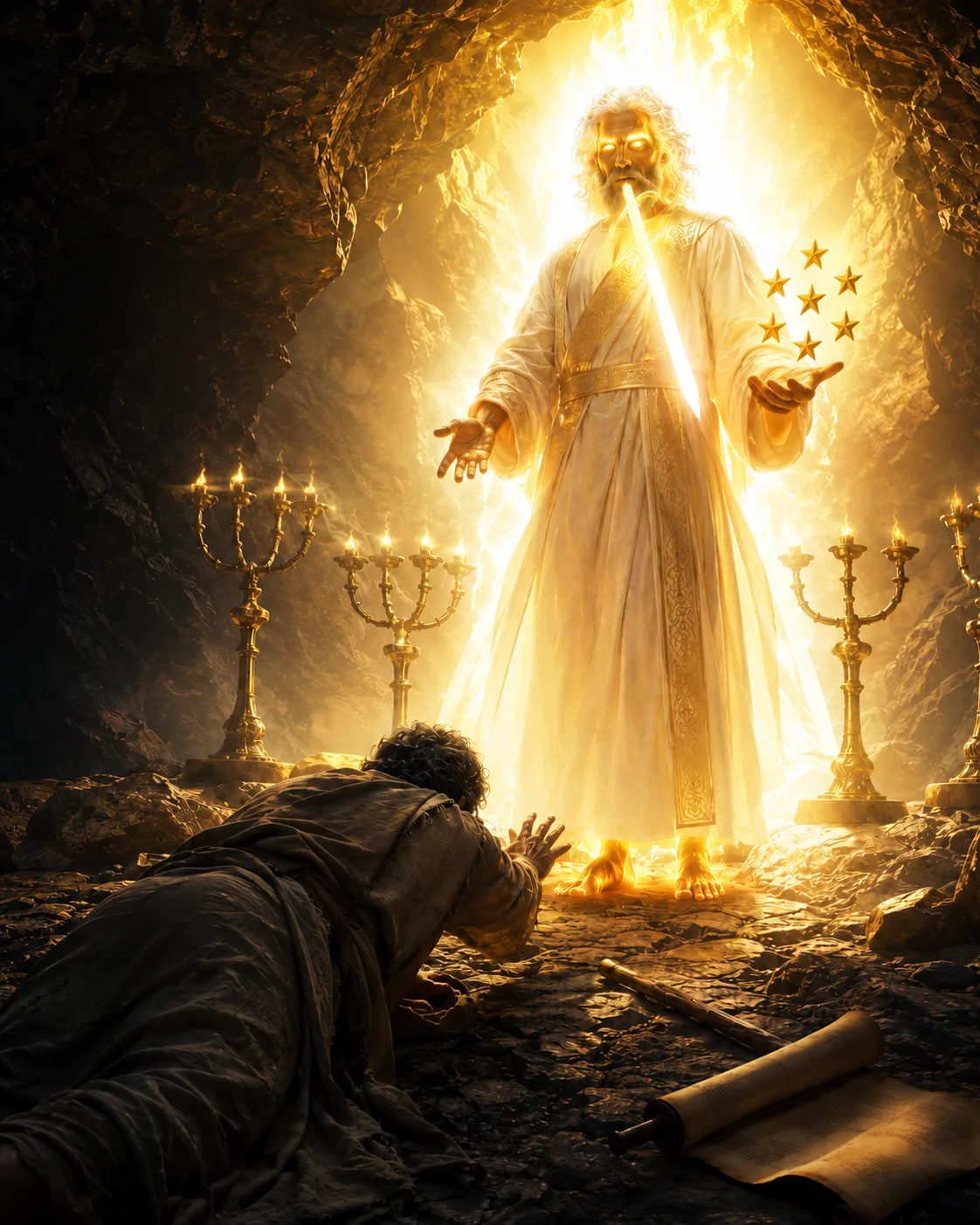
John turns to see the voice that has spoken to him. The vision is the most concentrated portrait of the risen Christ in the New Testament, and every line of it is borrowed from the Old.
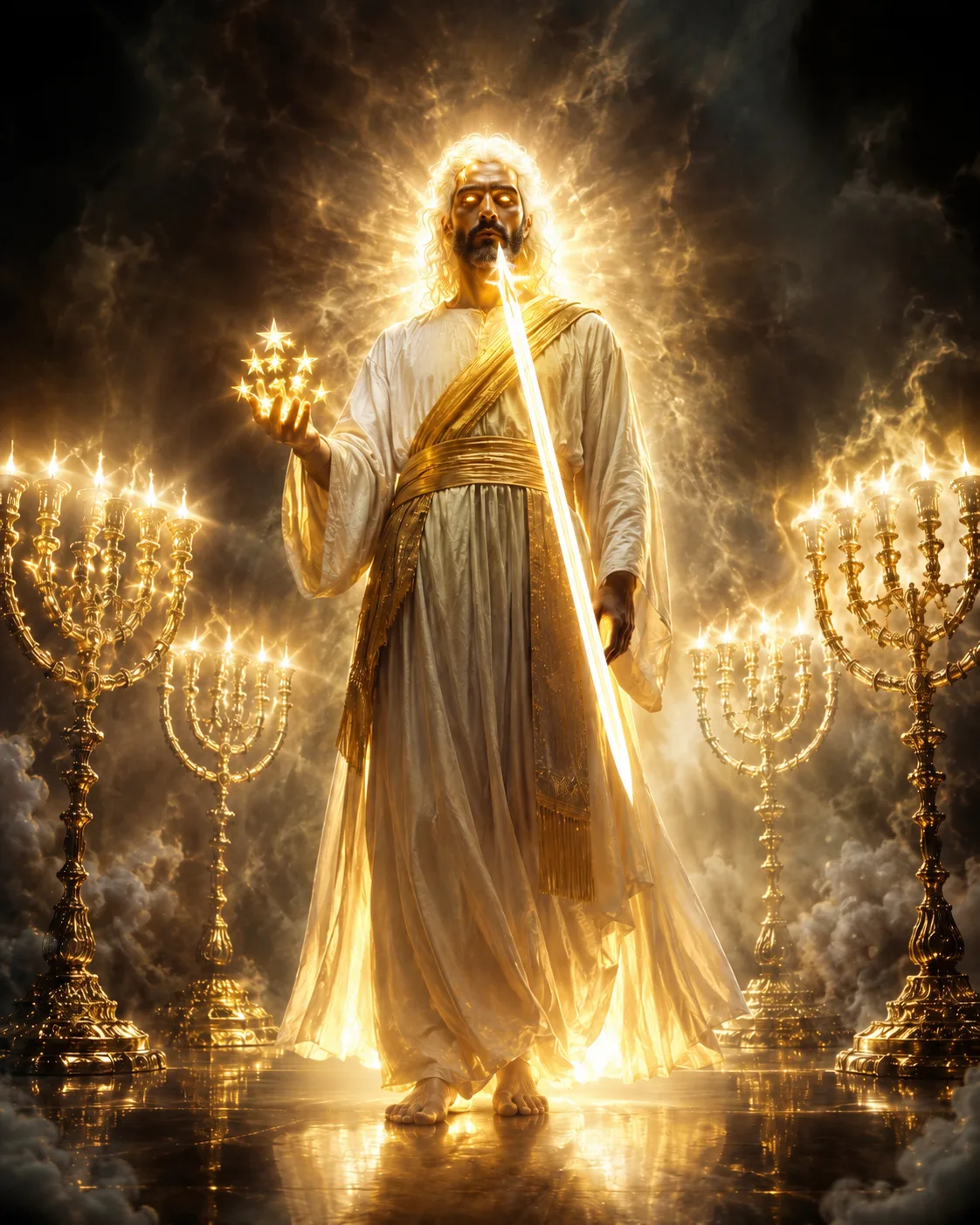
… one like unto the Son of man, clothed with a garment down to the foot, and girt about the paps with a golden girdle. His head and his hairs were white like wool, as white as snow; and his eyes were as a flame of fire; and his feet like unto fine brass, as if they burned in a furnace; and his voice as the sound of many waters. And he had in his right hand seven stars: and out of his mouth went a sharp twoedged sword: and his countenance was as the sun shineth in his strength.
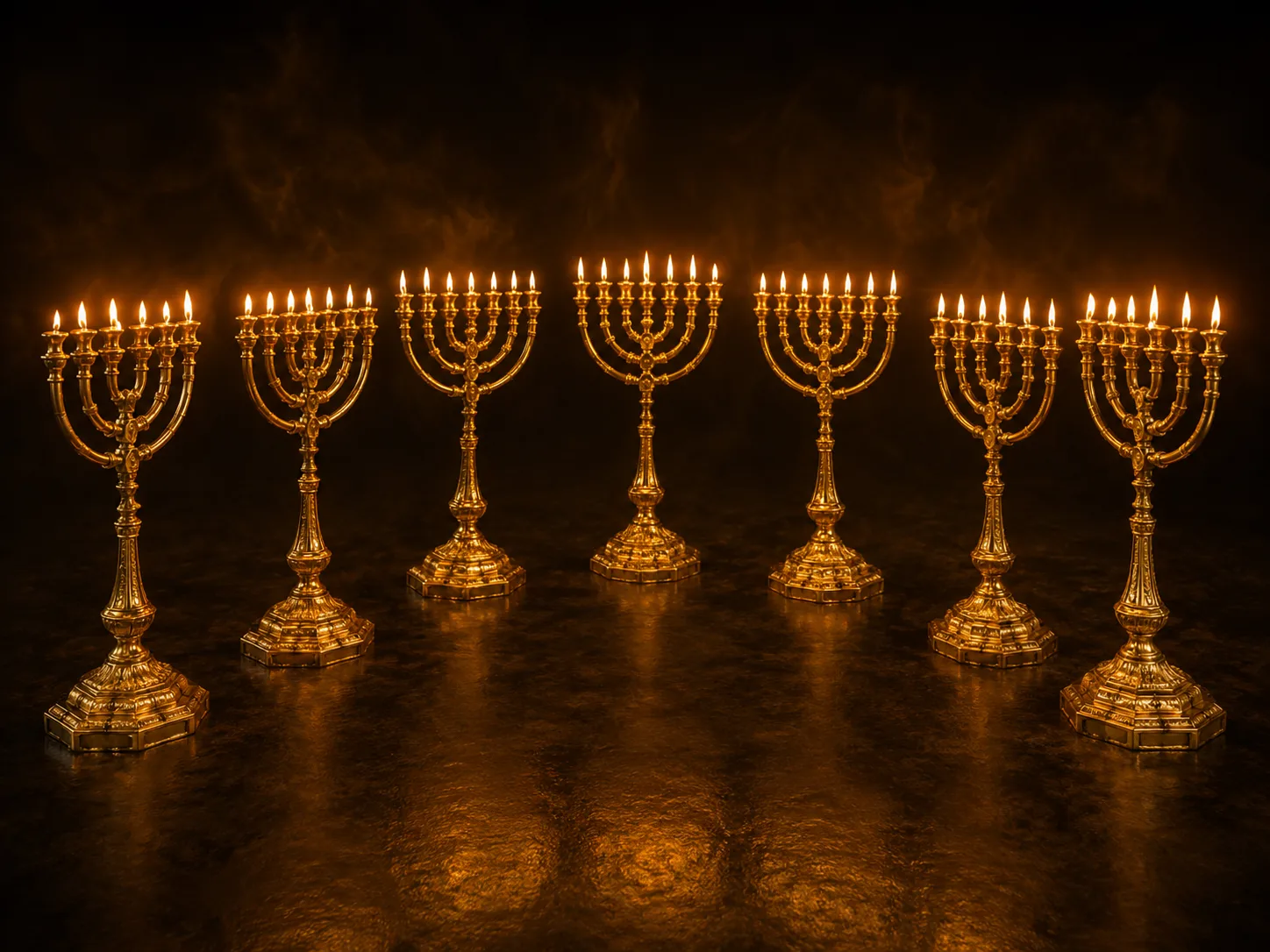
The garment to the feet and the golden girdle are the high-priestly vestments of Exodus 28. Christ is pictured as the priest — not in the earthly tabernacle, but in its heavenly original (Hebrews 8:1–2), walking among the seven golden lampstands that represent the seven churches He sustains (Rev 1:20). The first thing the vision says about Him is what He is doing: priestly intercession in the heavenly sanctuary, in the holy place, where the lampstands stood.
The hair white as wool, white as snow, is the language Daniel used to describe the Ancient of Days Himself (Daniel 7:9). The imagery transfers without explanation. The eyes as a flame of fire mark Him as the One from Whom nothing is hidden. The feet like fine brass refined in a furnace mark Him as the One Who walked through the fire and came out tested. The voice as the sound of many waters is the voice of God Himself (Ezekiel 43:2). The countenance shining as the sun in His strength is the unveiled glory of the One through Whom all things were made (John 1:3).
And then He speaks of Himself the words that no created being could speak:
Fear not; I am the first and the last: I am he that liveth, and was dead; and, behold, I am alive for evermore, Amen; and have the keys of hell and of death.
Earlier in the chapter He had been named “the Alpha and the Omega, the beginning and the ending” and the Almighty (Rev 1:8). The titles by which God identifies Himself in the Old Testament — “I am the first and the last” (Isaiah 44:6); “the Alpha and the Omega” (Rev 22:13); the Almighty — are spoken in Christ’s own voice. The text is not arguing for His divinity; it is letting Him declare it.
Why this matters for the rest of the book
The chapters that follow will introduce beasts, harlots, a dragon, a counterfeit trinity of powers, false worship enforced by economic compulsion. Against all of it, this Christ stands. The book does not first warn; it first shows Him. Every warning in the chapters to come is given by the priest in the midst of the lamps, the One Whose hair is the Ancient of Days, the One Who has the keys of death.
Further reading
- Revelation 2–3 — the seven letters from the Christ of this vision, to the seven churches along the postal route and to the seven eras of the visible church.
- The historicist hermeneutic — Revelation 1:19 read in detail, with the rival preterist and futurist methods set alongside it.
- Daniel 7 — the source of the “Son of man” language and the Ancient of Days imagery that this vision draws on.