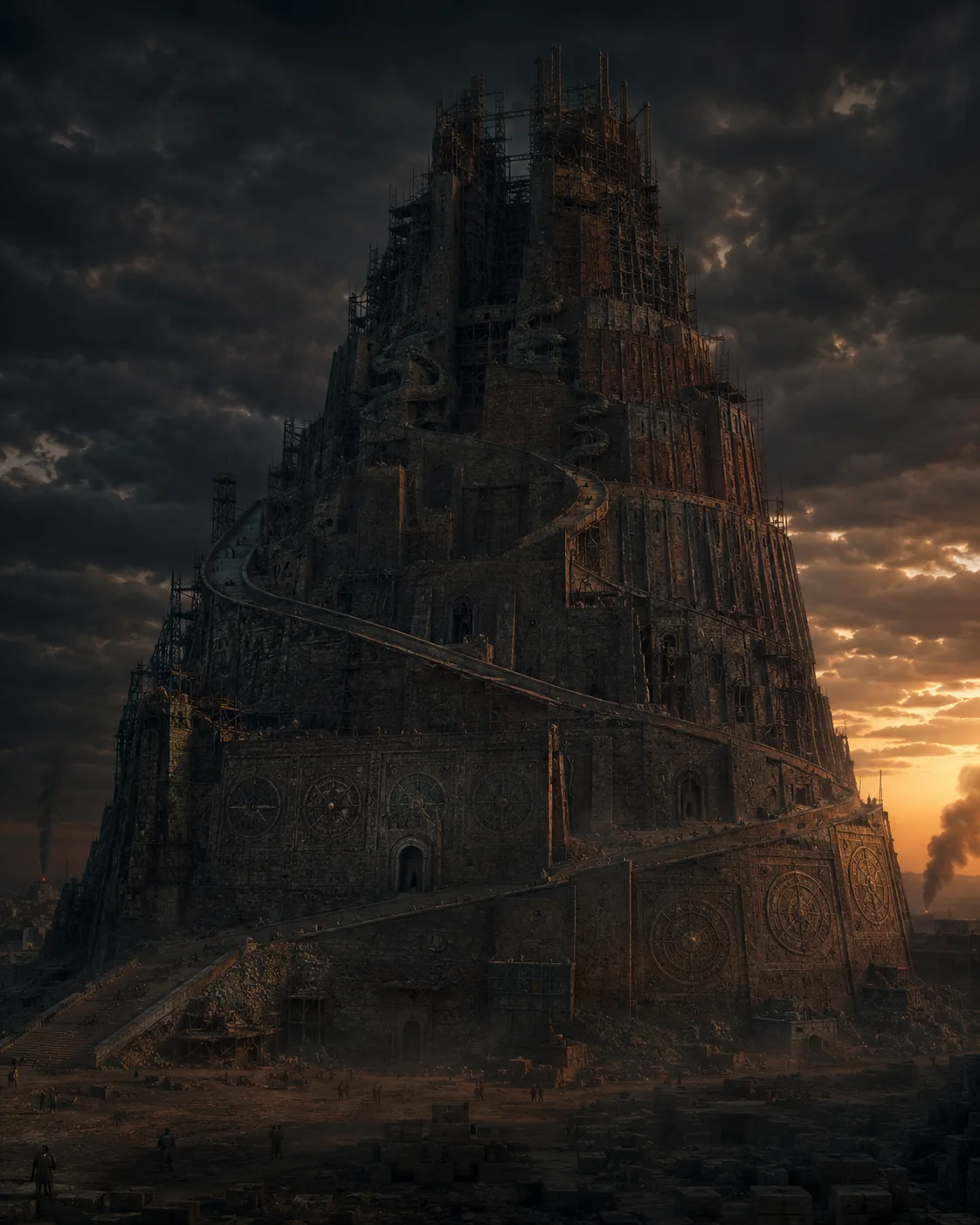
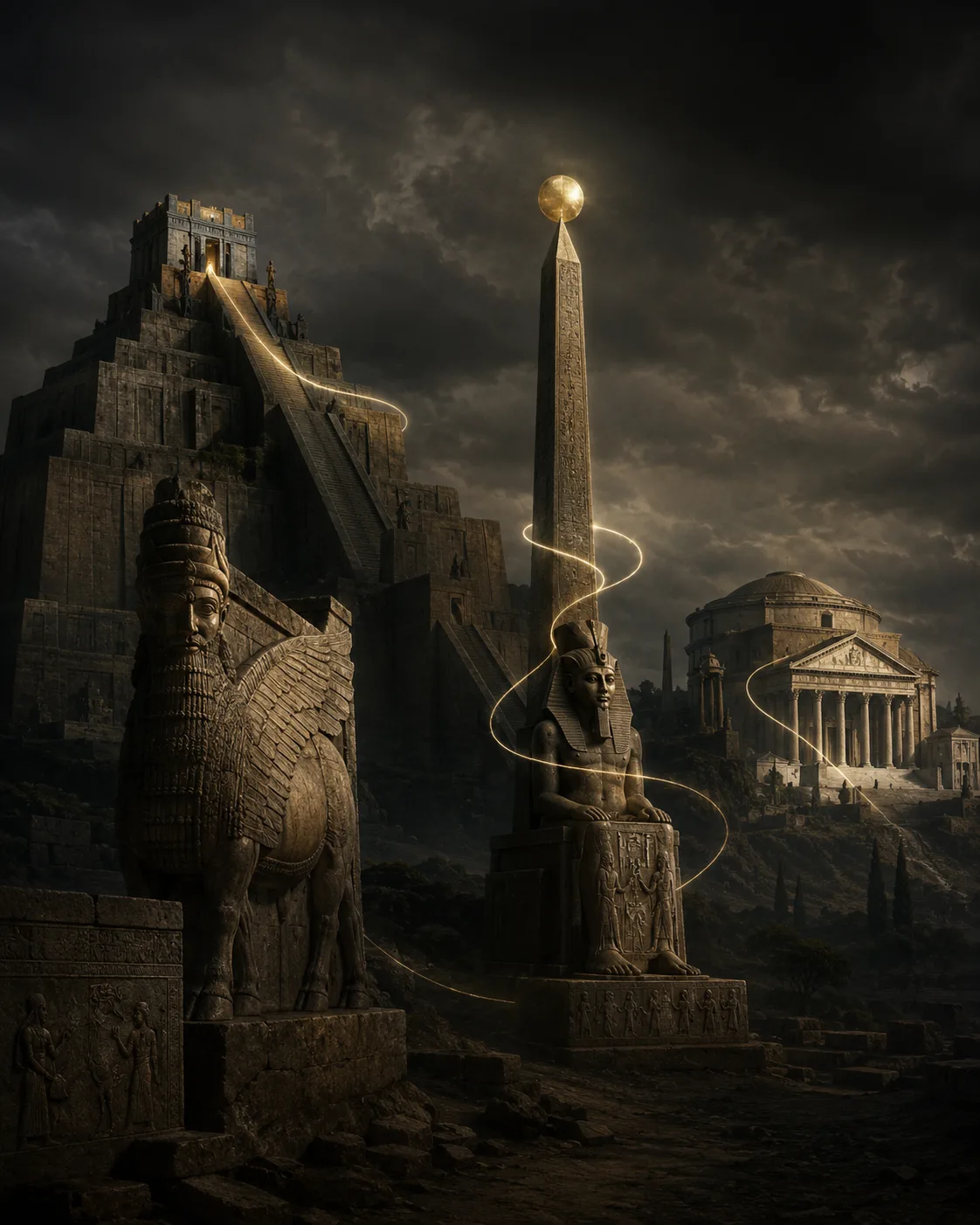
Every later system of confused worship in the biblical record traces back, structurally, to one ancient project: the religion of Babel. This lesson walks the Babylonian mystery religion as Scripture identifies it — from Nimrod’s tower in Genesis 11 to the apostate woman of Revelation 17 — and traces the elements that migrated forward through Egyptian, Hellenistic, and post- Constantinian Christianity into the system Heaven calls, at the closing hour, come out of her, my people.
The Hidden Architecture course begins where every later question this course will raise actually begins: at Babel. The Babylonian mystery religion was not destroyed when the historical Babylonian empire fell to Cyrus in 539 BC. The religion outlived the empire. Its institutional structure migrated through the Egyptian, Phoenician, and Hellenistic mystery cults, was carried into the imperial Roman state religion in the late centuries before Christ, and entered the apostate Christianity of the post-Constantinian centuries as a recognisable inheritance. By the time Revelation 17 gives Babylon her closing-hour name, the system has been operative under various banners for nearly four thousand years. This lesson identifies the system, its components, and the genealogical chain that connects Babel to the closing crisis. Subsequent lessons of the course walk the institutional successors (the Counter-Reformation, the secret societies, the New World Order political project, the cosmological deception, the religious one-world project) and their convergence in the third angel’s message.
Lesson 14 of the main Study Guides (Who Is Babylon?) walked the political identification of Revelation’s Babylon as the closing-hour confederacy of the recovered Papacy, apostate Protestantism, and the spiritualist branch. This lesson walks the religious-historical content of the mystery religion itself — what Babylon actually carries from one historical iteration to the next, and what the willing reader is being called out of when the call comes.
Question 01
How does Scripture name Babylon — and what is the symbolic vocabulary?
Answer
And there came one of the seven angels which had the seven vials, and talked with me, saying unto me, Come hither; I will shew unto thee the judgment of the great whore that sitteth upon many waters… And I saw a woman sit upon a scarlet coloured beast, full of names of blasphemy, having seven heads and ten horns. And the woman was arrayed in purple and scarlet colour, and decked with gold and precious stones and pearls, having a golden cup in her hand full of abominations and filthiness of her fornication: and upon her forehead was a name written, MYSTERY, BABYLON THE GREAT, THE MOTHER OF HARLOTS AND ABOMINATIONS OF THE EARTH.
Three observations on the name. First, the name is written upon her forehead: not hidden, but publicly displayed in the place of conviction and identity. Babylon does not hide what she is; her identifying mark is on her face. Second, the word MYSTERY is the Greek mysterion — the technical term in the ancient world for the initiatory secrets of the mystery religions. Babylon is identified by the mystery- religion structure itself. Third, she is named THE MOTHER OF HARLOTS: not one harlot among others, but the source of all subsequent religious-systemic adultery against the true God. Every later iteration of confused worship traces back to her.
The symbolic vocabulary the angel uses is the consistent vocabulary of the Hebrew prophets and of Revelation itself. A woman in biblical prophecy is a church — faithful when chaste (2 Cor 11:2; Eph 5:25–27; Rev 12:1; 19:7–8), apostate when adulterous (Ezek 16, 23; Hos 2; Rev 17). The waters on which she sits are decoded by the same angel in the same chapter: the waters which thou sawest, where the whore sitteth, are peoples, and multitudes, and nations, and tongues (Rev 17:15). The wine in her cup is doctrine, the way nations are intoxicated by the teaching they imbibe (cf. Jer 51:7). The beast she rides is the political power (Dan 7:17, 23). The decoding is internal to Revelation itself; nothing is being read into the chapter from outside.
Question 02
Where does Babylon historically begin?
Answer
And Cush begat Nimrod: he began to be a mighty one in the earth. He was a mighty hunter before the Lord: wherefore it is said, Even as Nimrod the mighty hunter before the Lord. And the beginning of his kingdom was Babel, and Erech, and Accad, and Calneh, in the land of Shinar.
Nimrod is the first person in the biblical record described as a founder of a kingdom — and the first item in the list of his foundations is Babel. The Hebrew phrase gibbor tsayid liphne YHWH, translated a mighty hunter before the Lord, was read by rabbinic and patristic tradition (Targum Pseudo-Jonathan; Josephus, *Antiquities* 1.4) as carrying the connotation of opposition — before the Lord in the sense of against the Lord, in defiance. Nimrod is, in the Genesis record, the post-flood prototype of the religious-political rebel who builds a kingdom in defiance of God’s covenant order.
And the whole earth was of one language, and of one speech… And they said one to another, Go to, let us build us a city and a tower, whose top may reach unto heaven; and let us make us a name, lest we be scattered abroad upon the face of the whole earth… Therefore is the name of it called Babel; because the Lord did there confound the language of all the earth.
The Babel project has three identifying features that the later Babylonian empire and the later spiritual Babylon will carry forward. First: defiance of God’s explicit command. God had told Noah’s sons to be fruitful and multiply and replenish the earth (Gen 9:1); Babel was the program to gather and centralise lest we be scattered abroad. Second: false worship by human invention. A tower whose top may reach unto heaven — a human-engineered access to the divine, independent of God’s appointed mediation, constructed on human authority. Third: the making of a name. Let us make us a name — the project of human self-glorification under a religious banner, the institution claiming for itself the prerogative of naming and being named.
The Lord disrupts the project by confusing the language and scattering the builders, but does not destroy it. The builders carry the project with them in fragmented form to every region they settle. The Babylonian religion that emerges in the historical record of Mesopotamian civilisation is the continuation of the Babel project under new political dispensations. Every subsequent system of defiant religious-political centralism with human- engineered mediation between the people and the divine is a continuation of the same project. Babel, in Hebrew, also means confusion; the system is named by what it does to those it absorbs.
Question 03
What were the structural components of the Babylonian mystery religion?
Answer
The Babylonian religion, as documented in the cuneiform inscriptional record, the prayers and rituals of the first-millennium-BC priesthood, and the descriptive observations of the classical Greek writers who visited and recorded it (Herodotus, Berossus, Diodorus), had several recurring components that recur, with cultural variation, in every subsequent system descended from it:
- Sun-worship as the central cult. Marduk, Shamash, Bel — the sun under various names — was the supreme deity of the late Babylonian state religion, with elaborate solar processions, solstitial festivals, and a calendar organised around the sun’s annual cycle. The post-Constantinian shift of Christian worship to Sunday is the most visible continuity of this thread (cross-link: Study Guides Lesson 7, Which Day Is the Sabbath?).
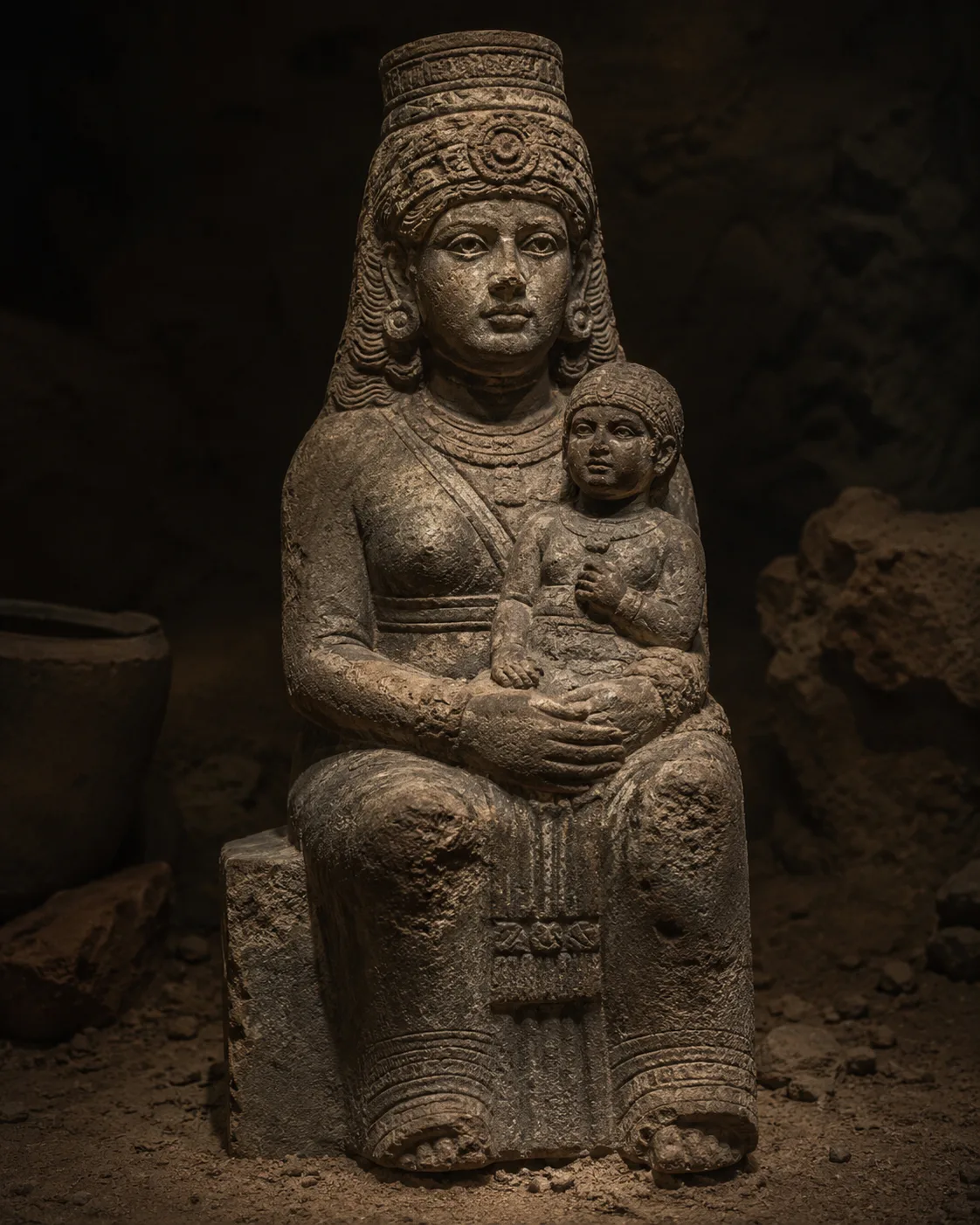
- The mother-and-child cult. Ishtar (the queen of heaven) and Tammuz (her son / consort, the dying-and-rising god). The cult is named explicitly in the Hebrew Bible (Jer 7:18; 44:17–19; Ezek 8:14) — treated in Q5 below.
- A dying-and-rising vegetation god. Tammuz, mourned annually with women weeping at the temple gates (Ezek 8:14); Adonis in the Phoenician form; Osiris in the Egyptian form; Attis in the Phrygian. The motif of a god who dies and rises with the agricultural year is the central liturgical structure of the entire mystery-religion family.
- A celibate, sacramentally mediating priesthood. The Babylonian priesthood stood between the people and the gods, performing sacrifices, interpreting omens, mediating divine judgement, and holding initiatory knowledge restricted to insiders. The structure migrated, with cultural variation, into the Egyptian, Persian, and Hellenistic cults, and recognisably into the post-apostolic sacerdotal Christianity of the post-Constantinian centuries.
- Sacramental rites of purification, indulgence, and intercession. Confession to a priest; ritual sacraments for the cleansing of sin; offerings on behalf of the dead; intercession of the priest between the supplicant and the deity. These elements are documented across the cuneiform sources and migrated forward through every successor cult.
- Communication with the dead / necromancy. The Babylonian religion held the dead to be conscious in a separate residence and available for consultation through trained mediums. The doorway the immortal-soul doctrine has held open for sixteen centuries of post-apostolic Christianity is the same doorway (cross-link: Study Guides Lesson 9, What Happens When We Die?).
- A tri-form deity-structure. Babylonian state theology by the first millennium BC had organised its high gods in triadic patterns — Anu, Bel (Enlil), and Ea, and later Sin, Shamash, and Ishtar — with the structural pattern of three distinct yet co-related deities sharing the supreme office. The pattern recurs across virtually every subsequent religious system in the genealogical chain. Treated in Q8 below.
These components are not anachronistic projections; they are the substance of the Babylonian religion on the primary record, and they migrated, recognisably, into the successor systems. The willing reader can verify each component in any standard university-press history of ancient Near Eastern religion. The relevance for this course is the genealogical continuity: every subsequent system the course will examine inherits one or more of these components from this root.
Question 04
How does the Bible itself trace Babylon’s continuity through history?
Answer
Sit thou silent, and get thee into darkness, O daughter of the Chaldeans: for thou shalt no more be called, The lady of kingdoms… And thou saidst, I shall be a lady for ever… Therefore hear now this, thou that art given to pleasures, that dwellest carelessly, that sayest in thine heart, I am, and none else beside me… thy wisdom and thy knowledge, it hath perverted thee; and thou hast said in thine heart, I am, and none else beside me.
Isaiah’s prophecy against the historical Babylonian empire uses language Revelation 18 will use of the spiritual Babylon of the closing crisis. The lady of kingdoms; I sit a queen, and am no widow, and shall see no sorrow (cf. Rev 18:7); I am, and none else beside me (a self-deifying claim that echoes the beast’s blasphemies in Rev 13:5–6). The continuity is deliberate. The Hebrew prophets identify Babylon as a recurring office, not a single historical event. Where the office is held, the prophetic name applies.
The church that is at Babylon, elected together with you, saluteth you; and so doth Marcus my son.
Peter, writing in the AD 60s, sends greetings from the church that is at Babylon. Peter was not in the literal Mesopotamian Babylon — a city by then already largely depopulated and of no ecclesiastical significance. The apostolic and patristic consensus from the second century onward (Eusebius, *Ecclesiastical History* 2.15; Jerome; Tertullian, *Against Marcion* 3.13) is that Peter is writing from Rome under the symbolic name Babylon, which the early Christians used as a cipher for the imperial capital. The identification of Rome with the prophetic Babylon is therefore not a Protestant invention or an Adventist polemic; it is the apostolic Christian usage that Revelation, written perhaps thirty years after 1 Peter, formalises into prophecy.
Babylon, in our own John, is a figure of the city of Rome, as being equally great and proud of her sway, and triumphant over the saints.
The connecting tissue between Old Testament Babylon and New Testament Babylon is the institutional and ritual continuity. Cyrus’s conquest of Babylon in 539 BC ended the political Babylonian empire but did not end the Babylonian religion. The Babylonian priesthood and the cult of Marduk transferred their religious infrastructure westward through the Persian period; the Hellenistic successor kingdoms preserved the mystery religion in their syncretic state cults; Roman religion absorbed the mystery cults systematically in the late Republic and early Empire; the imperial Roman state religion under Constantine carried the inheritance into the official Christianity of the post-Edict-of-Milan centuries. The chain is documentary, not speculative.
Within the Babylonian period itself, Scripture preserves in Daniel 3 a prototypical narrative the willing reader should weigh as the template for every subsequent confederacy-of-worship the prophetic record will identify. Nebuchadnezzar of Babylon erected an image of gold “whose height was threescore cubits, and the breadth thereof six cubits” (Dan 3:1) in the plain of Dura. A herald proclaimed to all peoples, nations, and languages that “at what time ye hear the sound of the cornet, flute, harp, sackbut, psaltery, dulcimer, and all kinds of musick, ye fall down and worship the golden image” (Dan 3:5). The penalty for refusal was a burning fiery furnace. Three Hebrew exiles — Shadrach, Meshach, and Abed-nego — refused to bow, were preserved through the fire, and stood as the prophetic type of every subsequent remnant who would refuse the worship-coercion of a Babylonian system.
The narrative supplies the institute’s working vocabulary for the closing-test confederacy on three load-bearing details. First, the dimensions are deliberate: threescore cubits (sixty) and six cubits together compose the number Revelation 13:18 identifies as the number of the beast (six hundred sixty and six). Scripture itself signals the typological link between Nebuchadnezzar’s gold image and the Revelation’s closing-test image. Second, the medium of coercion is music — all kinds of musick, a hypnotic mass-induction crafted to override individual conscience. Third, the test is worship; the form of the test is bowing down; the locus of resistance is the individual conscience refusing the institutional coercion. The pattern is preserved across the prophetic canon and applied in Revelation 13:14–17 to the closing-crisis confederacy of the second-beast power causing an image to the first beast to be made and worshipped. The contemporary manifestation of the Daniel 3 typology — including the dedicated twenty-two-foot golden image of a sitting Western head of state at the close of 2025 — is walked in detail in Lesson 6 of this course (Q9).
Question 05
What does the Bible itself say about the mother-and-child cult?
Answer
Seest thou not what they do in the cities of Judah and in the streets of Jerusalem? The children gather wood, and the fathers kindle the fire, and the women knead their dough, to make cakes to the queen of heaven, and to pour out drink offerings unto other gods, that they may provoke me to anger.
But we will certainly do whatsoever thing goeth forth out of our own mouth, to burn incense unto the queen of heaven, and to pour out drink offerings unto her, as we have done, we, and our fathers, our kings, and our princes, in the cities of Judah, and in the streets of Jerusalem: for then had we plenty of victuals, and were well, and saw no evil. But since we left off to burn incense to the queen of heaven, and to pour out drink offerings unto her, we have wanted all things, and have been consumed by the sword and by the famine. And when we burned incense to the queen of heaven, and poured out drink offerings unto her, did we make her cakes to worship her, and pour out drink offerings unto her, without our men?
Then he brought me to the door of the gate of the Lord’s house which was toward the north; and, behold, there sat women weeping for Tammuz.
Three passages, two prophets, one cult. The queen of heaven Jeremiah names is the Babylonian-Phoenician Ishtar / Astarte / Inanna complex — the divine mother-figure, consort and progenitor of Tammuz, the dying-and-rising son. The cult is named in the biblical record before the historical exile to Babylon: it had already penetrated Israel and Judah through the Phoenician and trans-Jordanian networks during the divided-kingdom centuries. Ezekiel, writing in the early sixth century BC from Babylonian exile, sees women weeping for Tammuz at the gate of the temple itself — Babylonian content within the courts of the Lord’s house in Jerusalem.
The geographical and theological pattern is identifiable in the comparative-religion record outside the Bible. The Egyptian Isis (mother) and Horus (son); the Phoenician Astarte and Tammuz; the Phrygian Cybele and Attis; the Hindu Isi (the name itself a cognate) and Iswara — all preserve the same structural cult: a divine mother through whom the worshipper accesses the divine son, who dies and rises with the agricultural cycle, with cakes, drink-offerings, candles, and tears as the standard liturgical elements. The post-Constantinian Marian cult of post-apostolic Christianity, with its mother-of-God title (theotokos, formalised at Ephesus in 431), its candle-and-cake votives, its weeping rituals, its appeals for intercession through the mother to the son, and its co-redemptrix theology, is recognisable on every structural feature as the continuation of the same biblically-named cult. The names changed; the structure did not.
Question 06
What is the wine of Babylon — and what makes the cup mixed?
Answer
Babylon hath been a golden cup in the Lord’s hand, that made all the earth drunken: the nations have drunken of her wine; therefore the nations are mad.
And the woman was arrayed in purple and scarlet colour, and decked with gold and precious stones and pearls, having a golden cup in her hand full of abominations and filthiness of her fornication.
For all nations have drunk of the wine of the wrath of her fornication, and the kings of the earth have committed fornication with her, and the merchants of the earth are waxed rich through the abundance of her delicacies.
The cup is gold; the contents are abominations and filthiness. The substance of the wine is the doctrine the system mediates to the nations. Three things deserve emphasis. First, the cup is mixed: gold on the outside, abominations on the inside. The mixed-cup figure names the central feature of the Babylonian system — the apostolic gospel is not absent from it; it is compounded with content that contradicts the gospel, and offered to the nations as a single beverage. The willing reader who hears Babylon’s system preached hears the Father, the Son, the cross, the resurrection, the second coming — and hears also the immortal-soul doctrine, the sun-day Sabbath, the sacramental priesthood, the Marian intercession, the eternal-torment doctrine, all served in the same cup. The compound is the deception.
Second, the wine is distributed globally: all nations have drunk. Babylon’s reach is not limited to one ethnic or political constituency; the system penetrates every nation through its religious apparatus and its commercial network. Third, the result on the drinkers is intoxication: therefore the nations are mad. The biblical figure of intoxication is the inability to think and act clearly — not because the drinker is unintelligent, but because the substance has impaired the faculties. Babylon’s wine produces a generation of religious adherents who sincerely love Christ but cannot consistently apply Scripture to their own practice because the practice was mixed with the cup’s contradictory content from childhood.
The decoding of the wine is the doctrinal task to which every previous lesson of the main Study Guides has been addressed. The wages of sin is death, not eternal conscious torment (Lesson 10). The seventh day is the Sabbath, not the first (Lessons 7–8). The dead are asleep until the resurrection, not conscious in a separate residence (Lesson 9). Christ is the only mediator between God and men, not through a priestly hierarchy (1 Tim 2:5). Each recovered doctrine is a portion of the wine identified and poured out.
Question 07
How did the Babylonian mystery religion enter the Christian church?
Answer
The entry is documented across three centuries of post- apostolic Christian history and is recognised in academic-mainstream church history, not only in confessional Adventist or Reformation sources. The major stages of the assimilation:
- Hellenisation of Christian theology (2nd–3rd centuries). The Greek philosophical inheritance, particularly Platonic psychology (the immortal soul), Stoic ethical categories, and Hellenistic mystery-religion sacramentalism, was systematically incorporated into Christian theology by the early Greek apologists and the Alexandrian school (Clement, Origen). The apostolic Jewish-monotheist categories were progressively recoded in Hellenistic terms.
- Constantine and the imperial adoption (4th century). The Edict of Milan (313) and the subsequent imperial promotion of Christianity occurred under an emperor whose personal religious history was solar (Sol Invictus, the unconquered sun) and whose coinage continued to bear the Sol Invictus imagery for years after his conversion is conventionally dated. The Council of Nicaea (325) imported the language and metaphysical categories of late Platonist philosophy into the christological formulations of the imperial church — a recoding the apostolic confession of 1 Cor 8:6 and Jn 17:3 did not require.
- Sunday observance (321 and after). Constantine’s civil-law edict of 7 March 321 commanded rest on the venerable day of the sun (die Solis veneratione). The Council of Laodicea (c. 336) commanded Christians to cease keeping the Sabbath and to honour the Lord’s day. The Justinian decrees of the sixth century formalised the transfer. The replacement of the seventh-day Sabbath with the venerable day of the sun is the most direct documentary continuity between the Babylonian solar cult and post-Constantinian Christianity.
- Sacramental priesthood and Marian devotion (4th–5th centuries). The sacramental priesthood, the cult of relics, the invocation of the dead, the formal title theotokos for Mary (Ephesus, 431) and the associated mother-of-God iconography, the elaborate liturgical calendar of saints’ days mapped onto the older pagan solar calendar (most famously, the December 25 placement of the nativity on the older Sol Invictus festival of natalis solis invicti): each of these elements is documented in the historical record of the period and recognisable as the late-antique continuation of the mystery-religion inheritance.
- Institutionalisation under the Bishop of Rome (6th century). Justinian’s constitution of 533 (the “Letter to John” in the Code I.i.4) named the Bishop of Rome head of all the holy churches; the breaking of the Ostrogothic check in 538 allowed the decree to take effective force. The 1,260-year period of Daniel 7 and Revelation 13 begins at this moment (Study Guides Lessons 12–13), and the institutional preservation of the inherited Babylonian content runs from that point forward as a single ecclesiastical office.
The historical chain is documentary. Each stage can be verified from primary sources independent of any confessional commitment. The willing reader who is skeptical of any single attestation is invited to walk the chain from contemporary historians (Eusebius, Sozomen, Socrates Scholasticus), from the conciliar acts themselves, and from the imperial legal codices. The continuity is not a thesis being asserted; it is a record being read.
Question 08
What does Christ Himself name as the alternative to Babylon’s system?
Answer
The Babylonian mystery-religion structure offered the worshipper a system of mediators, sacraments, intercessory figures, and tri-form deity arrangements through which the divine could be accessed. The apostolic confession offered something structurally different: one God, the Father, of whom are all things, and we in him; and one Lord Jesus Christ, by whom are all things, and we by him (1 Cor 8:6). One God, one Lord, one mediator (1 Tim 2:5), accessed directly through the begotten Son by the willing heart. The simplicity of the apostolic confession is the precise contrast Christ Himself names in His own voice:
Jesus saith unto him, I am the way, the truth, and the life: no man cometh unto the Father, but by me.
Three claims arrive together in His own voice, set against every component of Babylon’s system. I am the way: set against Babylon’s many ways of access through priestly sacraments, intercessory mediations, ritual purifications, and initiatory grades. There is one way, and He Himself is it. I am the truth: set against Babylon’s mixed-cup doctrine of compound teaching, esoteric initiatory knowledge restricted to insiders, and the layered mystery structure that withholds truth from those outside the inner circle. The truth is a Person who speaks Himself plainly. I am the life: set against Babylon’s dying-and-rising fertility deity who must die and rise each year to keep the cycle going. Christ’s death is once for all (Heb 9:28); His resurrection is once for all; His life is the gift He gives to those who come to Him. No man cometh unto the Father, but by me: set against every mother-of-God, every saint-intercessor, every priestly mediator, every ascended master who claims to stand between the Father and the soul. The Son is the one mediator, on the apostolic confession, and Christ Himself is the speaker.
Hear, O Israel: The Lord our God is one Lord.
And this is life eternal, that they might know thee the only true God, and Jesus Christ, whom thou hast sent.
The apostolic and prophetic confession sets against the Babylonian tri-form deity-structure the Shema of Moses and the prayer of Christ. The Lord our God is one Lord. And, in Christ’s own naming of eternal life: that they might know thee the only true God, and Jesus Christ, whom thou hast sent. The Father, the one true God; Jesus Christ, His sent Son; the willing reader, in right relation to both. Where post-Nicene Christianity re-codified the apostolic confession in metaphysical categories drawn from late-antique Platonism — categories that have, structurally, more in common with the tri-form patterns of the older mystery cults than with the Shema and the apostolic prayer of John 17 — the TAHBRI position commends the willing reader to the simpler, earlier, apostolic confession of Christ’s own voice and the apostles’ pen.
Question 09
What about the standard objections to this reading of Babylon?
Answer
Five alternative readings or critiques circulate in the modern academy and the modern church. Each is addressed in its own terms below:
| Alternative reading | Why the text and the record resist it |
|---|---|
| Babylon is first-century Rome only / AD 70 fulfilment | Revelation 17:14 places Babylon at the moment the kings of the earth "make war with the Lamb, and the Lamb shall overcome them" — the second coming, not the AD 70 destruction of Jerusalem. Revelation 18:21 says Babylon shall be "thrown down, and shall be found no more at all" — total and permanent, which AD 70 Rome was not. The geopolitical Rome of the apostolic age was the seed; the spiritual Babylon of the closing crisis is the harvest. The preterist reading absorbs only the seed and ignores the harvest. |
| Babylon is a literal future rebuilt city in Iraq (dispensational) | Isaiah 13:19–22 and Jeremiah 51:62–64 record God's sworn promise that the literal Babylon would be desolate "for ever" and shall not be inhabited "from generation to generation." The literal site near modern Hillah, Iraq, has stood ruined and unpopulated as a functioning city for over two millennia, fulfilling the Old Testament prophecy on the record. Requiring a literal rebuild to fulfil a New Testament prophecy would have God reversing His own sworn Old Testament prophecy — a hermeneutic Scripture itself does not support. |
| The mystery-religion genealogy is folk anthropology — Hislop's Two Babylons is dated | Alexander Hislop's *The Two Babylons* (1853) is not the load-bearing source for the genealogy this lesson sets out. The argument here rests on primary historical evidence: explicit Old Testament naming of the Babylonian-Phoenician cults (Jer 7:18; 44:17–19; Ezek 8:14), classical sources on the Egyptian mystery cults (Herodotus *Histories* 2; Plutarch *On Isis and Osiris*), the inscriptional record of Babylonian sun-worship and Tammuz veneration, and the documented post-Constantinian importation of pagan ritual and iconography into Christian practice (recorded by Christian writers themselves, including the fourth-century catechetical lectures and the conciliar acts). Hislop is supplementary where his work converges with the primary record, not load-bearing where his nineteenth-century inferences run ahead of the evidence. |
| Constantine's church was just absorbing local culture, not Babylonian content specifically | The "local culture" being absorbed in the fourth century was itself the late-Hellenistic synthesis of the older Babylonian-Egyptian mystery cults: Cybele and Attis, Isis and Horus, Mithras and the unconquered sun (Sol Invictus). These were not local Roman creations; they were the Mesopotamian and Egyptian mystery religions translated into Greco-Roman form. The "local culture" was Babylonian content one or two cultural generations downstream. Constantine's own conversion narrative is from Sol Invictus to a sun-coded Christianity, not from religious neutrality; his coinage continued to bear the Sol Invictus imagery for years after his conversion is conventionally dated. |
| Mother-and-child cults are universal across cultures with no shared origin | The cult's spread is not the load-bearing claim; the cult's explicit naming in the biblical record is. Jeremiah names the queen of heaven by office (Jer 7:18; 44:17–19), Ezekiel names Tammuz (Ezek 8:14), and the geographical spread the biblical writers themselves trace runs from Babylonian Mesopotamia through Phoenician coastal cities to the apostate Israelite cult at Jerusalem in the prophetic generations. The Scripture-attested chain is a historical chain, not a Jungian archetype. The further parallels in the Egyptian Isis-Horus and the Hindu Isi-Iswara cults are recognised in classical and Sanskrit sources independently of the biblical record and converge with it. |
Five alternatives, five failures. The biblical identification of Babylon — an institutional and ritual continuity from Babel through the historical Mesopotamian and Mediterranean mystery cults into post- Constantinian Christianity — stands on the Scripture-attested chain (Jer, Ezek, the apostolic Babylon cipher) and on the primary historical record of the post-apostolic centuries. The willing reader is invited to weigh the evidence and to recognise the system Heaven calls Babylon when the call comes to come out of it.
A note on what is being identified
This lesson identifies a religious-historical system, not the millions of sincere believers within the system across two thousand years. The Catholic grandmother praying the rosary, the Eastern Orthodox monk keeping the hours, the evangelical Sunday-school teacher passing on the gospel she herself received, the charismatic pastor preaching Christ crucified — none of them is being charged with knowing complicity in the Babylonian inheritance their tradition has carried forward across generations. The institute’s posture toward Christ’s sheep scattered through the systems is the posture of Revelation 18:4: come out of her, my people. They are His people. The call is for their sake, not against them. The doctrine corrected is the structure, not the believer within it. What this lesson aims at is the substance the system has been carrying forward, so the willing reader who has been carrying some of it without recognising it can see it for what it is and weigh whether to keep carrying it.
Question 10
What does the willing reader do with this identification?
Answer
And I heard another voice from heaven, saying, Come out of her, my people, that ye be not partakers of her sins, and that ye receive not of her plagues.
The call is not, in the first instance, an organisational departure from any specific church body. The institute commits no formula on that point. The call is an allegiance shift — a recognition that the Babylonian content the willing reader has been carrying is not the apostolic gospel and a deliberate renunciation of that content in favour of what Scripture teaches in its place. The shift may, for some readers, involve an organisational change of fellowship; for others, a quiet recalibration of belief and practice within the fellowship they are already in; for others, a more public articulation of the recovered apostolic position. The pace is the pace of the conviction Scripture and the Spirit work in the heart. The substance, however, is the same for every willing reader:
- The seventh-day Sabbath recovered against the venerable day of the sun (Study Guides Lessons 7–8).
- The sleep of the dead recovered against the immortal-soul doctrine (Study Guides Lesson 9).
- The destruction of the wicked recovered against eternal conscious torment (Study Guides Lesson 10).
- The one mediator Jesus Christ (1 Tim 2:5) recovered against the priestly-saintly- Marian mediating apparatus.
- The Father as the only true God and the begotten Son as Saviour (1 Cor 8:6; Jn 17:3) recovered against the metaphysical re-codings of the post-Nicene centuries.
- Biblical authority over tradition recovered against the magisterial interpretive apparatus.
- The historicist reading of prophecy recovered against preterism, futurism, and the dispensational substitution (Study Guides Lessons 11–14).
The list is the substance of what coming out of Babylon actually means. It is the recovered apostolic gospel as the institute commends it. The willing reader who has walked the main Study Guides course has already encountered each item; this lesson sets them all together as the substance of the come-out call. Subsequent lessons of this short course will walk the institutional successors of the Babylonian system (Lessons 2–6) and the convergence in the third angel’s message (Lesson 7).
Summary of Lesson 1
- Babylon is identified in Revelation 17 by a name written on her forehead: MYSTERY, BABYLON THE GREAT, THE MOTHER OF HARLOTS. The word MYSTERY is the technical term for the initiatory mystery-religion structure.
- Babylon’s historical origin is at Babel under Nimrod (Gen 10–11): defiance of God’s command, human-engineered access to the divine, and self-glorification under a religious banner. The project survived the confusion of language and migrated forward.
- The Babylonian mystery religion’s documented components: sun-worship, mother-and-child cult, dying-and-rising god, celibate sacramental priesthood, sacramental rites of intercession, necromancy, and a tri-form deity-structure.
- The Hebrew prophets (Isa 47) and the apostles (1 Pet 5:13) identify Babylon as a recurring office, not a single historical event. Rome under the apostolic age inherits the office; the patristic consensus (Tertullian, Jerome) names Rome as Babylon explicitly.
- The mother-and-child cult is named in the biblical record before the historical Babylonian exile: Jer 7:18 and 44:17–19 name the queen of heaven; Ezek 8:14 names Tammuz. The cult’s structural continuation in the post-Constantinian Marian devotion is recognisable in the comparative record.
- The wine of Babylon (Jer 51:7; Rev 17:4; 18:3) is a mixed cup: the apostolic gospel compounded with content that contradicts it, mediated to the nations as a single beverage and producing intoxication that impairs doctrinal judgement.
- The entry into Christianity is documented across the 2nd–6th centuries: Hellenisation of theology; Constantinian imperial adoption; the Sunday transfer of 321; the sacramental priesthood and Marian devotion of the 4th–5th centuries; the formal institutionalisation under the Bishop of Rome in 538.
- Christ’s own self-designation in His own voice sets the apostolic alternative: I am the way, the truth, and the life: no man cometh unto the Father, but by me (Jn 14:6). One way, one truth, one life, one mediator — against Babylon’s many.
- The apostolic confession (1 Cor 8:6; Jn 17:3) and the Shema (Deut 6:4) commend the simpler, earlier framework of one God the Father and one Lord Jesus Christ — in contrast to the metaphysical re-codings of the post-Nicene centuries.
- The call of Revelation 18:4 — come out of her, my people — is an allegiance shift to the recovered apostolic gospel before it is any organisational departure. The substance is the recovered doctrines of the main Study Guides course (Sabbath, state of the dead, destruction of the wicked, the one mediator, the Father and the begotten Son, biblical authority, historicist prophecy).
Personal response
The Babylonian mystery religion is, on first hearing, the most counter-intuitive lesson of the closing-crisis material. The system identified is a system most modern Christians have not been taught to see, because the system is the one most of modern Christianity has been carrying forward without recognising. The willing reader is not asked to take the identification on the institute’s authority; the reader is asked to weigh the biblical record (the queen of heaven and Tammuz are in the Bible by name; Babylon as a cipher for Rome is in 1 Peter; the mystery-religion structure is named in Revelation 17), the historical record (the post-Constantinian assimilation is documented in primary sources), and the alternative Christ’s own voice supplies (the way, the truth, the life, the one mediator, the Father as the only true God, the Son as His sent One). The substance is in the documents. The institute’s pastoral priority is to set the documents before the willing reader plainly and to commend the recovered apostolic gospel.
Father in heaven, the only true God, the Maker of heaven and earth and the giver of Your only begotten Son, thank You for the plainness of Your word on Babylon and the mystery religion. I have seen Your warning in Jeremiah, Ezekiel, Peter, and John. I have heard Your Son’s own voice setting Himself as the way, the truth, and the life, with no other mediator standing between me and You. Where my tradition has carried forward the Babylonian substance without my recognising it, give me grace to see what I have been carrying and to set it down. Bring me out of every system of mixed-cup doctrine into the recovered apostolic gospel of Your only begotten Son. Let me be among those who hear the voice from heaven saying come out of her, my people, and answering. In the name of the One who is Himself the way, the truth, and the life, Jesus Christ. Amen.
From the identification of the mystery religion at its root, the next lesson asks the next question: how was the Reformation’s recovery of the apostolic gospel institutionally resisted? Lesson 2 walks the Council of Trent, the founding of the Society of Jesus in 1540 under Ignatius Loyola, the Jesuit method of infiltration and counter-recovery, and the modern phase — Vatican II, ecumenism, and the systematic re-Romanisation of post- Protestant Christianity.
Foundational text
“And upon her forehead was a name written, MYSTERY, BABYLON THE GREAT, THE MOTHER OF HARLOTS AND ABOMINATIONS OF THE EARTH.”
— Revelation 17:5