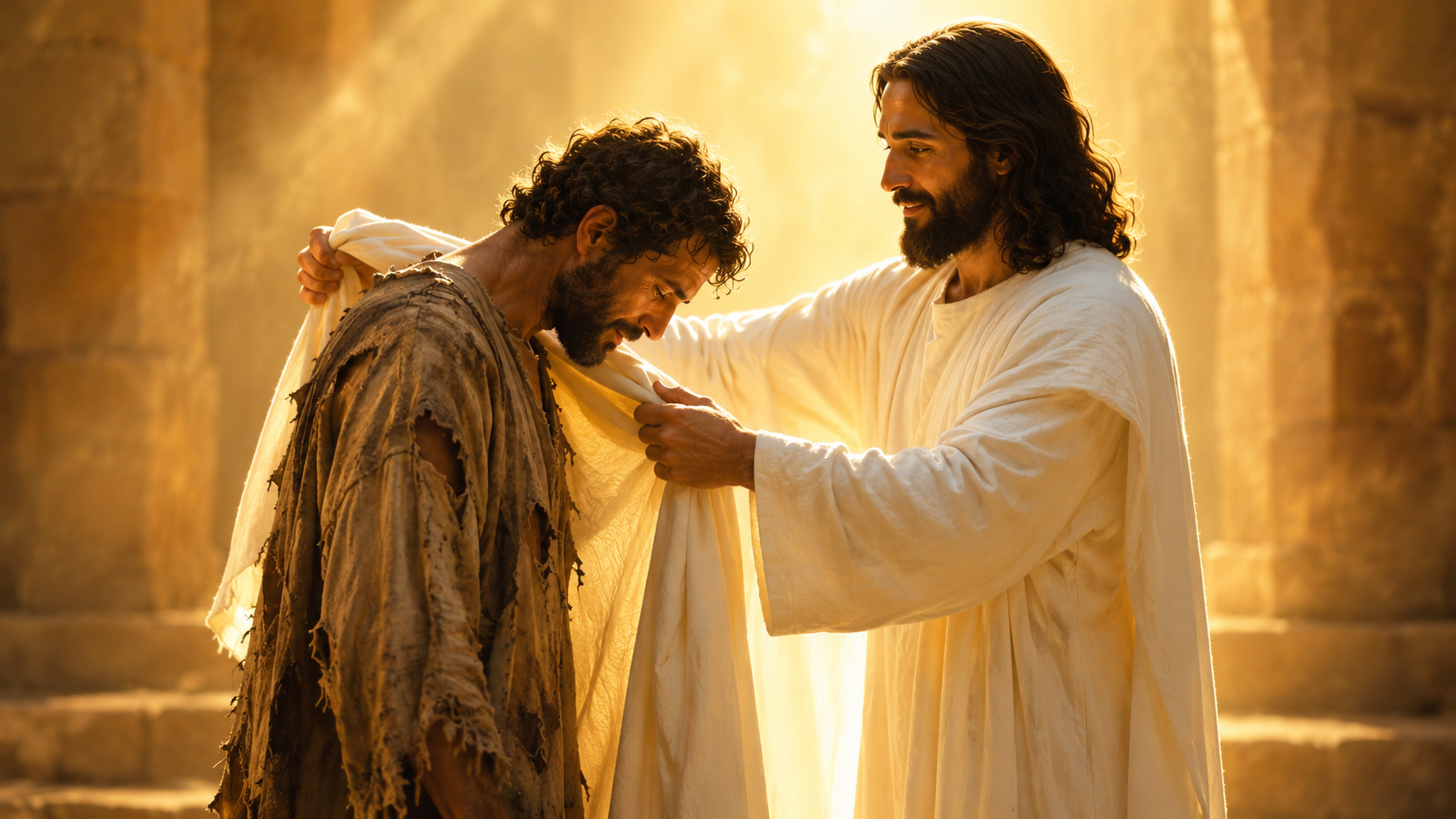


This is the lesson the whole course has been climbing toward. Every thread so far — sonship, the fall, the second Adam, the new birth — gathers here, at the single question on which the gospel stands or falls: how can a guilty sinner be right with a holy God? The Reformation was fought over one small word in the answer. Get it right and you have peace; smuggle in the wrong word and the gospel quietly collapses back into a religion of merit. The answer of Scripture is bracing in its simplicity: by faith alone.
Question 01
What does it mean to be “justified”?
Answer
It is a courtroom word. To justify is not to make a person good; it is for the judge to declare the accused righteous — acquitted, cleared, the case dismissed. That is what makes the gospel almost too good to believe, because of whom God justifies:
But to him that worketh not, but believeth on him that justifieth the ungodly, his faith is counted for righteousness.
Read that twice. God justifieth the ungodly — not the reformed, not the deserving, but the ungodly who simply believe. And it is a free verdict, handed down on the basis of what Another has done:
Being justified freely by his grace through the redemption that is in Christ Jesus.
Question 02
On what basis — works, or faith?
Answer
Paul will not let the question stay vague. He states it as flatly as language allows: the verdict comes by faith, and explicitly not by the works of the law:
Therefore we conclude that a man is justified by faith without the deeds of the law.
…a man is not justified by the works of the law, but by the faith of Jesus Christ… for by the works of the law shall no flesh be justified.
And to seal off every back door — every suspicion that we contribute even a little — he names the reason God built it this way: so that no one, ever, could boast:
For by grace are ye saved through faith; and that not of yourselves: it is the gift of God: not of works, lest any man should boast.
Question 03
What can the law do — and what can it not do?
Answer
The law is holy, and it does its work well — but its work is diagnosis, not cure. It shows you the disease; it cannot heal it:
Therefore by the deeds of the law there shall no flesh be justified in his sight: for by the law is the knowledge of sin.
…Nay, I had not known sin, but by the law: for I had not known lust, except the law had said, Thou shalt not covet.
Think of the law as a mirror. A mirror is wonderful for showing you the dirt on your face — and utterly useless for washing it off. No one tries to clean himself by rubbing his cheek against the glass. The mirror sends you to the water. So the law, having shown you your guilt, can do nothing further; it can only point you to Christ. Far from being a weakness, this is the law’s glory:
The law, being “holy, and just, and good,” cannot justify a sinner… A law that would justify a wicked man would be a wicked law. The law should not be reviled because it cannot justify sinners. On the contrary, it should be extolled on that account.
Question 04
Whose righteousness clothes the believer?
Answer
Not your own — that is the whole point. The righteousness that saves is imputed: credited to your account, reckoned to you as a gift, exactly as it was to Abraham:
…Abraham believed God, and it was counted unto him for righteousness… even as David also describeth the blessedness of the man, unto whom God imputeth righteousness without works.
Paul wants nothing to do with a homemade righteousness; he counts it loss for the sake of one that comes only from Christ, received through faith:
And be found in him, not having mine own righteousness, which is of the law, but that which is through the faith of Christ, the righteousness which is of God by faith.
This is the prophet’s ancient name for the Messiah — not a righteousness we generate, but a righteousness that is the Lord, given to His people:
…and this is his name whereby he shall be called, THE LORD OUR RIGHTEOUSNESS.
Since the sinner has none of his own and cannot produce any, there is only one way righteousness can ever reach him — as an outright gift:
Since the best efforts of a sinful man have not the least effect toward producing righteousness, it is evident that the only way it can come to him is as a gift.
Question 05
The fatal little word “and”
Answer
Here is where the gospel is most often lost — not by denying Christ, but by adding to Him. The Galatians did not abandon faith; they kept it and slipped in one small word: faith and. Paul is so alarmed he nearly shouts:
O foolish Galatians, who hath bewitched you… Are ye so foolish? having begun in the Spirit, are ye now made perfect by the flesh?
That is the whole error in a sentence: begun in the Spirit, perfected by the flesh. Start by grace, finish by effort. And Paul does not call it a minor imbalance — he calls it a fall from grace altogether:
Christ is become of no effect unto you, whosoever of you are justified by the law; ye are fallen from grace.
The tragedy, Paul says of his own people, is sincere and zealous — and still fatal: trying to build a righteousness of their own rather than submit to God’s:
For they being ignorant of God’s righteousness, and going about to establish their own righteousness, have not submitted themselves unto the righteousness of God.
“Faith alone” is not faith plus a little; the moment you add the word and, you have changed the gospel into a wage system — and a wage cannot be a gift.
Question 06
If it is by faith alone, does obedience not matter?
Answer
It matters enormously — but as fruit, not root. The instant grace is preached, someone asks whether it gives a license to sin. Paul’s reply is the strongest negative in his vocabulary:
What shall we say then? Shall we continue in sin, that grace may abound? God forbid. How shall we, that are dead to sin, live any longer therein?
James presses the same truth from the other side: a faith that produces nothing is not real faith at all. Works are the evidence that faith is alive — the way a pulse is evidence of life, never its cause:
Even so faith, if it hath not works, is dead, being alone… For as the body without the spirit is dead, so faith without works is dead also.
Hold the order with both hands. We are not saved by good works; we are saved unto them — created in Christ for a life of obedience that flows out of salvation already given:
For we are his workmanship, created in Christ Jesus unto good works, which God hath before ordained that we should walk in them.
…but faith which worketh by love.
So the faith that justifies is never idle — it works, and it works by love. But the working is the fruit hanging on the tree, never the root that makes the tree alive. Reverse that order and you lose the gospel; keep it, and obedience becomes the joy it was always meant to be.
Question 07
What is saving faith, really?
Answer
Here we must be careful, because the human heart will try to turn faith itself into a work — a quality I muster, an achievement I can be proud of. But faith is not a work; it is the empty hand that receives a gift. It has no value in itself; all its value is in the One it lays hold of. Saving faith is not believing hard enough — it is trusting a Person, the way Abraham trusted the God who had promised:
He staggered not at the promise of God through unbelief; but was strong in faith, giving glory to God; and being fully persuaded that, what he had promised, he was able also to perform.
Notice that Abraham’s faith gave glory to God, not to Abraham. That is the nature of faith: it empties the believer of all boasting and rests the whole weight of the soul on Christ. Faith does not earn the righteousness; it simply takes the hand that is already held out.
Question 08
Justification and sanctification — how are they related?
Answer
Distinct, but inseparable — like a birth and a life. Get them confused and you ruin both; keep them in order and the whole gospel breathes. Justification is the verdict: in a single moment God declares the believing sinner righteous, the righteousness of Christ imputed — credited from outside. Sanctification is the lifelong growth: the righteousness of Christ imparted — worked out within, day after day, by His Spirit. The first is instant and complete; the second is gradual and ongoing. Both come by faith; neither one is earned:
If you give yourself to Him, and accept Him as your Saviour, then, sinful as your life may have been, for His sake you are accounted righteous. Christ’s character stands in place of your character, and you are accepted before God just as if you had not sinned.
That is justification — accepted just as if you had not sinned, not because of any goodness in you, but because Christ’s character stands in place of yours. And the imparted work that follows is named alongside it, kept carefully distinct yet never separated:
Our only ground of hope is in the righteousness of Christ imputed to us, and in that wrought by His Spirit working in and through us.
Scripture binds the two into one Christ, so we can never play them off against each other: He is made unto us both at once — righteousness for the verdict, and sanctification for the life:
But of him are ye in Christ Jesus, who of God is made unto us wisdom, and righteousness, and sanctification, and redemption.
Personal response
Search your heart for the little word and. Somewhere in most of us hides the quiet conviction that God accepts us because of faith and our progress, faith and our sincerity, faith and how well the week went. That word is the thief of all peace. Today, take your hands off your own righteousness — even your best religious righteousness — and receive His as the pure gift it is. Pray something like this, in your own words:
Father, I have been trying to bring You a righteousness of my own, and it is filthy rags. I stop. I lay down the word “and.” I trust Your Son alone — His life lived for me, His death died for me — and I receive the righteousness I could never earn. Let Christ’s character stand in place of mine, and account me righteous for His sake. Now work that life out in me by Your Spirit, until what You have declared is what I have become. Amen.
If justification is a finished verdict, an obvious question follows — and it is the most pastoral one of all. Can I actually know I am saved? Or must I live forever unsure, waiting to see whether my obedience holds up? Lesson 6 turns from the courtroom to the heart, to the peace and assurance that flow from being justified by faith — and to the right place of God’s holy law in the life of a soul that is already accepted.
Foundational text
“For by grace are ye saved through faith; and that not of yourselves: it is the gift of God: not of works, lest any man should boast.”
— Ephesians 2:8–9