Most religion is in the repair business — it takes the old life and tries to fix it: bad habits filed down, good habits bolted on, the whole thing buffed until it looks presentable to God. The gospel is not in that business. It does not patch the old man; it buries him and raises a new one. Salvation, Scripture insists, is a birth — and a birth puts you into a new family, with a new Head, a new nature, and a new life that was never yours to manufacture. This lesson is about what it means to be in Christ.
Question 01
What must happen for you to enter the kingdom?
Answer
A ruler of the Jews came to Jesus by night — moral, learned, sincere, the very model of a religious man trying hard. And Jesus did not tell him to try harder. He told him he had to start over, from the ground up:
Jesus answered and said unto him, Verily, verily, I say unto thee, Except a man be born again, he cannot see the kingdom of God… Except a man be born of water and of the Spirit, he cannot enter into the kingdom of God. That which is born of the flesh is flesh; and that which is born of the Spirit is spirit. Marvel not that I said unto thee, Ye must be born again.
Notice He does not say you must do better; He says ye must be born again. There is no amount of reform that turns a caterpillar into an eagle — you would have to be born a different creature. That is exactly the point. The kingdom is not entered by the improvement of the old life but by the receiving of a new one.
Question 02
What does Scripture call a person who is “in Christ”?
Answer
Paul reaches for the strongest word he has. Not improved, not reformed — a new creature, with an entire world made over:
Therefore if any man be in Christ, he is a new creature: old things are passed away; behold, all things are become new.
The word he uses is the same word for the original creation — the act of Genesis 1 happening again, this time inside a soul. And he ties it all to a location: in Christ. To be in Christ is to stand on new ground, to have a new origin. The forgiveness God grants is not a fresh coat of paint on the old house; it is the laying of a new foundation:
It actually clears him from guilt; and if he is cleared from guilt, is justified, made righteous, he has certainly undergone a radical change. He is, indeed, another person… And so the full and free forgiveness of sins carries with it that wonderful and miraculous change known as the new birth; for a man cannot become a new creature except by a new birth.
Question 03
How do you get “into” Christ — and what becomes of the old self?
Answer
Paul’s answer is startling. You are united to Christ at the deepest possible point: His death. To come into Christ is to be joined to Him in the grave, so that the person you were is left behind in it:
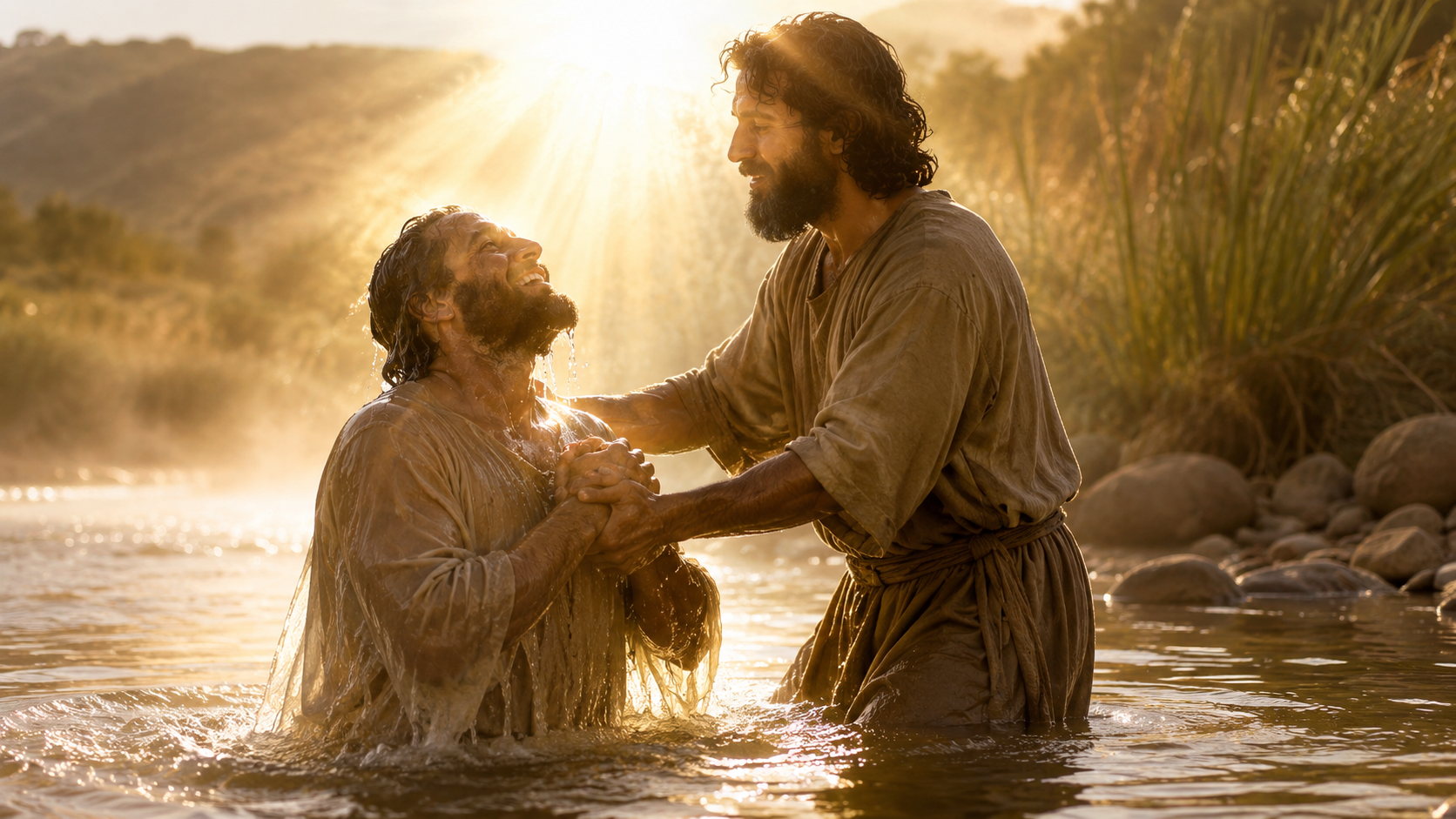
Know ye not, that so many of us as were baptized into Jesus Christ were baptized into his death? Therefore we are buried with him by baptism into death: that like as Christ was raised up from the dead by the glory of the Father, even so we also should walk in newness of life… Knowing this, that our old man is crucified with him, that the body of sin might be destroyed, that henceforth we should not serve sin.
The old man is not rehabilitated — he is crucified. You do not negotiate with him or send him to correction; you bury him and walk out of the tomb a new person. Paul says it about himself in the first person, and means every word of it:
I am crucified with Christ: nevertheless I live; yet not I, but Christ liveth in me…
Question 04
Two Adams, two races — which family am I in?
Answer
Behind every human being stand two men, and you belong to one of them by birth. From the first Adam you inherited a fallen nature and a death sentence you never signed. From the second Adam — Christ — comes the opposite inheritance, life and righteousness, given on the same principle: not earned, but received by belonging:
For if by one man’s offence death reigned by one; much more they which receive abundance of grace and of the gift of righteousness shall reign in life by one, Jesus Christ… For as by one man’s disobedience many were made sinners, so by the obedience of one shall many be made righteous.
You were never asked to consent to Adam’s ruin; it came to you by birth. And the cure comes the same way — by a second birth into a second family. The question is no longer how good am I? but whose am I? Two heads, two races, two natures — and you bear the image of the one whose life you carry:
As is the earthy, such are they also that are earthy: and as is the heavenly, such are they also that are heavenly. And as we have borne the image of the earthy, we shall also bear the image of the heavenly.
Question 05
If I’m a new creature, why do I still struggle?
Answer
Because a birth is the beginning of a life, not the end of one. A newborn child is fully and truly alive — and still has all his growing to do. The new birth is real and complete the moment it happens; the growth that follows is real too, and it takes a lifetime. The Christian lives in that “already, but not yet,” and the comfort is that the One who started the work has promised to finish it:
Being confident of this very thing, that he which hath begun a good work in you will perform it until the day of Jesus Christ.
Your struggle is not evidence that the birth did not happen; a corpse does not struggle. The very fact that sin now grieves you, that you fight it and long to be free of it, is the cry of the new life that was not there before. Do not measure the reality of your new birth by how far you have come — measure it by Whose you are, and trust Him to perform what He began.
Question 06
Is the new life my achievement, or His life in me?
Answer
This is the hinge that keeps the new birth from quietly turning back into legalism. The new life is not a better version of you that you worked up; it is Christ Himself living His life through you. Paul finishes the sentence we began earlier:
…I live; yet not I, but Christ liveth in me: and the life which I now live in the flesh I live by the faith of the Son of God, who loved me, and gave himself for me.
…Christ in you, the hope of glory.
And lest we imagine we can borrow His life and then run it on our own steam, Jesus pulls up that idea at the root with a vine and its branches:
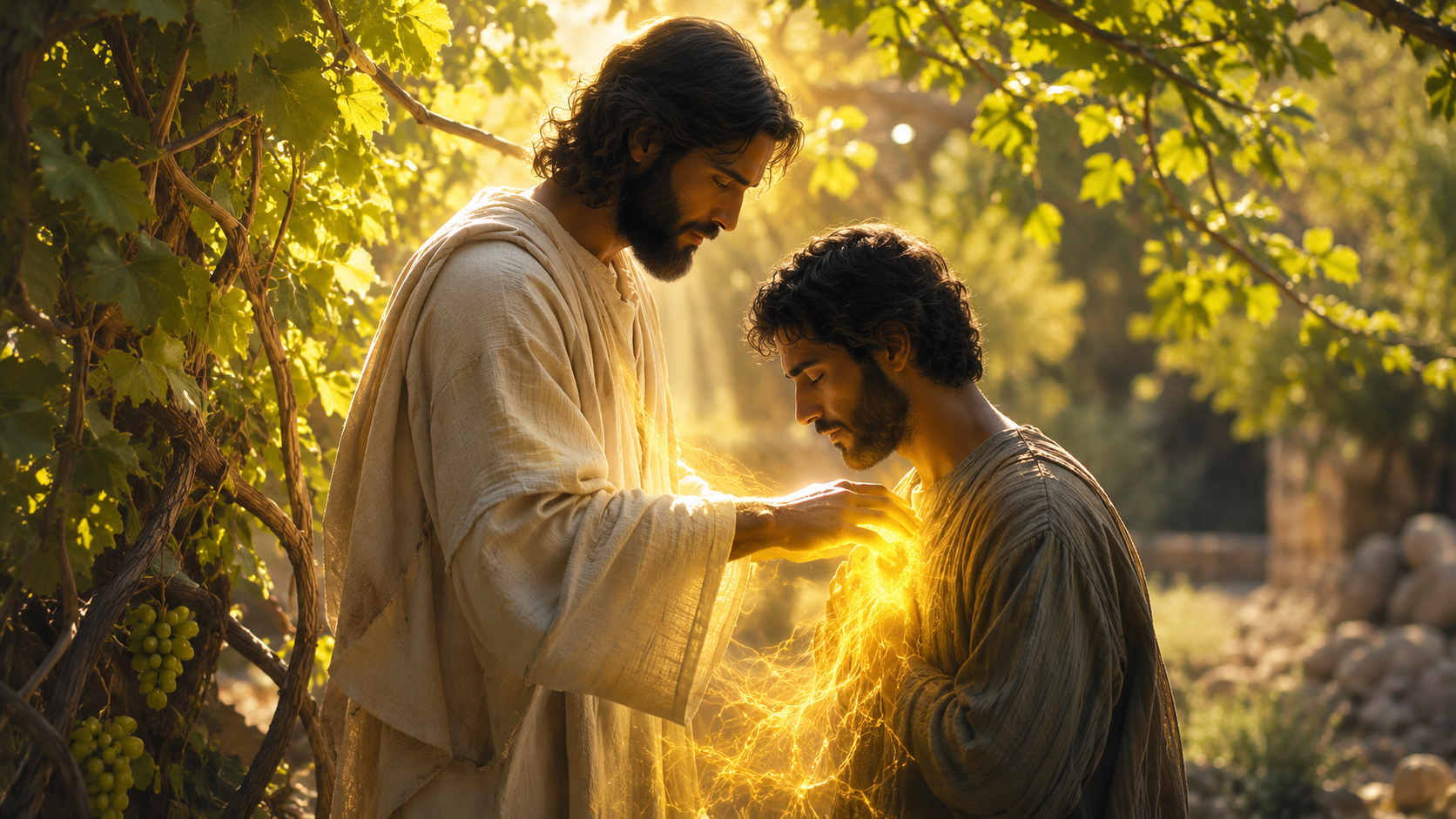
Abide in me, and I in you. As the branch cannot bear fruit of itself, except it abide in the vine; no more can ye, except ye abide in me. I am the vine, ye are the branches… for without me ye can do nothing.
A branch does not strain to produce grapes; it stays joined to the vine, and fruit comes. The whole secret of the Christian life is not effort applied to the old nature but union with the living Christ. He does not adopt the already-good and reward them; He adopts the unworthy in order to make them His own:
God does not adopt us as His children because we are good, but in order that He may make us good.
Question 07
What is the evidence of the new birth?
Answer
If the life is real, it shows — not as the cause of the new birth, but as its fruit. And the first, surest mark is not a list of things avoided but a love that was not there before:
But the fruit of the Spirit is love, joy, peace, longsuffering, gentleness, goodness, faith, meekness, temperance: against such there is no law.
We know that we have passed from death unto life, because we love the brethren…
Read John’s logic carefully: love is how we know we have passed from death to life — it is the evidence, the symptom, the proof — never the price we paid to cross over. Fruit hangs on a tree because the tree is alive; it does not make the tree alive. Keep that order and you will never again confuse the proof of salvation with its purchase. And here is where we are also reminded that this new standing was never something we attained our way into:
This shows that there is no ground for the idea that a person must go through a sort of probation, and attain to a certain degree of holiness, before God will accept him as His child. He receives us just as we are.
Personal response
Stop, for a moment, trying to renovate the old man. He is not the building God intends to save — He means to give you a new one. The gospel is not become better and God will receive you; it is receive Christ and be made new. If you have been exhausting yourself improving a self that Scripture says belongs in the grave, the invitation today is to die and be raised — to let go of the old life and receive His. Pray something like this, in your own words:
Father, I am tired of repairing a life I cannot fix. I let the old self go to the cross where it belongs, and I ask You to raise me up new in Your Son. Christ, live Your life in me; let me abide in You as a branch in the vine, and bear the fruit that only Your life can bear. Make me Yours — not because I am good, but so that You may make me good. Amen.
Yet a question remains, and it is the very heart of this course. If I am a new creature, joined to Christ — on what exact basis does a holy God declare a sinner like me righteous? Is it because the new birth has finally made me good enough? Lesson 5 takes us into the courtroom of heaven to answer it without flinching: how a sinner is justified by faith alone, clothed in a righteousness that is not his own.
Foundational text
“Therefore if any man be in Christ, he is a new creature: old things are passed away; behold, all things are become new.”
— 2 Corinthians 5:17