
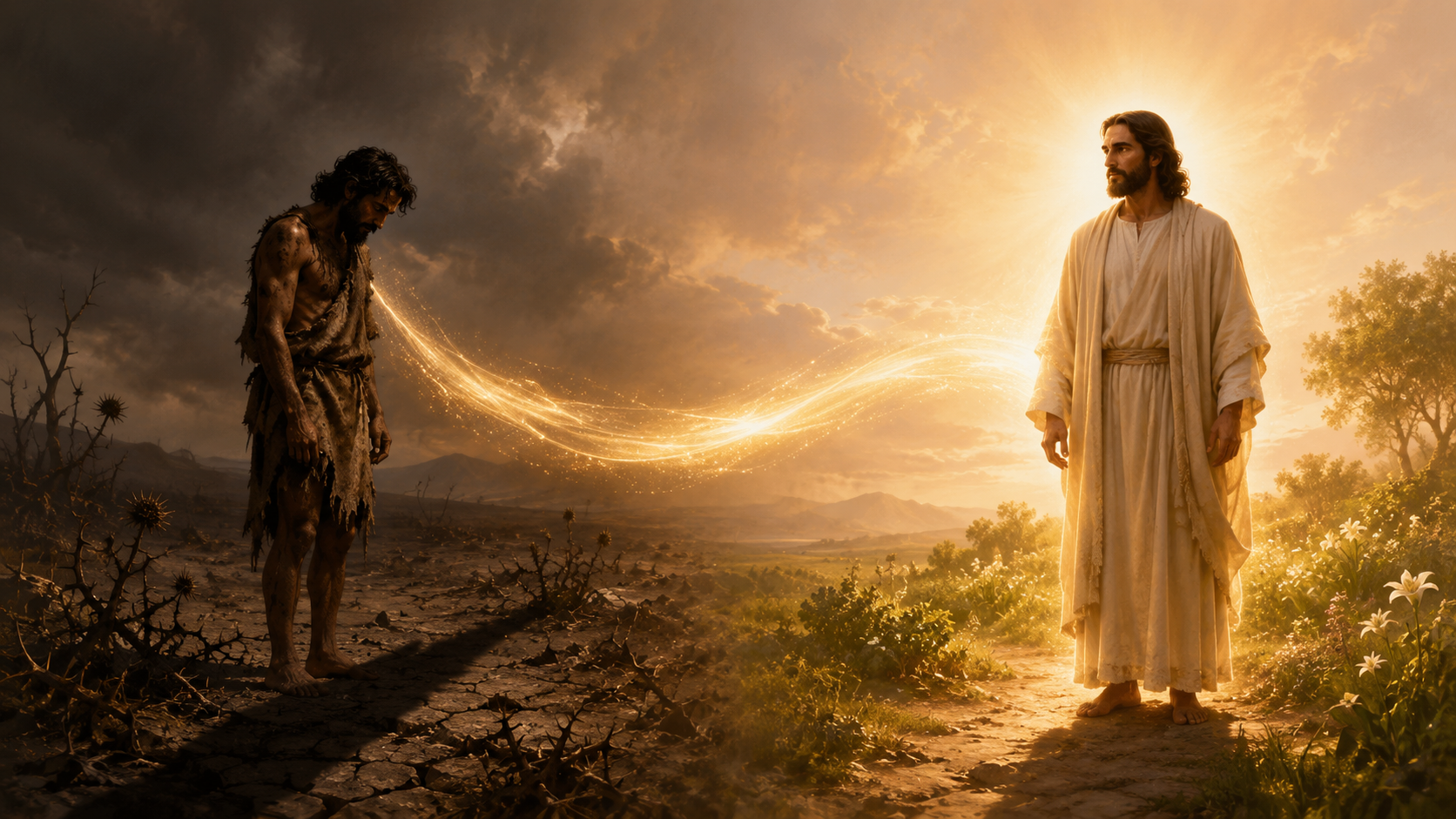
The first Adam pulled a whole race down with him. The good news of the gospel is that he is not the only head of humanity. Scripture sets a second Adam against the first — a new beginning for the human family, in a Man who entered our ruin to reverse it from the inside. At the center of His work stands a single, staggering exchange: He took what was ours so that we could receive what was His. And that exchange is not only a legal payment in a courtroom; it is the moment the heart of God is unveiled before the whole watching universe. This lesson holds both together — the price He paid, and the love He revealed.
Question 01
Who is the “second Adam,” and why does it matter?
Answer
Paul reads all of human history through two representative men. Each is a head — a fountainhead — and what flows from him flows to everyone joined to him. From the first Adam came sin, condemnation, and death; from the second comes righteousness and life:
For if by one man’s offence death reigned by one; much more they which receive abundance of grace and of the gift of righteousness shall reign in life by one, Jesus Christ… For as by one man’s disobedience many were made sinners, so by the obedience of one shall many be made righteous.
The symmetry is deliberate. What the first man lost, the second Man regains — not for Himself only, but for all who belong to Him:
For as in Adam all die, even so in Christ shall all be made alive.
And so it is written, The first man Adam was made a living soul; the last Adam was made a quickening spirit.
This is the architecture of salvation. We are not saved one isolated rescue at a time; we are saved by being transferred out of one humanity and into another — out of the dying race of the first Adam and into the living race of the last. Everything else in this lesson is about how He made that possible.
Question 02
Why must the second Adam be truly human?
Answer
Because He came to redeem humanity from the inside, He had to stand where we stand. A rescuer who never entered the wreckage could not lift us out of it. So the Son took our very flesh and blood:
Forasmuch then as the children are partakers of flesh and blood, he also himself likewise took part of the same; that through death he might destroy him that had the power of death, that is, the devil… Wherefore in all things it behoved him to be made like unto his brethren, that he might be a merciful and faithful high priest in things pertaining to God, to make reconciliation for the sins of the people.
He did not come dressed in Adam’s unfallen vigor, untouched by the long ruin of sin. He came into our weakened, fallen flesh — the actual flesh of the fallen race He came to save:
For what the law could not do, in that it was weak through the flesh, God sending his own Son in the likeness of sinful flesh, and for sin, condemned sin in the flesh.
And here we hold a precise conviction, two truths kept distinct. The flesh He took was ours — fallen, tempted, worn by four thousand years of sin. But within there was no answering pull toward evil, no inclination to sin, not for a moment. He was tempted at every point, as really as we are, and never once yielded:
For we have not an high priest which cannot be touched with the feeling of our infirmities; but was in all points tempted like as we are, yet without sin.
So He was near enough to be our true brother and our merciful High Priest, yet pure enough to be our spotless substitute. This is not the old Adam slightly improved; it is a new and sinless Man, standing in our flesh, fit to do for us what we could never do for ourselves.
Question 03
What is “the great exchange”?
Answer
It is the heart of the whole gospel, and Paul states it in a single, breathtaking sentence. The sinless One was made to stand in the sinner’s place, so that sinners could stand in His:
For he hath made him to be sin for us, who knew no sin; that we might be made the righteousness of God in him.
Isaiah saw it centuries before the cross — the punishment falling on Him so that the peace could fall on us:
But he was wounded for our transgressions, he was bruised for our iniquities: the chastisement of our peace was upon him; and with his stripes we are healed. All we like sheep have gone astray; we have turned every one to his own way; and the LORD hath laid on him the iniquity of us all.
Christ was treated as we deserve, that we might be treated as He deserves. He was condemned for our sins, in which He had no share, that we might be justified by His righteousness, in which we had no share. He suffered the death which was ours, that we might receive the life which was His.
Read that exchange in both directions and you have the gospel entire. He took our sin, our condemnation, our death; He gives us His righteousness, His acceptance, His life. Nothing is split halfway. It is a complete trade — our worst for His best.
Question 04
Did He really bear the penalty for sin?
Answer
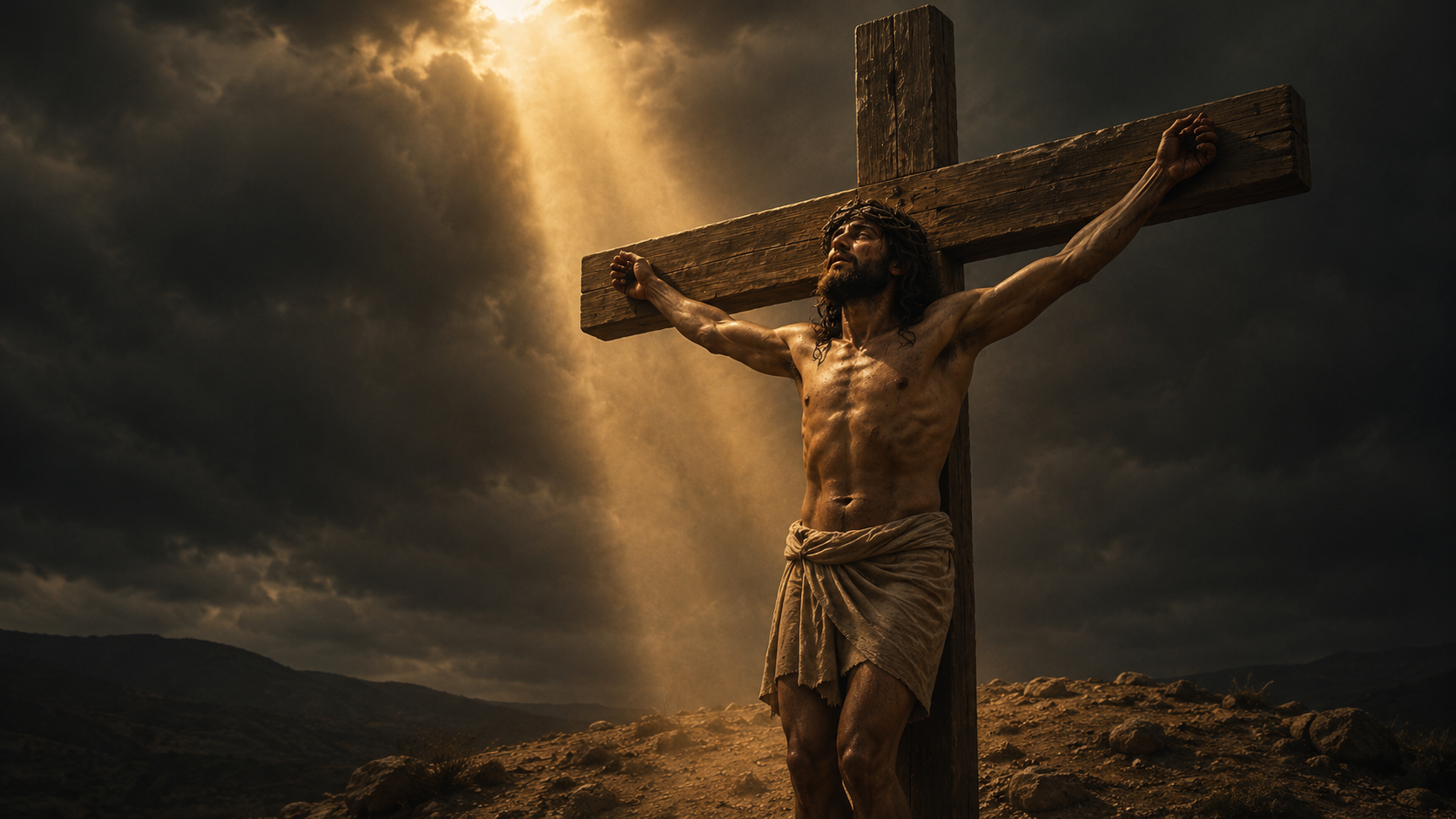
Yes — plainly, and we will not soften it. The wages of sin is death, and the second Adam paid those wages in our place. The curse our sin had earned fell upon Him:
Christ hath redeemed us from the curse of the law, being made a curse for us: for it is written, Cursed is every one that hangeth on a tree.
He did not merely sympathize with our plight or model a better way; He bore in His own Person the very penalty that was due to us. This is substitution in the fullest sense — the innocent standing under the sentence of the guilty, so that the guilty could go free:
But God commendeth his love toward us, in that, while we were yet sinners, Christ died for us.
Mark when He did it: while we were yet sinners — before we reformed, before we deserved it, while we were still His enemies. The penalty was real, and the love that paid it was real. That is penal substitution, and it is not a harsh idea bolted onto a gentle gospel. It is the gospel’s tenderest proof that God loved us at our worst.
Question 05
Was the cross only a legal payment, or did it reveal something?
Answer
It was a true legal payment — and far more. The cross is the great turning point in a controversy older than our world: Satan’s ancient charge that God is a tyrant, that His government is unjust, that no one could serve Him from love. Calvary answered every accusation at once. On the cross the justice of God’s law was upheld to the full, and the love of God’s heart was poured out without measure — and the lie at the root of all rebellion was exposed for what it is:
Through Christ’s redeeming work the government of God stands justified. The Omnipotent One is made known as the God of love. Satan’s charges are refuted, and his character unveiled.
This is why we hold the atonement together and never let it split. It is not either a penalty paid or a character revealed; it is both, in one act. The same cross that satisfies justice unveils love. Christ bore our penalty and, in bearing it, He vindicated God’s government and unmasked the enemy before the whole watching universe. The legal and the relational are not rivals at Calvary. They embrace.
Question 06
What does the exchange cost me — and give me?
Answer
That is the wonder of it: it costs you nothing you could ever have paid, and gives you everything you could never have earned. It cost Him everything; it costs you only the empty hands of faith that receive it. Waggoner names the transaction for what it is — the most lopsided trade in the universe, all in the sinner’s favor:
God … puts His own righteousness on the sinner who believes in Jesus, as a substitute for his sins. Surely, this is a profitable exchange for the sinner, and it is no loss to God, for He is infinite in holiness, and the supply can never be diminished.
A profitable exchange for the sinner. You hand over your sin; He hands you His righteousness — and His holiness is so infinite the supply is never diminished by giving. But notice the one indispensable word: believes. This righteousness is not produced by your effort and not added to your résumé; it is laid upon the one who simply trusts Jesus. It is received by faith alone. Your part is not to manufacture it but to take it.
Question 07
By whose obedience are we made righteous?
Answer
Not by ours. Paul has already told us, and the answer is the foundation of everything that follows in this course:
For as by one man’s disobedience many were made sinners, so by the obedience of one shall many be made righteous.
Read it exactly as it stands. We were made sinners by Adam’s disobedience, not first by our own deeds; and we are made righteous by Christ’s obedience, not first by ours. Our own obedience has its place — a vital one — but it is the fruit of being joined to the second Adam, never the ground of it. We do not obey in order to become righteous; we are made righteous in Him, and obedience grows out of that new life like fruit from a living branch. And that is exactly where the next lesson goes: if righteousness comes by belonging to the second Adam, then the great question becomes how we are joined to Him — how a child of the first Adam is born into the new race of the second. That union, and the new birth that brings it, is Lesson 4.
Personal response
Stop for a moment under the weight of the exchange. Everything that was rightly against you fell on Him; everything that is His is freely offered to you. There is nothing left for you to add — only a gift to receive with open hands. If you have been trying to earn a standing with God that He already purchased at the cross, lay the effort down. Look at the One who was treated as you deserve, that you might be treated as He deserves, and simply trust Him. Pray something like this, in your own words:
Lord Jesus, You were made sin, who knew no sin, so that I might be made the righteousness of God in You. You bore my curse and my death; You unveiled the Father’s love and answered every charge against Him. I bring no righteousness of my own — I have none. I receive Yours by faith. Treat me as You deserve, for You were treated as I deserve. Amen.
We have seen the exchange that makes us righteous in Christ. The next lesson asks the question that exchange demands. How are we actually joined to the second Adam, so that what is His becomes ours? Lesson 4 turns to the new birth and the new race — how a child of fallen Adam is taken out of the dying family and made a living member of Christ’s own.
Foundational text
“For he hath made him to be sin for us, who knew no sin; that we might be made the righteousness of God in him.”
— 2 Corinthians 5:21