We were made for sonship and fellowship. So before the gospel can mean anything, we have to look honestly at what went wrong — and the surprising answer is that the first sin was not, at root, an act of the hands at all. It was a failure of trust. Adam did not merely break a rule; he believed a lie about his Father’s heart. From that broken trust came a broken nature and a reign of death that no amount of reform can reverse. This lesson refuses the comforting fiction that we are basically fine and only need to try harder. We do not need improvement. We need to be made new.
Question 01
What was the real temptation in Eden?
Answer
God gave Adam an immense freedom hedged by a single, loving boundary — a boundary that was really just an invitation to keep trusting Him:
And the LORD God commanded the man, saying, Of every tree of the garden thou mayest freely eat: But of the tree of the knowledge of good and evil, thou shalt not eat of it: for in the day that thou eatest thereof thou shalt surely die.
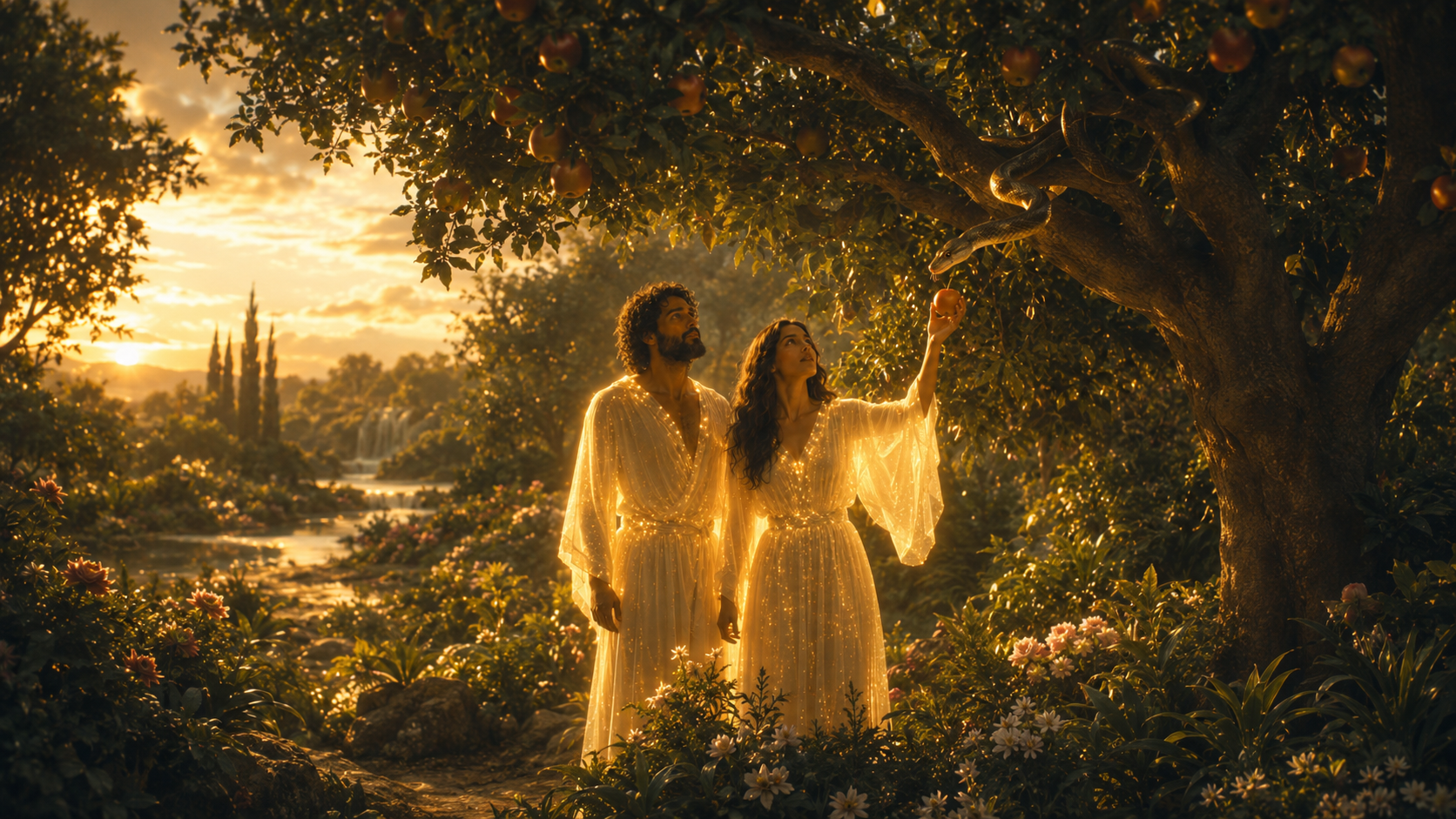
Notice that the serpent did not begin by urging Adam and Eve to do something. He began by getting them to doubt something — to question whether God had told them the truth, and whether God was keeping something good from them:
And the serpent said unto the woman, Ye shall not surely die: For God doth know that in the day ye eat thereof, then your eyes shall be opened, and ye shall be as gods, knowing good and evil.
Read it slowly and you can see the lie underneath the lie. “Ye shall not surely die” calls God a liar. “Ye shall be as gods” whispers that you can have life on your own terms, independent of the One who gave it. The fruit was only the symptom. The sin had already happened in the heart the moment they believed God could not be trusted. Sin, at its origin, is broken trust — a creature deciding to be his own god.
Question 02
What did the fall do to the relationship?
Answer
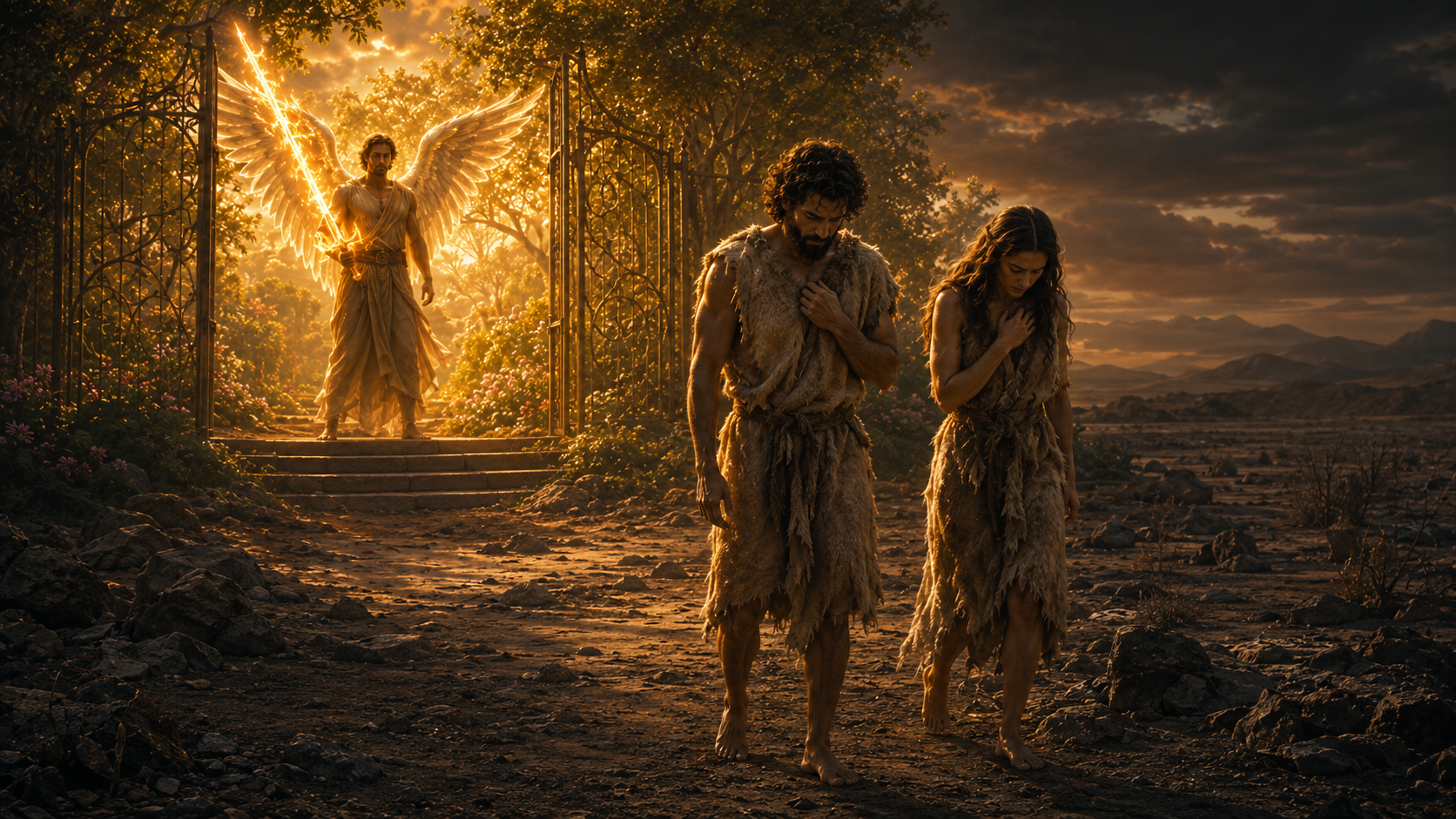
Everything in Lesson 1 hung on the relationship — a child made for open fellowship with his Father. The first casualty of sin was exactly that. The God they had walked with became the God they ran from:
And they heard the voice of the LORD God walking in the garden in the cool of the day: and Adam and his wife hid themselves from the presence of the LORD God amongst the trees of the garden. And the LORD God called unto Adam, and said unto him, Where art thou? And he said, I heard thy voice in the garden, and I was afraid, because I was naked; and I hid myself.
Where there had been love, now there was fear; where there had been nearness, now there was hiding. The wound was not in God — He still came walking, still called, still sought. The wound was in man, and it cut clean through the fellowship he was made for:
But your iniquities have separated between you and your God, and your sins have hid his face from you, that he will not hear.
Before the entrance of sin, Adam enjoyed open communion with his Maker; but since man separated himself from God by transgression, the human race has been cut off from this high privilege.
This is why the gospel can never be reduced to a tidied-up ledger. The problem is not first a list of offenses to be cancelled; it is a severed relationship to be restored. Whatever salvation turns out to be, it must put us back in the company of God.
Question 03
Is sin only wrong acts, or something deeper?
Answer
We instinctively think of sin as a tally of bad things done. Scripture digs far lower than that. Sin is not merely what we do; it is what we have become — a corruption woven into the nature itself, present before we are old enough to commit a single act:
Behold, I was shapen in iniquity; and in sin did my mother conceive me.
The heart is deceitful above all things, and desperately wicked: who can know it?
For I know that in me (that is, in my flesh,) dwelleth no good thing: for to will is present with me; but how to perform that which is good I find not.
That is a devastating diagnosis, and an honest one. The trouble is not on the surface; it is in the spring. And it means even our best moral efforts are tainted at the source, because they flow from a fallen nature we inherited and cannot escape:
Since evil is a part of man’s very nature, being inherited by each individual from a long line of sinful ancestors, it is very evident that whatever righteousness springs from him must be only like “filthy rags” (Isa. 64:6), compared with the spotless robe of the righteousness of God.
Hold this carefully, because it overturns the whole self-help reflex. If the problem were only my acts, better behavior could fix it. But the problem is my nature — and a fountain cannot purify its own water.
Question 04
How far did the damage spread?
Answer
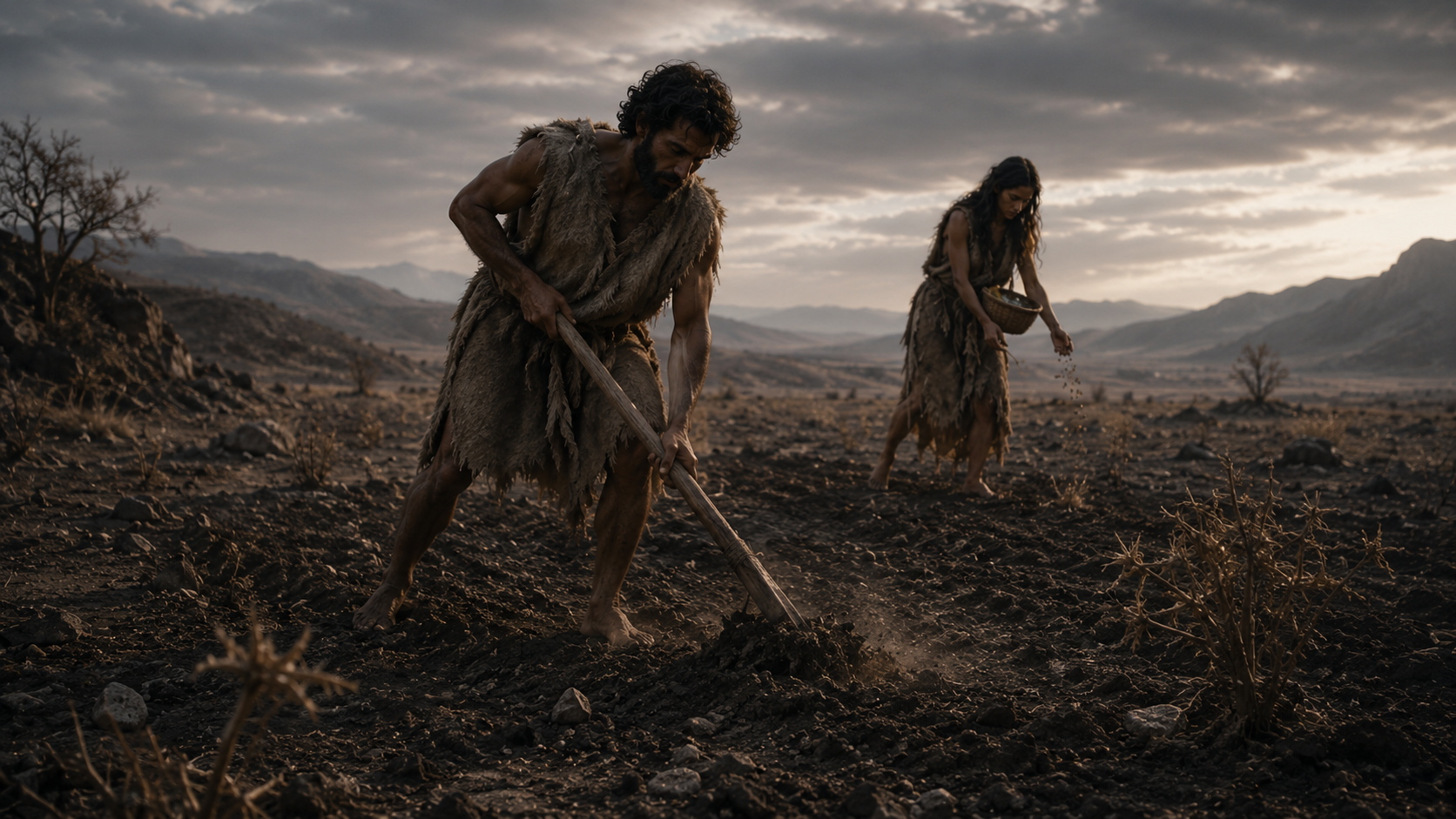
Not to Adam alone, and not to a corner of his life. Sin entered the human family like poison in the bloodline, and it carried with it a single, sweeping consequence — death — reigning over the whole race:
Wherefore, as by one man sin entered into the world, and death by sin; and so death passed upon all men, for that all have sinned.
For the wages of sin is death; but the gift of God is eternal life through Jesus Christ our Lord.
And the death Scripture means is not only the grave at the end. It names a present condition — a deadness toward God that we are born into, alive on the outside yet lifeless toward the One who made us:
And you hath he quickened, who were dead in trespasses and sins.
This is what Scripture calls the reign of death. Notice the verb — death reigns. It is not an occasional visitor but a ruling power over a fallen race. A people under that reign do not need a little coaching. They need to be raised.
Question 05
Can we reform our way back to God?
Answer
Every religion of human effort says yes — clean yourself up, climb back up, earn your way home. Scripture says it cannot be done, and it says so for a reason that no amount of sincerity can get around: the natural mind is not merely weak toward God; it is at war with Him:
Because the carnal mind is enmity against God: for it is not subject to the law of God, neither indeed can be. So then they that are in the flesh cannot please God.
“Neither indeed can be.” That is not a low score we might raise with practice; it is an impossibility built into the fallen nature itself. Jeremiah puts the same truth in an image we can feel:
Can the Ethiopian change his skin, or the leopard his spots? then may ye also do good, that are accustomed to do evil.
That is to say, a man cannot do good until he first becomes good. Therefore, deeds done by a sinful person have no effect whatever to make him righteous … He must first be made righteous before he can do the good that is required of him, and which he wants to do.
Read that twice: a man cannot do good until he first becomes good. Reform tries to produce a good tree by tying on better fruit. It has the whole order backwards.
Question 06
Why does “just try harder” always fail?
Answer
Because the problem is in the tree, not the fruit — and Jesus says so plainly. The kind of fruit a life bears is determined by the kind of life it is:
A good tree cannot bring forth evil fruit, neither can a corrupt tree bring forth good fruit.
A corrupt tree cannot bear good fruit. You may prune it, stake it, paint better-looking apples and wire them to the branches — but you have changed nothing at the root, and next season the tree is exactly what it was. This is the difference between reform and re-creation. Reform polishes the old nature. Re-creation gives a new one. Self-improvement labors to make the carnal mind behave; the gospel does something no effort can — it makes a new kind of person. What we need is not a better version of the old Adam. We need a new nature, a new birth, a new life altogether.
Question 07
So what do we actually need?
Answer
Not a self-help program but a Savior; not improvement but rescue. Paul carries the whole argument of this lesson to its honest end — and then, at the bottom of his despair, finds the one door out:
O wretched man that I am! who shall deliver me from the body of this death? I thank God through Jesus Christ our Lord…
Read the shape of it. The question is not what shall deliver me but who — because the answer was never a method, always a Person. The fall left us with a broken trust, a fallen nature, and a reign of death that human effort cannot touch. Which is precisely why the next lesson is good news: where the first Adam dragged a whole race down into ruin, a second Adam has come to stand in our place and to author a new humanity. The cure for what Adam broke is not us trying harder. It is Christ.
Personal response
This lesson asks something hard: to stop pretending. If you have spent years managing your behavior while quietly knowing the root never changed, the gospel begins exactly where you are — at the end of your own resources. You are not asked to fix yourself before God will have you. You are asked to admit that you cannot, and to look away from yourself to the Deliverer. Pray something like this, in your own words:
Father, I have tried to mend by effort what only You can re-create. I confess that the trouble runs deeper than my acts — it is in my nature, and I cannot change my own heart. I stop pretending I am whole. O wretched as I am, deliver me through Jesus Christ. Give me not a better version of the old life, but a new one. Amen.
With the ruin seen for what it is, the next lesson turns to the rescue. If the first Adam plunged the whole race into death, who can lift it out? Lesson 3 meets the Second Adam — the One who took our flesh, bore our penalty, and on the cross both paid what we owed and unveiled the very heart of God. Where Adam fell, He stood; what Adam lost, He won back.
Foundational text
“For the wages of sin is death; but the gift of God is eternal life through Jesus Christ our Lord.”
— Romans 6:23