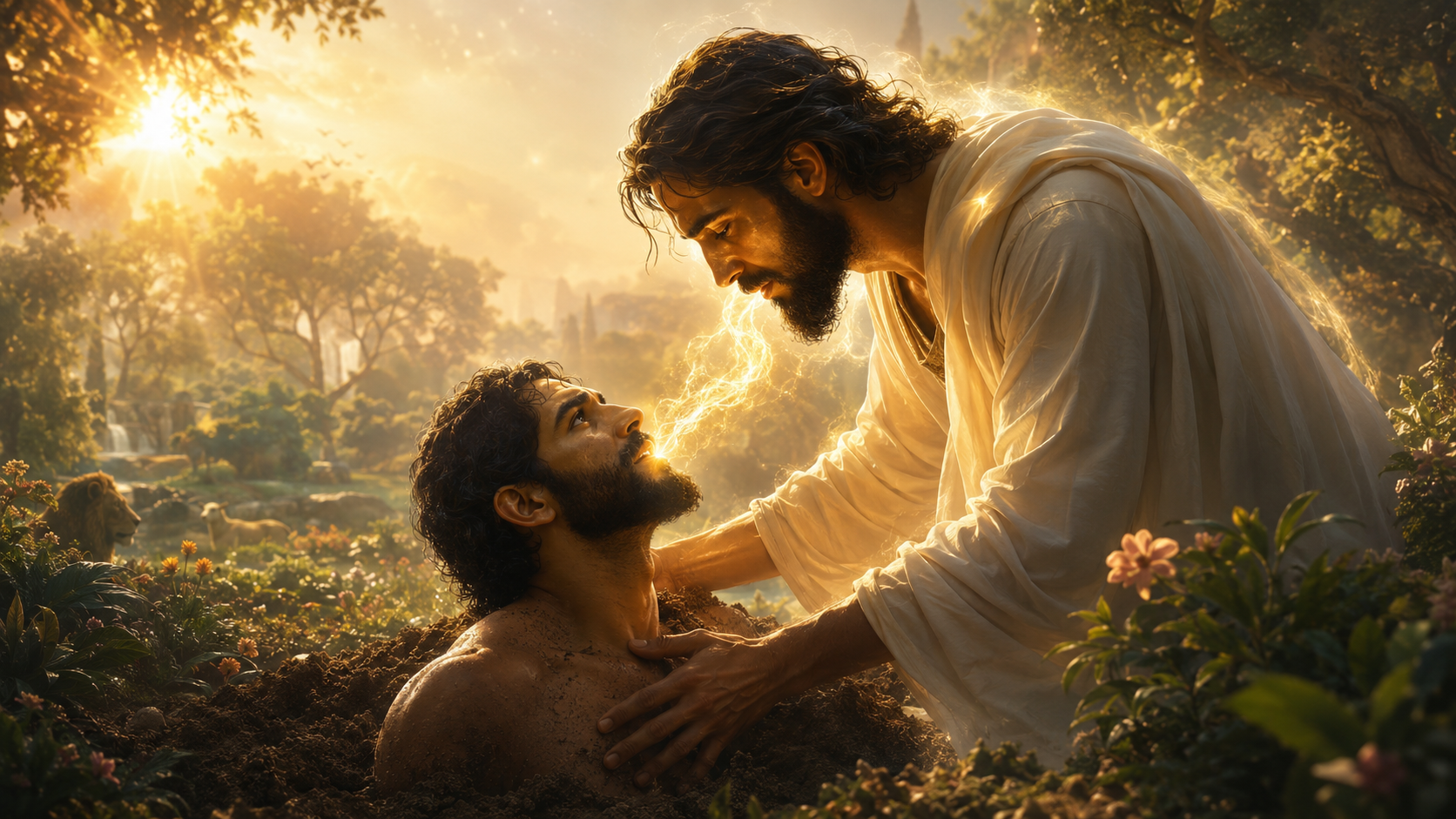
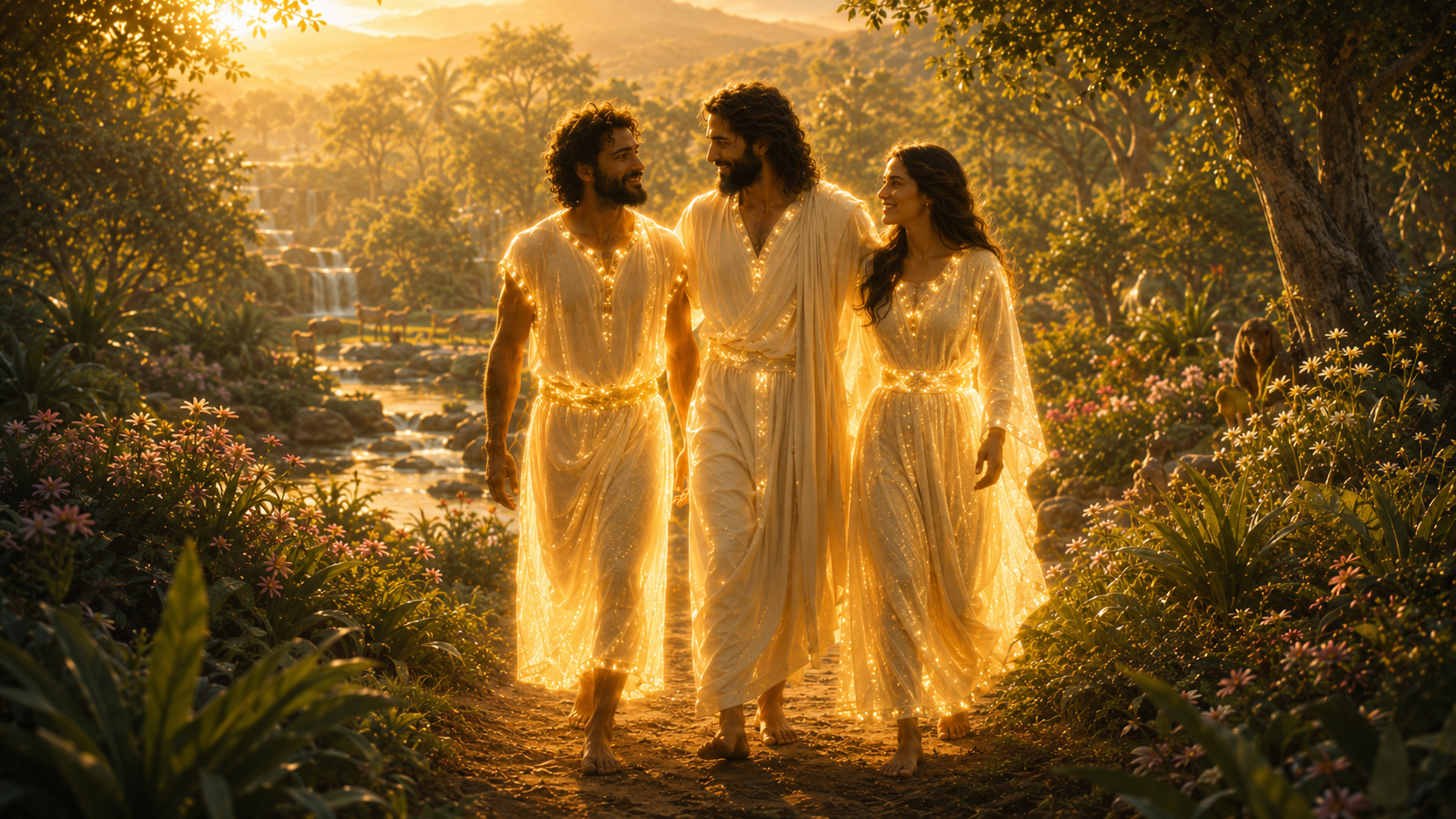
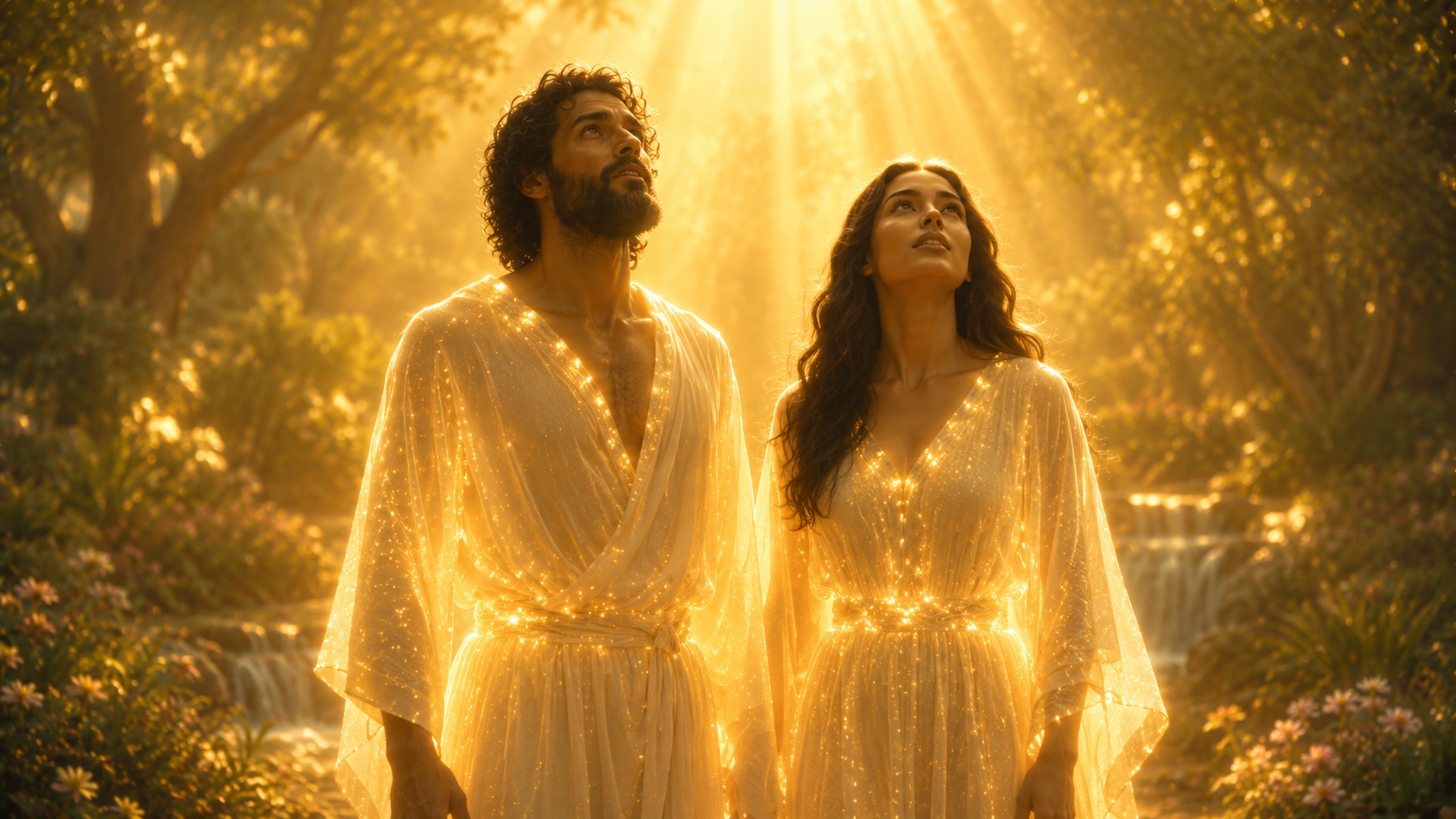
You cannot understand the cure until you understand what you were made for. Before this course speaks a word about justification, faith, or the law, it has to answer an older question — why do you exist at all? Get that wrong, and the gospel will always sound like a system for earning God’s approval. Get it right, and righteousness by faith turns out to be the most natural thing in the world: a Father restoring a child He made for Himself.
Question 01
Why did God create you?
Answer
Not by accident, and not as a tool. Scripture opens with deliberate, unhurried intent — a council of love deciding to make a creature like no other:
And God said, Let us make man in our image, after our likeness… So God created man in his own image, in the image of God created he him; male and female created he them.
Twice in one breath: in His image. You were made to resemble God — to carry His likeness into the world and reflect His character back to Him — and that resemblance was meant to deepen, not fade, across a whole unending life:
“God created man in His own image,” and it was His purpose that the longer man lived, the more fully he should reveal this image,—the more fully reflect the glory of the Creator.
Hold onto that word purpose. Your existence is not a riddle and not a mistake. You were made on purpose, for a purpose — to bear the image of the One who made you.
Question 02
What is the “image of God” in you?
Answer
It is both outward and inward — and the world has spent centuries trying to delete the first half. Begin with what Scripture plainly says, because it is more literal than most people have been taught. The very same “image and likeness” language Genesis uses of God and man, it uses again of a human father and his son:
And Adam lived an hundred and thirty years, and begat a son in his own likeness, after his image; and called his name Seth.
Seth bore Adam’s likeness and image — a son carries his father’s form and face. That is the identical word God uses of us: we were made in His image, after His likeness(Genesis 1:26). So God is not a vague force or a cosmic mood; He is a personal Being with a real form. Scripture speaks of His face, and tells us the reason we do not see Him now is not that there is nothing to behold, but that the unveiled glory would consume us:
And he said, Thou canst not see my face: for there shall no man see me, and live.
The Son is “the express image of his person” (Hebrews 1:3) and “the image of the invisible God” (Colossians 1:15); and in the resurrection our lowly body will be “fashioned like unto his glorious body” (Philippians 3:21). The pioneers held exactly this — that God is a true person with a form, the original our form was patterned after. Ellen White was shown it in vision:
I asked Jesus if His Father had a form like Himself. He said He had, but I could not behold it, for said He, “If you should once behold the glory of His person, you would cease to exist.”
So the human form itself is no accident of chemistry; it is shaped after God’s own. But the image is fuller still — it reaches inward. When God formed man He did for him what He did for no animal: He breathed into him directly.
And the LORD God formed man of the dust of the ground, and breathed into his nostrils the breath of life; and man became a living soul.
With that breath came the inner endowment to match the outward one: the power to reason, to choose, to love — a moral nature, a conscience, a will genuinely free, the capacity to know God and to answer Him back.
Every human being, created in the image of God, is endowed with a power akin to that of the Creator,—individuality, power to think and to do.
Body and soul, form and character, you were made to resemble your Maker. And notice what the inner half means for everything ahead: a creature with a free will cannot be programmed to love God. He has to be won. The whole drama of salvation — and the reason righteousness can never be forced or manufactured — is folded into the kind of being God chose to make you.
Question 03
Were you made to be God’s servant, or His child?
Answer
Both words appear in Scripture, but the order matters, and the world almost always gets it backwards. Before Adam was ever a servant, he was a son. Luke traces the human family back to its source and ends with a startling phrase:
…which was the son of Enos, which was the son of Seth, which was the son of Adam, which was the son of God.
Paul says the same to the philosophers of Athens — that we are not God’s property but His family:
For in him we live, and move, and have our being; as certain also of your own poets have said, For we are also his offspring. Forasmuch then as we are the offspring of God…
This sets the God of the Bible apart from the god of almost every other system. Much of the world is taught to reach toward a remote, unknowable power — a being “without parts,” so distant and so unlike us that no one would dare call Him Father. Scripture’s God is the opposite: near enough that in Him we live and move, personal enough to have a form we were patterned after, and Fatherly enough that He wants to be called Father. He is not far off, and He is not an abstraction. He is a Person, and He is ours.
This is the hinge of the whole course. If you were made to be a servant, then religion is a job, and acceptance is a wage you earn by good work. But if you were made to be a child, then acceptance comes first, as a gift of belonging, and the work flows out of the relationship — never the other way round. Every legalism on earth is, at bottom, a son trying to get hired by his own Father.
Question 04
Does God want your obedience first, or your love?
Answer
Ask Jesus which command comes first, and He does not name an action at all. He names an affection:
…Thou shalt love the Lord thy God with all thy heart, and with all thy soul, and with all thy mind. This is the first and great commandment.
The first and great commandment is not “do” but “love.” God designed you, at the root, for relationship — to love and be loved. Obedience was always meant to be the fruit of that love, the way a happy child gladly does his father’s will, not the price of admission to the family. Keep this straight and you will never again confuse the gospel with a performance review. We obey because we are loved and accepted, not in order to become accepted.
Question 05
If we were made for all this, why doesn’t the world feel like it?
Answer
Because something broke. The image was marred and the relationship was cut. We saw a moment ago that Seth was born in Adam’s likeness and image (Genesis 5:3) — but after the fall that was now a fallenlikeness, no longer the unspoiled image of Eden. A fallen father could only pass down a fallen nature. And the fellowship that had defined Eden was severed:
But your iniquities have separated between you and your God, and your sins have hid his face from you…
That is the wound the gospel comes to heal — and Lesson 2 will look at it honestly and without flinching. For now it is enough to see what was lost: the image, and the nearness. Salvation will be God restoring both.
Question 06
So what is salvation actually for?
Answer
Here is why beginning at creation changes everything. If sin is the ruin of the image and the breaking of the relationship, then salvation is not God grading our self-repair efforts. It is God re-creating in us what was lost — restoring the likeness and bringing the child back home:
And have put on the new man, which is renewed in knowledge after the image of him that created him.
But we all, with open face beholding as in a glass the glory of the Lord, are changed into the same image from glory to glory, even as by the Spirit of the Lord.
“Renewed… after the image of him that created him.” The gospel runs the ruin of Eden in reverse. Which means righteousness by faith is not a legal loophole bolted onto an unrelated religion — it is the restoration of the very thing you were made for. That is why it is good news and not merely a transaction.
Question 07
Who brings the lost children home?
Answer
Only a true Son can restore lost sons. And here Scripture sets the only-begotten Son apart from every creature — He is Son not by creation and not by adoption, but by His own nature:
It is true that there are many sons of God; but Christ is the “only begotten Son of God,” and therefore the Son of God in a sense in which no other being ever was or ever can be. The angels are sons of God, as was Adam… by creation; Christians are the sons of God by adoption…; but Christ is the Son of God by birth.
Because He is the true Son, He can do what no servant could: bring us back into the family He has belonged to from the beginning. What we lost as children of the first Adam, He restores to us as children of God — received, not earned:
But as many as received him, to them gave he power to become the sons of God, even to them that believe on his name.
…God sent forth his Son… to redeem them that were under the law, that we might receive the adoption of sons.
That is where this course is going. We were made to be God’s children; we fell and lost the likeness; and the only-begotten Son came to win us back and restore the image — by a righteousness He provides and we receive. Everything else is the unfolding of that one story.
Personal response
Before the doctrine, hear the invitation underneath it. You were not made to earn a Father’s love by performance; you were made for that love, to bear His likeness and walk in His company. If life has taught you to relate to God as a wary servant — always measuring, never sure — the gospel of this course is permission to come home. Pray something like this, in your own words:
Father, You made me in Your image and for Yourself, and I have lived far from that — as a stranger, or as a servant trying to earn what You only ever meant to give. Restore in me the likeness I lost. Teach me to come to You as a child, through Your only-begotten Son, and to receive the righteousness I could never produce. Amen.
With our purpose in view, the next lesson turns to face what went wrong. What did the fall actually break — and why can no amount of human effort mend it? Lesson 2 looks honestly at sin as a broken relationship and a fallen nature, and at the reign of death that followed — the ruin that makes a Savior not a luxury but a necessity.
Foundational text
“So God created man in his own image, in the image of God created he him; male and female created he them.”
— Genesis 1:27