
This is the lesson on which the whole course turns. Everything we will later say about the Son and the Spirit must fit through the door we open here, so it is worth opening it carefully. The Bible is emphatically a book of one God — and yet it just as plainly calls both the Father and the Son God. The key that holds those two facts together without contradiction is a single, often-overlooked definition: when Scripture says “one God,” it means one Source of all things — and that Source is the Father.
Question 01
Whom does the Bible call the one God?
Answer
The clearest answer in all of Scripture comes from Paul, and it is startling in its precision. Writing to settle whether a Christian may eat meat once offered to idols, he reaches for the bedrock of the faith — the confession of the one true God — and states it like this:
But to us there is but one God, the Father, of whom are all things, and we in him; and one Lord Jesus Christ, by whom are all things, and we by him.
Read the verse exactly as it stands. The one God is named — and He is the Father. Beside Him stands one Lord, Jesus Christ. This is the verse to weigh above every other, because if Paul had believed the one God were a trinity of three co-equal persons, this was the place — the very sentence devoted to defining the one God — to say so. He did not. He identified the one God as a single Person, the Father, and the one Lord as another Person, His Son. Far from lowering Christ, the verse exalts Him as the One by whom all things were made; but it reserves the title “the one God” for the Father, from whom all things — including the Son Himself — proceed.
Question 02
What does “one God” actually mean?
Answer
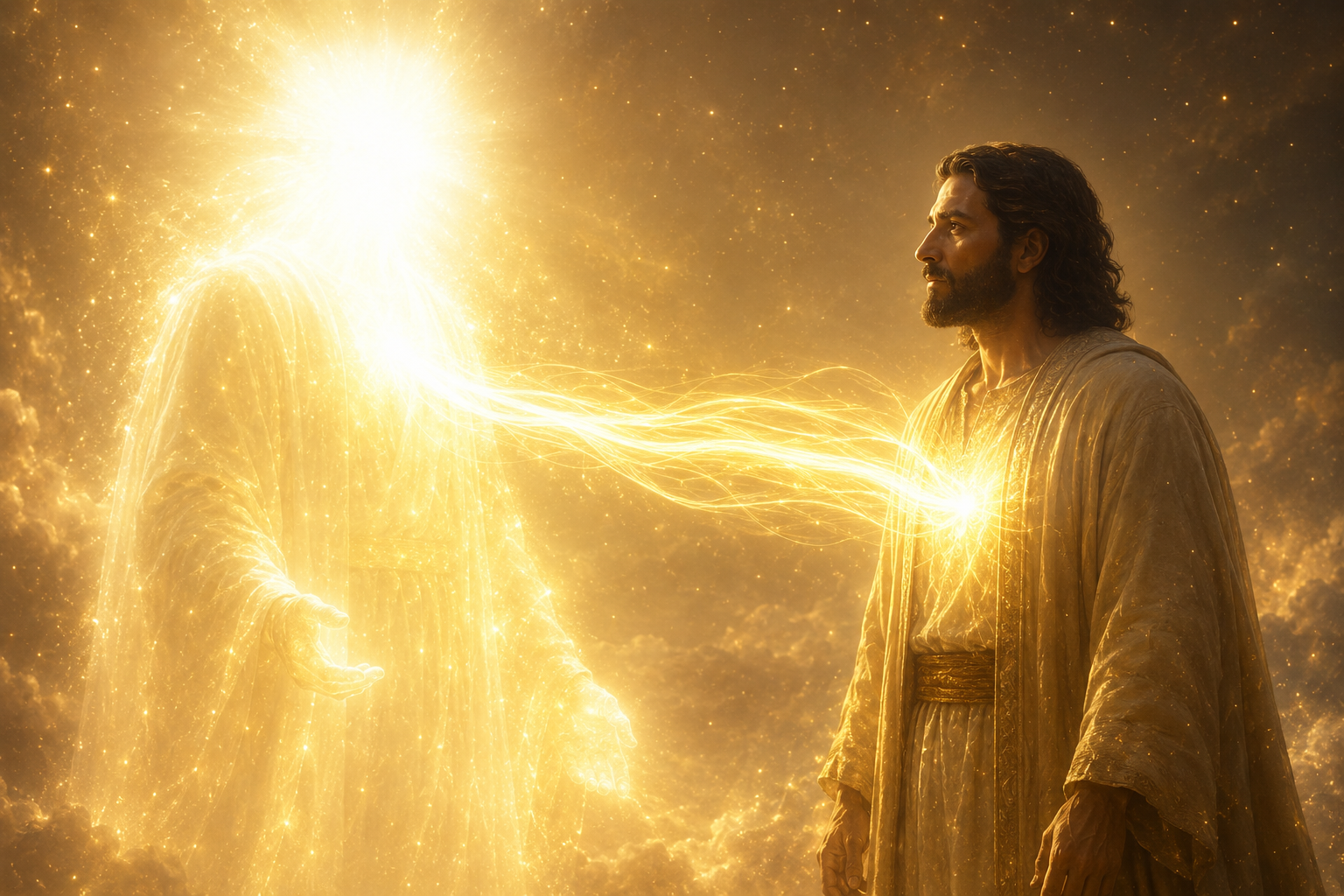
Here is the hinge of the entire study. The phrase “one God” does not mean “only one Being who has a divine nature.” It means one Source of all things. Notice the very structure of Paul’s sentence: the Father is the One of whom are all things; the Son is the One by whom are all things. The Father is the fountain; the Son is the channel through which that fullness flows out into creation. There is one fountainhead of divinity, one unoriginated Origin — and Scripture calls Him the Father:
One God and Father of all, who is above all, and through all, and in you all.
This is why the doctrine of one God and the full divinity of the Son are not at war. The Son is not a second God set up alongside the first, which would be two Gods. He is the One who came forth from the one God, inheriting His nature — divine by derivation from the single Source. To confess “one God, the Father” is therefore not to diminish the Son at all; it is simply to name where the river begins.
Question 03
What does “the only true God” mean?
Answer
Some hear Christ’s own words — that the Father is “the only true God” — and conclude the Son must somehow be excluded from divinity. But that reads the word only against the grain of Scripture’s own usage. Consider how the same kind of word works in another text, where Paul speaks of God:
…the King of kings, and Lord of lords; Who only hath immortality, dwelling in the light which no man can approach unto…
God “only” hath immortality — and yet the same Scripture promises that the redeemed will one day “put on immortality” and be made deathless (1 Corinthians 15:53–54). How can both be true? Because “only” here does not mean God is the lone Being who will ever possess immortality; it means He is the only Source of it — the only One who has it underived, in Himself, and who gives it to others. Take that key and return to Christ’s prayer:
And this is life eternal, that they might know thee the only true God, and Jesus Christ, whom thou hast sent.
The Father is “the only true God” in exactly that sense: the one underived Source of all divinity. This in no way shuts the Son out, any more than “who only hath immortality” shuts out the redeemed who are given it. And notice that in the very same breath Christ sets Himself beside the Father as the One whom to know is eternal life — hardly the words of a mere creature. The verse names the Father as the sole Fountain and the Son as the One sent forth from that Fountain.
Question 04
How does the Father share His life with the Son?
Answer
Scripture answers with a sentence so balanced it settles the matter. The Father has life in Himself — original, unborrowed, underived — and He gave the Son to have that very same life in Himself:
For as the Father hath life in himself; so hath he given to the Son to have life in himself.
Weigh both halves. The Son truly has life in Himself — this is full divinity, the same self-existent life the Father has, not a flickering, dependent existence like ours. Yet that life was given. It came from the Father. This is the whole pattern in one verse: the Father is the unbegotten Source; the Son is the begotten One who has received the Father’s own divine life and now possesses it in Himself. He is not God by being a second fountain. He is God by having come forth from the one Fountain and inherited all that the Father is — “for it pleased the Father that in him should all fulness dwell” (Colossians 1:19). The Son lacks nothing of deity; He simply owes all of it to the Father.
Question 05
What did the apostles say the one God is?
Answer
It is not Paul alone. Every apostolic voice in the New Testament, when it names the one God, names the Father. Peter opens his letter by blessing “the God and Father of our Lord Jesus Christ” (1 Peter 1:3) — God is the Father of the Lord Jesus. James, defending plain monotheism, appeals to the same God to whom Christ prayed (James 2:19). And John writes that the love of God was shown in this, “that God sent his only begotten Son into the world” (1 John 4:9) — the Sender is God; the Sent is His Son. Paul makes the distinction unmistakable when he gathers Father and Son into one sentence:
But to us there is but one God, the Father… and one Lord Jesus Christ…
Across four different writers the witness never wavers: the one God of the New Testament is consistently and specifically the Father, while Jesus is His Son, His Lord, His Christ — divine, but divine as the Son who came from the Father. The apostles had every occasion to call Jesus “God the Son,” a member of a triune Godhead. They never once did. They called Him “the Son of God,” which names a real Father and a real Son.
Question 06
What does Revelation show us?
Answer
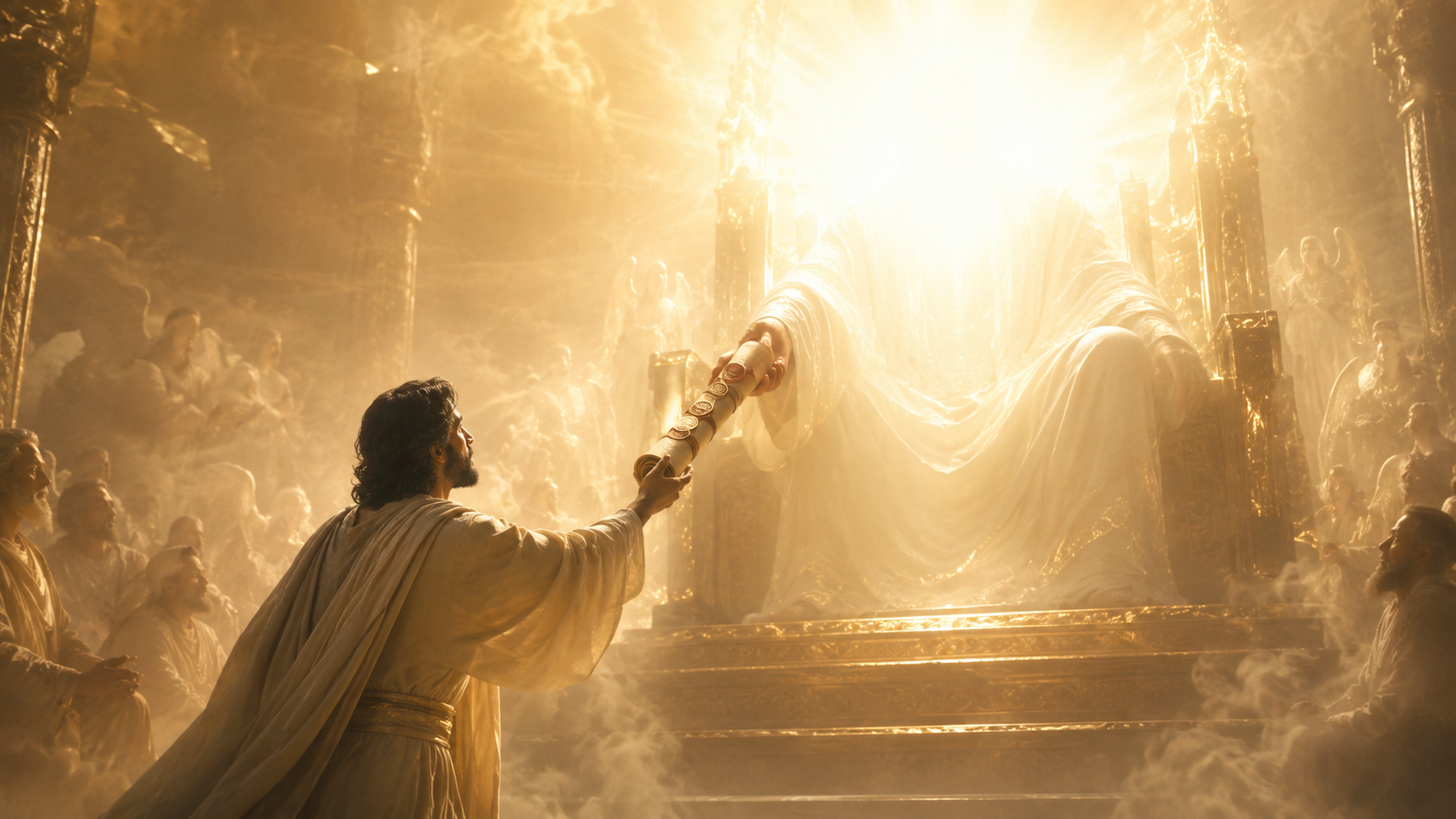
The final book of the Bible draws back the curtain on heaven itself, and what it shows confirms everything Paul taught. In the throne-room vision, there is One seated upon the throne — the Lord God Almighty — and around Him all creation pours out worship to Him as Creator and Source:
Thou art worthy, O Lord, to receive glory and honour and power: for thou hast created all things, and for thy pleasure they are and were created.
Then a second figure appears — not on the throne, but coming to it: the Lamb that was slain, who steps forward to receive what the One on the throne gives:
And he came and took the book out of the right hand of him that sat upon the throne.
Mark the relationship the scene makes visible. The One on the throne is the Father, the Source, who holds and gives; the Lamb is the Son, who comes and receives. The whole book is built on this very distinction — it opens by calling itself “The Revelation of Jesus Christ, which God gave unto him” (Revelation 1:1): God gives, Christ receives. And when worship rises at the climax, it rises “unto him that sitteth upon the throne, and unto the Lamb” (Revelation 5:13) — two distinguishable Persons, the Father and His Son, never collapsed into one, never multiplied into three. Heaven’s own scene is the picture of 1 Corinthians 8:6.
Question 07
Does naming the Father, Son, and Spirit prove a trinity?
Answer
Here we must be careful, because this is the leap most often made without warrant. Scripture certainly names the Father, the Son, and the Spirit together. At baptism, disciples are commanded to baptize “in the name of the Father, and of the Son, and of the Holy Ghost” (Matthew 28:19); Paul writes of “one Spirit… one Lord… one God and Father” in a single passage:
There is one body, and one Spirit, even as ye are called in one hope of your calling; One Lord, one faith, one baptism, One God and Father of all…
But notice what these texts do not say. They do not say the three are one God; they do not call them co-equal or co-eternal persons of a single Being. In fact this very passage, while listing all three, still reserves the title “one God” for the Father alone. To list the Father, the Son, and the Spirit no more proves a trinity than listing a king, his son, and his breath proves they are one threefold person. The doctrine of the trinity is not stated in these verses; it is read into them. When we let Scripture keep its own definition — one God, the Father, the Source; one Lord, His begotten Son; and the Spirit, God’s own presence and power going forth — every text fits, and none must be forced. The one true God is the Father, and Jesus Christ is His Son.
Personal response
Sit with the simplicity of it: one God, the Father, the Source of all things; one Lord, Jesus Christ, His own divine Son, sent forth from Him. Have you been taught to read more into the word “one” than the apostles ever did? Ask the Father, in His Son’s name, to let you see Him as Paul saw Him — not a mystery of three, but a Father with a Son, the Fountain and the One who came forth from Him. To know Him this way is not to make Christ smaller; it is to love them both for who they truly are.
Foundational text
But to us there is but one God, the Father, of whom are all things, and we in him; and one Lord Jesus Christ, by whom are all things, and we by him.