
Before we can find the true God of Scripture, we have to be honest about the rival pictures of God already in the room. Christendom does not speak with one voice here; it offers at least three distinct answers, and they contradict one another. This lesson sets them side by side, defines each one fairly, and then asks the question that orders the whole course: how many Gods does the Bible actually confess — and does the answer settle which God we worship?
Question 01
What are the rival pictures of God in Christendom?
Answer
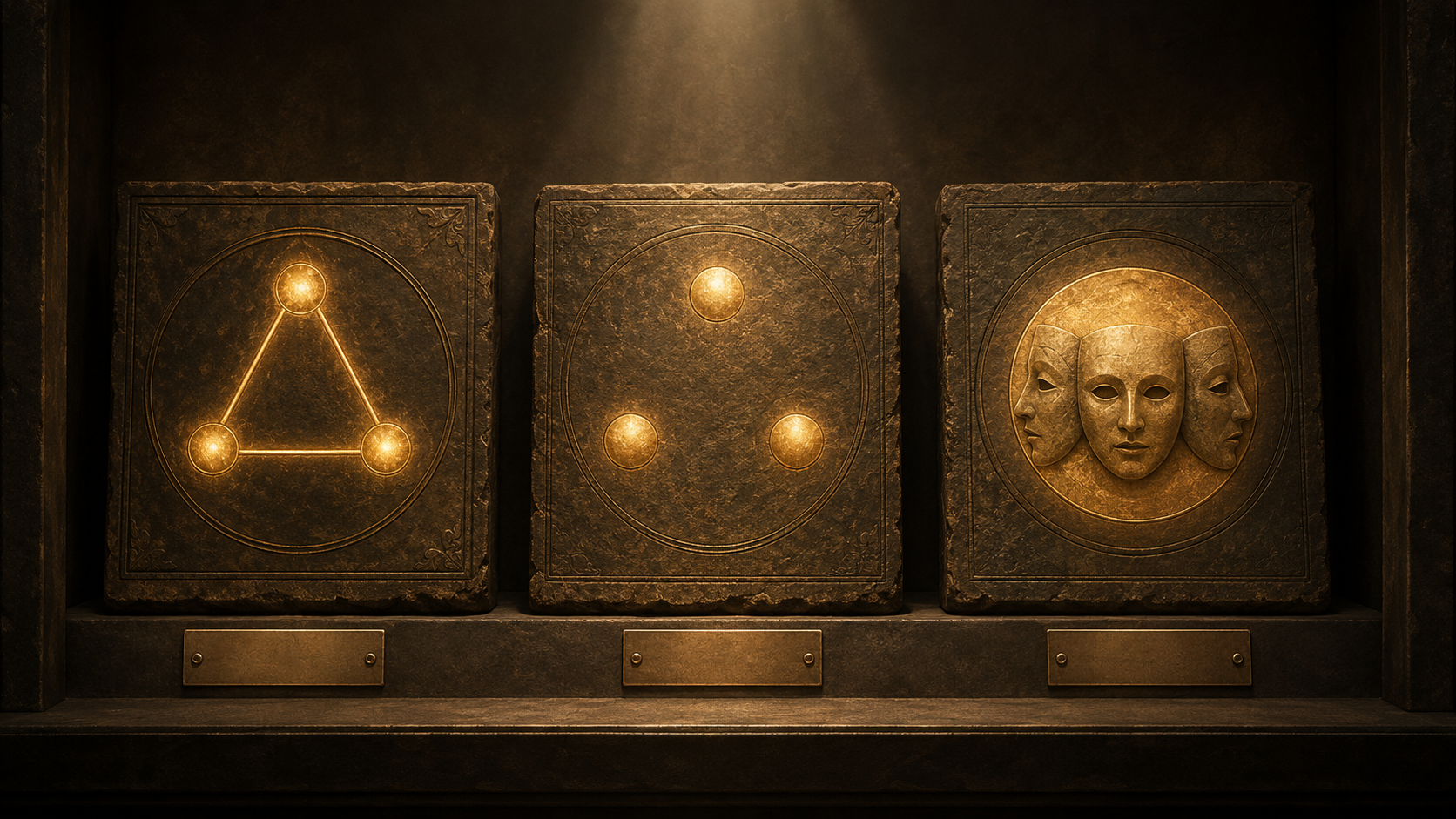
It surprises many people to learn that the churches of Christendom do not agree on who God is. Underneath the shared word God lie three very different conceptions, and they cannot all be right at once. There is the Trinity — by far the most widespread — which holds that there is one God who exists eternally as three co-equal, co-eternal persons: Father, Son, and Holy Spirit. There is tri-theism, which speaks of three distinct divine beings who together make up the Godhead. And there is Oneness, also called modalism, which insists there is only one divine person who appears in three different roles or modes. To know what we are accepting or rejecting, we must first state each view in its own best terms.
Question 02
What does the Trinity actually claim?
Answer
The Trinity is, in its own intention, a monotheistic doctrine. It does not mean to teach three Gods. It claims that there is one divine Being — one single God — Who subsists eternally as three distinct persons, and that each of the three is fully and equally God, none before or after another, none greater or less. The Father is God, the Son is God, the Holy Spirit is God; yet there are not three Gods, but one God. The three persons are said to be co-equal and co-eternal, sharing one undivided divine essence. Stated this way, the Trinity is a careful attempt to honor both the unity of God and the divinity of the Son and the Spirit. We will take it at its word, and weigh it not by caricature but by Scripture.
Question 03
What is tri-theism?
Answer
Tri-theism takes the language of three persons and quietly hardens it into three beings. On this view the Father, the Son, and the Holy Spirit are not three subsistences of a single divine essence but three separate divine individuals — three Gods, however closely united in purpose and love. Few teach this openly, because it is plainly polytheistic: it counts three where the Bible counts one. Yet it is the place that loose talk often drifts toward — picturing three divine persons as three centers of being who merely cooperate. Whatever its appeal, tri-theism collapses the moment Scripture is allowed to speak, for the Bible never once permits us to number more than one God.
Hear, O Israel: The LORD our God is one LORD.
Question 04
What is Oneness, or modalism?
Answer
Oneness, or modalism, runs hard in the opposite direction. Where tri-theism multiplies beings, modalism collapses them. It teaches that there is only one divine person, and that Father, Son, and Holy Spirit are not three persons at all but three names, masks, or modes that the one Being wears at different times — Father in creation, Son in redemption, Spirit in the church. Like the Trinity, it means to be monotheistic, and it earnestly guards the oneness of God. But its solution is to deny that the Father and the Son are genuinely distinct. On this view, when the Son prays, He is finally praying to Himself; the Father who loves and the Son who is loved are one and the same actor changing costumes.
Question 05
What do all three quietly share?
Answer
Here is the thing the three views hold in common, and it is more important than what divides them. None of them allows a real Father and a real Son in a real relationship. Tri-theism gives you a Father and a Son, but no longer one God — and a Son who never came out of the Father, only stands beside Him as a second deity. Modalism preserves the one God, but dissolves the Son into a role the Father plays, so there is no other to be begotten and no one to be sent. And the Trinity, for all its care, makes the Son co-eternal with the Father — which means He was never truly begotten at all, never genuinely came forth from the Father; the sonship is left as a title or a metaphor rather than a real bringing-forth. In each case the words Father and Son survive while the relationship they name is emptied out.
Yet Scripture insists that the relationship is real. The Father sent the Son; He gave the Son; and the Son is the only begotten of the Father — language of origin and gift that none of the three models can take at face value.
For God so loved the world, that he gave his only begotten Son, that whosoever believeth in him should not perish, but have everlasting life.
Question 06
Is the Bible a monotheistic book?
Answer
Without question. From Israel's great confession to the apostles' plainest statements, Scripture confesses one God and forbids any other. This is the first fixed point, and it is not in dispute. When Jesus was asked which commandment is first of all, He did not soften or amend the ancient creed of Israel — He repeated it:
And Jesus answered him, The first of all the commandments is, Hear, O Israel; The Lord our God is one Lord.
Paul says the same with full clarity, sweeping away the many so-called gods of the nations and leaving only one:
…we know that an idol is nothing in the world, and that there is none other God but one. For though there be that are called gods, whether in heaven or in earth, (as there be gods many, and lords many,) But to us there is but one God, the Father, of whom are all things, and we in him; and one Lord Jesus Christ, by whom are all things, and we by him.
This settles one thing decisively. Because the Bible counts only one God, tri-theism is ruled out at the door. There are not three Gods — not three divine beings to be added together — and any view that finally lands on three must be set aside as contrary to the plainest words of Scripture. So far, then, the field has narrowed: whatever the truth is, it must be a monotheism.
Question 07
Does “one God” settle which God?
Answer
Not yet — and seeing this clearly is the whole point of the lesson. To say “there is one God” rules out tri-theism, but it does not by itself decide between the remaining views, for both the Trinity and modalism also claim to be monotheistic. They agree there is one God; they disagree, sharply, about who that one God is and how the Father, the Son, and the Spirit are related to Him. The confession “one God” is the doorway, not the answer. It tells us the truth will be a monotheism; it does not yet tell us which monotheism is the Bible's own.
And notice that the apostle Paul, in the very breath where he confesses “but one God,” immediately tells us who that one God is: the Father, “of whom are all things” — and he names beside Him “one Lord Jesus Christ, by whom are all things” (1 Corinthians 8:6). That is the trailhead the rest of this course will follow. We have established that there is one God and that it cannot be three. The remaining question — the question that will occupy us from here — is this: when the Bible says one God, whom exactly does it mean, and where does that leave the Son who was given and the Spirit He sends?
Personal response
Which of the three pictures have you been carrying — perhaps without ever naming it? Sit for a moment with the one thing they share: each keeps the words Father and Son while quietly spending the relationship behind them. Ask the Father, in His Son's name, to let you read the next lessons without defending an inherited diagram — willing to confess one God exactly as the Bible confesses Him, and then to follow His own words to discover who that one God truly is.
Foundational text
But to us there is but one God, the Father, of whom are all things, and we in him; and one Lord Jesus Christ, by whom are all things, and we by him.