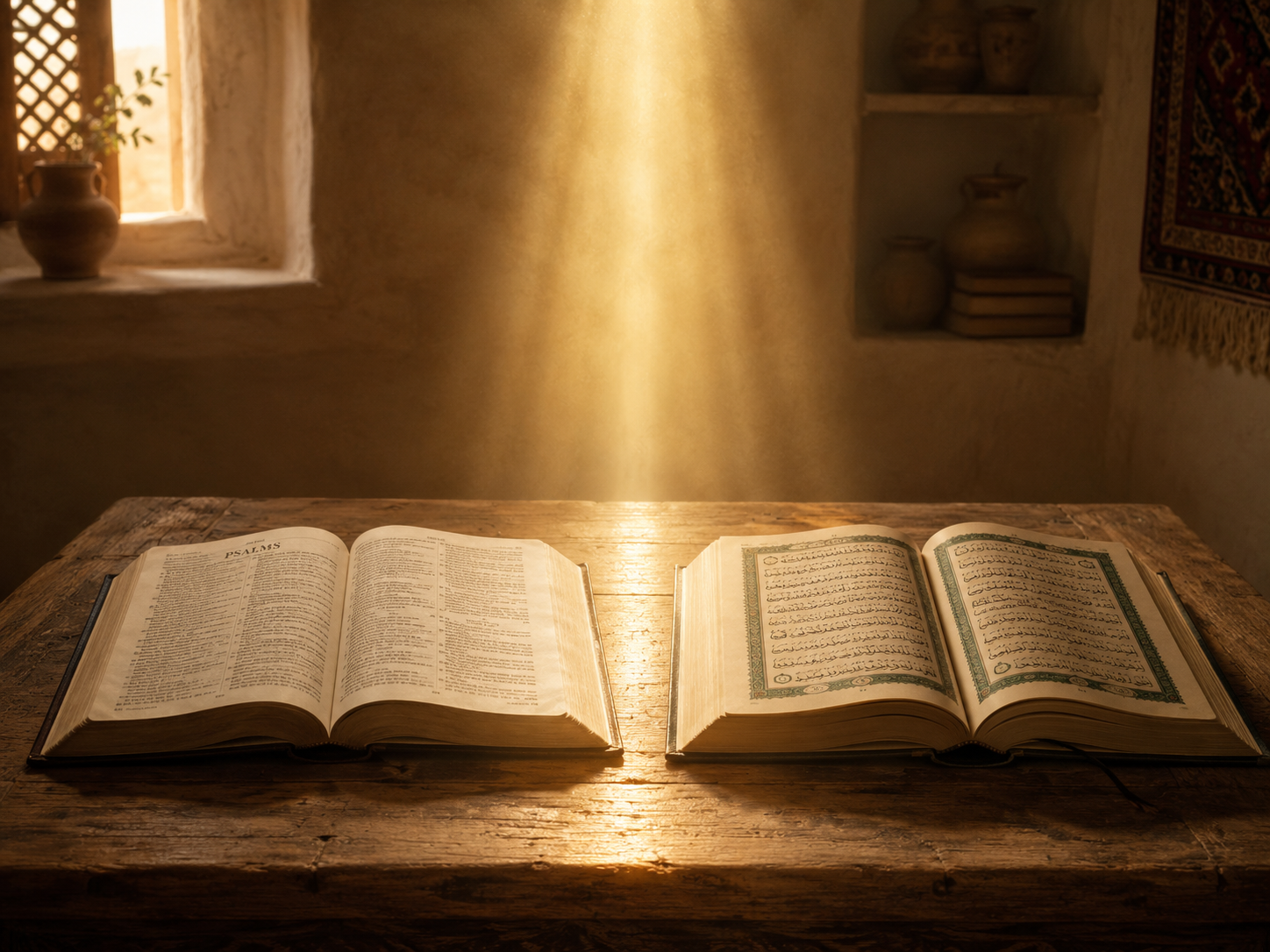

Peace be upon you. We write this not to win an argument but to open a door. You love God. You guard His oneness with a zeal that puts many who call themselves Christians to shame. You will not give His glory to another, and you are right not to. We honor that in you, and we share it. This letter is written by people who believe, as you do, that there is one God — supreme, eternal, self-existent — and who have found that the Bible, read plainly, guards His oneness even as it tells us something the world calls impossible: that this one God has a Son.
Companion study: How the Trinity Crept Into Christianity
Hear us out as a brother hears a brother. We will not mock your Book; we will quote it. We will not hide behind hard words like Trinity — in fact we will set that word aside, because much of what you have been taught to reject, we reject too. What remains, when the confusion is cleared, is a question that no honest seeker can avoid: who is Jesus, the Messiah, the son of Mary?
We do not worship three gods
Begin where your heart already stands. There is one God. Listen to how your own Book frames the charge against the Christians:
And [beware] when God will say, “O Jesus, Son of Mary, did you say to the people, ‘Take me and my mother as deities besides God?’”
Read that carefully. The “three” the Qur’an condemns is God, Mary, and Jesus — a Father, a mother, and a child, three separate gods worshiped side by side. We answer you plainly, with our hand on the Book: we have never believed that, and we reject it as firmly as you do. Mary is not divine. God did not take a wife. There are not three gods. If that is the doctrine you were taught Christians hold, then you were taught to reject something we also condemn.
What the Bible teaches is far simpler, and far closer to your own confession of God’s oneness than you have been told. There is one God, and the Bible names Him:
And this is life eternal, that they might know thee the only true God, and Jesus Christ, whom thou hast sent.
Jesus prays to the only true God — the Father — and calls Himself the One sent. He never claims to be the One Who sent Him. He worships, prays to, and obeys the one true God, exactly as you long to do. And the Spirit of God is not a third deity standing beside the Father; it is God’s own Spirit, His presence and power — the very life of the Father and the Son, reaching into the heart of the believer. One God, the Father. His Son, sent from Him. His Spirit, poured out from Him. No committee of three; no God with a consort. The oneness you defend is safe here.
The Son you were taught to deny
Now the heart of it. Your Book honors Jesus as no other prophet is honored. It calls Him the Messiah. It declares His virgin birth — that God created Him in the womb of Mary by His word, with no human father (Sura 3:45–47). It says He healed the blind and the leper and raised the dead by God’s leave (Sura 3:49). It says He was sinless, “a righteous one” (Sura 19:19). It says He was taken up to God and that He will return. No other prophet in your Book is born of a virgin, sinless, and raised alive to heaven. Has it never made you wonder why this One?
The one thing your Book will not say of Him is the one thing the Bible says first: that He is the Son of God. And here the Qur’an’s objection is sharp:
And they say, “The Most Merciful has taken [for Himself] a son.” You have done an atrocious thing … it is not appropriate for the Most Merciful that He should take a son.
We understand the fear behind that verse. To the Arabs of old, “a son of God” meant what it meant for their idols: a god who took a wife and fathered a child, the way Zeus fathered sons, the way the pagans called the angels “daughters of God.” That is what the Qur’an recoils from — God reduced to a creature who mates and multiplies. And we recoil from it with you. If that is what “Son of God” meant, it would be blasphemy. But it is not what the Bible means, and it never was.
What “begotten” does and does not mean
When the Bible calls Jesus the only begotten Son, it does not mean God took a wife. It does not mean a beginning in a mother’s womb — that was His human birth from Mary, which your Book also confesses. The begetting the Bible speaks of is something else entirely: the bringing-forth of the Son from the Father’s own being, before there was a world, before there was time, before anything was made.
When there were no depths, I was brought forth … before the hills was I brought forth.
Not built. Not fashioned from nothing as the creation was. Brought forth — from the Father, of the Father, sharing the Father’s own nature, the way light comes from a fire without the fire ever being without its light. This is why the Son is divine: not as a second, rival God, and not as a created angel, but as a true Son is of the very nature of his father. A son of man is a man; the Son of God is divine. He does not divide God’s oneness, because He is not a second source — He is from the one Source, the Father, Who alone is unbegotten, unsent, the fountain of all.
So when your Book says God “does not beget,” we can stand beside you and say: amen — not as men beget. God has no consort. God did not father a child in time. But the eternal Father did bring forth an eternal Son from Himself, and that Son is the One your Book honors above every prophet and will not quite explain.
The Word and the Spirit from God
Here is something that may surprise you. Your own Book, when it speaks of Jesus, reaches for two titles it gives to no other prophet — and both of them are the Bible’s titles for the Son.
The Messiah, Jesus, the son of Mary, was but a messenger of God and His word which He directed to Mary and a soul [spirit] from Him.
The Qur’an calls Jesus the Word of God and a Spirit from God. It does not call Moses that, or Abraham, or Muhammad. Only Jesus. Now hear how the Bible opens its account of Him:
In the beginning was the Word, and the Word was with God, and the Word was God … And the Word was made flesh, and dwelt among us.
The Word that was with God in the beginning became flesh in the womb of Mary. Your Book preserves the title — the Word of God — but stops before telling you what the Word is. The Bible tells you: the Word is the Son, Who was with the Father before the world, the One through Whom God made all things (John 1:3). A word is not separate from the one who speaks it; it comes out of him, carries his very mind, and is of one nature with him. That the Qur’an should call Jesus God’s Word and God’s Spirit, and no one else — this is a thread left hanging in your own hand. Follow it, and it leads to the Son.
The God who shows His face
You have been taught that God is utterly beyond likeness — that He has no form, no image, that nothing can represent Him. In one sense that is gloriously true: no idol, no carved thing, no created likeness can capture the Maker. But the longing of the human heart is not for a doctrine of God; it is to know Him, to see His face, to be sure of His love. A master far above us can issue commands. Only a father near us can be known. The Bible says God answered that longing by sending the One Who could show us exactly what He is like:
Who being the brightness of his glory, and the express image of his person …
The Son is the express image of the Father — not a carved idol, but a living likeness, God’s own character made visible in a real man Who walked, wept, forgave, and bled. When the disciples asked to be shown the Father, Jesus said, “he that hath seen me hath seen the Father” (John 14:9) — not because He is the Father, but because the Father dwelt in Him perfectly, so that to watch the Son love sinners was to watch the heart of God. The God of Islam is known by His commands. The God of the Bible drew near enough to be touched.
Why the Son had to die
Here we reach the place where the two roads part most sharply. Your Book denies that Jesus was crucified:
And [for] their saying, “Indeed, we have killed the Messiah, Jesus, the son of Mary, the messenger of God” — and they did not kill him, nor did they crucify him; but [another] was made to resemble him to them …
We say this gently, but we must say it: to remove the cross is to remove the gospel. The crucifixion of Jesus is one of the most certain events of ancient history — attested by His followers who died rather than deny it, by Roman and Jewish writers who had no reason to invent it, and by the empty tomb that even His enemies could not explain away. But it is more than history. The death of the Son is the very thing God had been promising from the beginning: a sacrifice that could do what the blood of animals never could — carry away the sin of the world.
Think of what is at stake. If God simply waves sin away by decree, then His justice is a pretense and your own striving means nothing. If God only condemns, then no one is saved, for who among us has kept His law perfectly? The cross is how the one true God remains both just and merciful at once: the Father gives the Son, and the sinless Son bears in Himself the penalty we earned, so that God can forgive the guilty without becoming unjust. This is not a weak God overpowered by enemies. This is the strongest love in the universe, freely poured out.
Therefore doth my Father love me, because I lay down my life … No man taketh it from me, but I lay it down of myself.
No one took His life; He gave it. And God raised Him on the third day — the resurrection your Book never centers, yet which is the whole ground of our hope. A dead prophet leaves you his words. A risen Savior gives you His life. The Father has placed the whole work of salvation in the hands of this risen Son (Matthew 28:18), so that the way to the one true God now runs through the One He sent.
The story remembered in pieces
You revere the prophets — Adam, Noah, Abraham, Moses, David, Jesus. So do we. But notice what the Bible does with them that the Qur’an does not: it binds them into one unbroken story, every chapter pointing forward to the Son. The Qur’an retells many of the same names, but as separate moral lessons, often assuming you already know the fuller account. The Bible is that fuller account — and its shape is everywhere the same: a coming sacrifice, a coming Savior.
Consider Abraham, the father of the faithful, whom you and we both love. God asked him to offer his son on a mountain. Your Book tells the story; the Bible tells it with a word that pierces:
Take now thy son, thine only son Isaac, whom thou lovest … and offer him there for a burnt offering.
Thy son, thine only son, whom thou lovest. A father, on a mountain, giving up the son of the promise — and at the last moment God provides a ram in the son’s place. Two thousand years later, on a hill near that same place, another Father gave His only Son, and this time there was no substitute ram, because the Son was the Lamb. Abraham’s mountain was a rehearsal. The whole Old Testament is full of such rehearsals — Joseph, betrayed by his brothers and sold for silver, who becomes the savior of the very ones who sold him; the Passover lamb whose blood turns away death; the priesthood, the sacrifices, the temple — every one a shadow cast backward by the cross.
And notice one more thing. The Bible does not hide the sins of its heroes. It tells you David committed adultery and murder; it tells you of Solomon’s folly, of Abraham’s lies, of Moses’ temper. The Qur’an tends to polish the prophets smooth, sinless. But the Bible leaves the failures in on purpose — because the whole story is driving toward one point: every man needs a Savior, and only one Man never did. The honesty of the Bible about its own prophets is not its weakness. It is the proof that it is not trying to sell you heroes. It is showing you why you need the Son.
A Father, not only a Master
Ask yourself what kind of God you have been given to know. In Islam, God is the Master and you are the slave (‘abd); your duty is submission to His decree, and His decree may change — your Book teaches that later verses can cancel earlier ones:
We do not abrogate a verse or cause it to be forgotten except that We bring forth [one] better than it or similar to it.
A God whose word can be overruled by a later word is a God you can obey but never quite rest in, for what He commanded yesterday He may lift tomorrow. The God of the Bible does not change His mind about right and wrong:
For I am the LORD, I change not.
And He does not relate to you only as a Master to a slave. He invites you to come close, to ask, even to reason with Him:
Come now, and let us reason together, saith the LORD: though your sins be as scarlet, they shall be as white as snow.
That is the voice of a Father, not only a Master. Islam can tell you God is merciful; it cannot tell you God is your Father, for to call Him Father would imply sons — and that is the very thing it must deny. But the deepest hunger of the soul is not merely to submit to a Master far away; it is to be loved by a Father near. The gospel is the news that the one true God so loved the world — loved you — that He gave His only Son, that whoever trusts in Him should not perish but have everlasting life (John 3:16). A Master demands. A Father gives. Our God gave His Son.
The Book you call corrupt — and trust
Perhaps you have been told that the Bible has been changed — that the Jews and Christians corrupted their Scriptures, so the Qur’an alone can be trusted. But here is a difficulty your teachers may not have shown you: your own Book commands Muslims to believe the earlier Scriptures and even tells the doubting to consult them.
So if you are in doubt … then ask those who have been reading the Scripture before you.
The Qur’an calls the Torah and the Gospel a guidance and light from God (Sura 5:46) and tells the people of the Gospel to judge by what God has revealed therein (Sura 5:47). But it makes no sense to send people to a corrupted book for guidance. Either the earlier Scriptures were trustworthy in Muhammad’s day — in which case the charge of corruption fails — or they were already corrupt, in which case your Book sends you to a ruined well. And we have the manuscripts to settle it: thousands of copies of the Gospel reaching back to within a lifetime of the events, from every corner of the ancient world, agreeing together. The Bible you can read today is the Bible they read then. It has not been changed.
So read it. Read it for yourself, not as an enemy hunting errors, but as a seeker who loves God and wants the truth. You will find one story from the first page to the last — a Father Who made us, a fall that ruined us, a promise repeated through every prophet, and a Son given to redeem us. It is not a law-book for building a state. It is the record of a Father’s love and a Son’s sacrifice, written so that you might believe and live.
Come to the Masîh
We have not written to take anything from you. We do not ask you to stop loving God or guarding His oneness — keep both, more fiercely than before. We ask only that you let the one true God show you the Son He sent. You already grant that Jesus was born of a virgin, lived without sin, spoke the word of God, healed and raised the dead, was taken up to heaven, and is coming again. We ask you to take the last step your own Book leaves you standing before: to trust Him not only as a prophet who pointed the way, but as the Son Who is the way back to the Father.
Jesus saith unto him, I am the way, the truth, and the life: no man cometh unto the Father, but by me.
The risen Christ is alive, and He hears those who call on Him. If something in these words has stirred you, do not silence it. Ask the one true God — the God of Abraham, whom you already worship — to show you the truth about His Son, and to give you the courage to follow wherever it leads. He is a Father, and a Father does not turn away the child who comes seeking. Peace be upon you, and may the God of Abraham, Isaac, and Jacob draw you to Himself through the Son He loves.
For the documentary history behind this letter, see How the Trinity Crept Into Christianity — how the creed of three was formulated in the fourth century, three hundred years after the apostles, and the apostolic confession it displaced.
On the worship of one God against the repeating of prayers and the calling of names, see Vain Repetitions. And for the larger historical question of where the religion you were born into may itself have come from, see Does Islam Come from Rome?