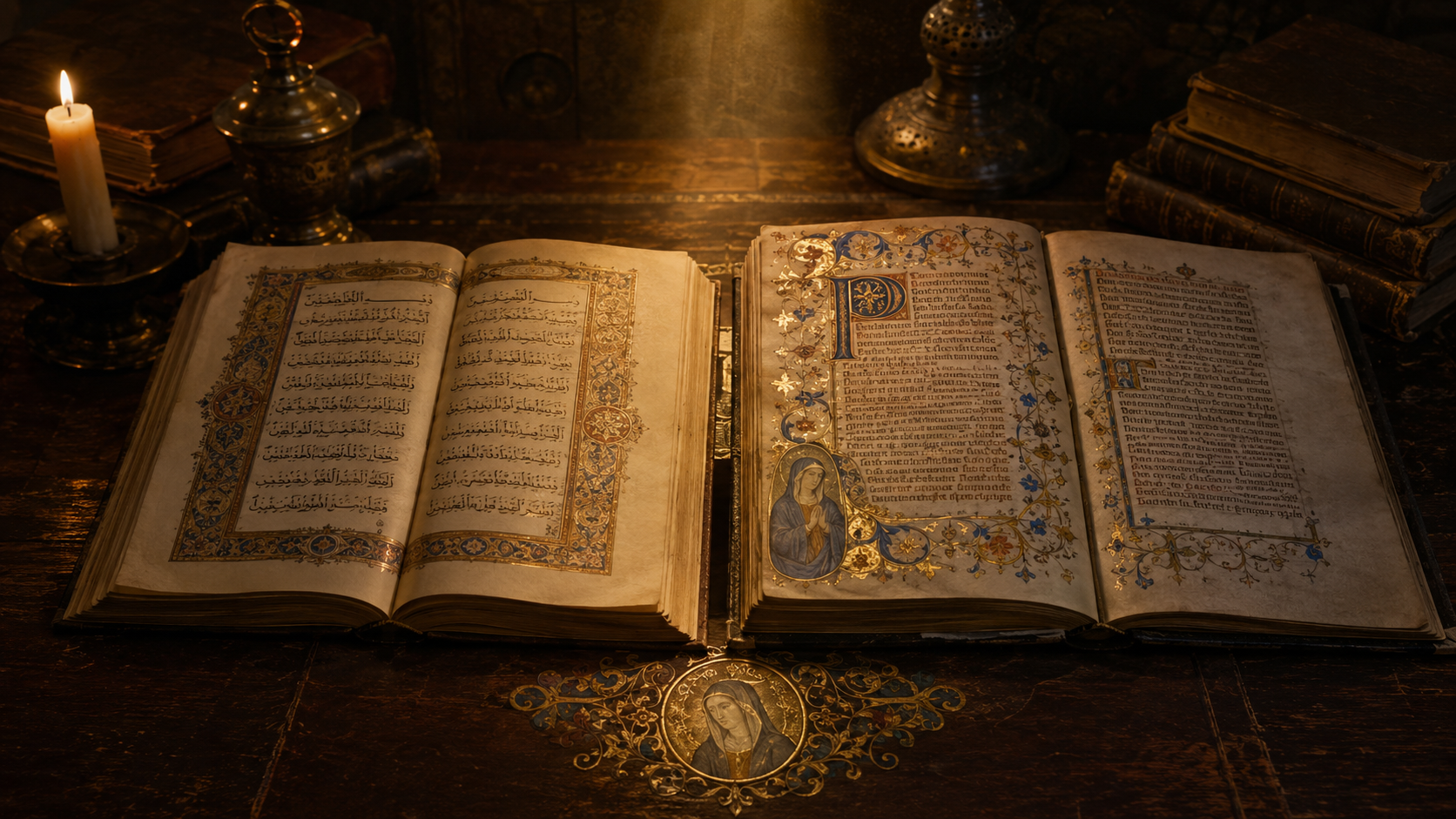
To most of the world, Islam and the Church of Rome are two separate powers — sometimes rivals, sometimes enemies, never the same thing. But set their symbols, their saints, their pilgrimages, and their stated hopes for the future side by side, and a pattern of overlap appears that is hard to explain by accident. This study does one thing: it lays the pieces on the table, in order, with their sources named and their dates checked — and then it leaves the question with you, the one in the title. We will be careful to mark which threads are documented and which are only claimed. We will not tell you what to conclude. We will ask whether you can look at all of it at once and not wonder.
The question, fairly put
Two cautions first, because this subject is handled badly far more often than well. First, this is not an attack on Muslims or Catholics as people. Where the argument runs hardest, its whole point is that the ordinary believers in both communions are sincere — devout, reverent, often shaming careless Christians by their earnestness — and that whatever may be true of the machinery behind their faiths, the people inside them are loved by God and worth every honest word. Second, we will be plain about which threads are firmly documented and which are claims advanced by particular authors, and we will not dress the one in the clothes of the other. With that said, look at the pieces.
One symbol, older than both
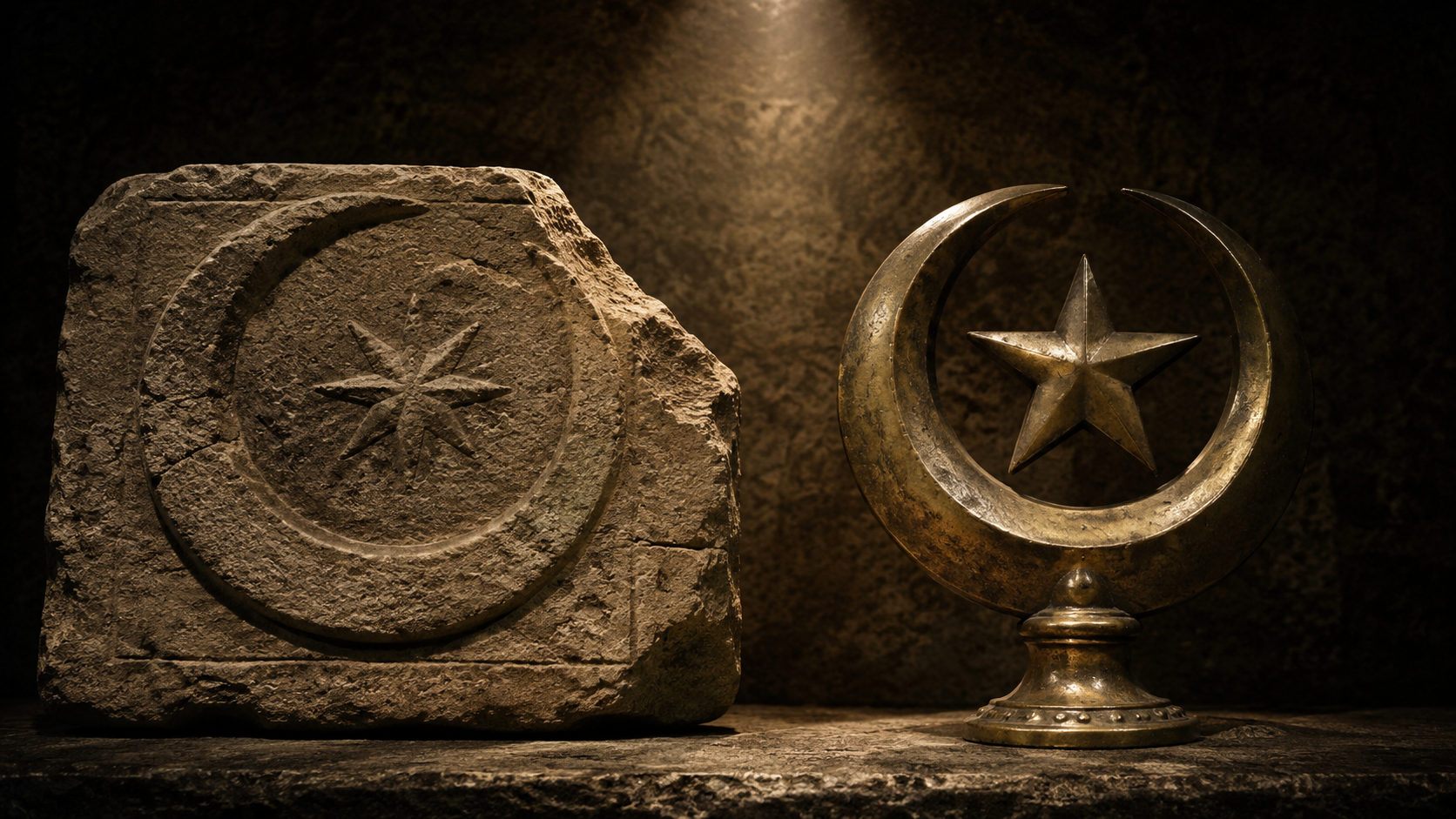
Begin with the most visible thing of all: the crescent moon and star. It crowns the minaret today and flies on the flags of the Islamic world. Yet the same crescent — with a star, or with a sun-disc resting in its horns — runs all through the imagery of Rome: Mary, in Immaculate-Conception art, stands upon a crescent moon with a ring of stars at her brow; the Mass produces a round white wafer that is then set into a monstrance, a golden sunburst, often mounted on a crescent base.
But here honesty sharpens the point rather than blunting it. The crescent did not begin with Islam, and Muhammad never used it. It is far older — a religious emblem of the ancient Near East, tied to the moon-goddess and to the sun-and-moon worship Scripture names again and again under the word Baal. It was the badge of the Greek colony of Byzantium centuries before Christ, and later of the Byzantine empire. The Ottoman Turks were flying it well before they took Constantinople in 1453; the star was added to it only in the late 1700s; and it was popularized as a “symbol of Islam” by association with the Ottoman flag — largely a development of the twentieth century. So the honest finding is not that Rome handed the crescent to Islam, but something arguably more interesting: both systems reached back and drew the same ancient pagan moon-and-star imagery up into the heart of their worship — Rome onto the brow of its Madonna, the Ottoman world onto its banners. Two religions, one symbol, and a well older than either. The first question, then, is not “who copied whom?” but “why do they both drink from the same ancient stream?”
And the stream has a name. The pagan Arabs of Mecca, long before Muhammad, worshipped a high god called Allah — a name the Encyclopedia of Religion traces to the Babylonian Bel, that is, Baal — and he was a moon-god, honored beside three daughter-goddesses, al-Lat, al-Uzza, and Manat (the very three the Qur’an itself would name, only to forbid them, in Surah 53). His emblem was the crescent, centuries before Islam existed — the same sun-and-moon worship Rome would draw up onto the brow of its Madonna. The half-moon-and-sun device of the ancient Hittites is, for that matter, the emblem of the United Nations today. One old well, and the buckets keep coming up in new hands.
The decode runs deeper than a flag, and we leave its coarsest detail in the source books. The crescent cradling a sun-disc, the Masonic writer Albert Pike explains (Morals and Dogma, p. 451), is the conjunction of sun and moon — read, in the occult tradition behind him, as a fertility sign, the male and female principles joined. The very same figure is worked into Rome’s monstrance: a round white wafer — a sun-disc — set in a golden sunburst on a crescent base, which the source reads as “the birth of the sun.” A Catholic church clock in Germany even stages it on the hour, its hands meeting beneath a moon and an eight-pointed star — and that eight-pointed star, a square set within a square, is the very “star of Islam,” found alike on the mosque, in Catholic cathedrals, and on a Knights Templar floor.
The Christian at the cradle
Consider the founder. Muhammad (c. 570–632) married Khadija, a wealthy widow who had employed him — he about twenty-five, she about forty and twice widowed. When he came home shaking from his first experience in the cave of Hira (c. 610), it was Khadija who took him straight to her cousin — and the cousin matters. His name was Waraqa ibn Nawfal, and by the testimony of Islam’s own earliest biographers (Ibn Isḥāq, and the collections of Bukhārī) he was a Christian, literate in the scriptures, who had learned to write the sacred script. It was Waraqa who examined the trembling Muhammad and pronounced the verdict that launched a religion — that this was “the greatest Law that came to Moses,” and that Muhammad was “the prophet of this people.” A Christian relative stands at the very cradle of the revelation, authenticating it; then, the traditions say, he died, and the revelations paused. What he spoke was gathered into a book only after his death — compiled around AD 650 — and held to be dictated word for word, which is why Islam insists the Qur’an can never truly be carried out of its original Arabic.
Note, too, the recurring setting: the cave. The ancient mystery religions made the cave the birthing-place of their gods, and the motif threads forward strangely — Rome’s Mary is forever appearing in a grotto: at Lourdes, at Fátima, in cave after cave. We do not build a doctrine on a cave. We set it beside the rest and let it sit there.
The Mary they share
Here the ground turns firm, and this may be the single most striking thread of all — because it is not speculation, and the Church of Rome has said it out loud, in print. The two religions meet on Mary.
The Qur’an exalts Mary — Maryam — above every other woman: it affirms her virginity, the miraculous conception of Jesus, and says God “chose and purified” her “above the women of all nations” (Surah 3:42; an entire chapter, Surah 19, bears her name). No figure outside Islam’s own prophets is so honored in it. And Rome has noticed and rejoiced. In 1952, the American bishop Fulton J. Sheen devoted a chapter of his book The World’s First Love — titled “Mary and the Moslems” — to arguing that Our Lady would be the bridge by which Islam is drawn to Rome. He leaned on a striking coincidence of names: the Marian apparitions of 1917 took place at a Portuguese town called Fátima — a town named, in the days of Muslim Iberia, after a Moorish chief’s daughter who bore the name of Muhammad’s own daughter. Sheen wrote that missionaries would win Muslims “in the measure that they preach Our Lady of Fátima.” The Vatican insider Malachi Martin recorded the same hope in John Paul II: that the world of Islam, already “attuned to the figures of Christ and of His mother Mary,” would one day receive the illumination and recognize the pope. Two religions that agree on almost nothing else agree, with remarkable precision, on the veneration of one woman. Why there, of all places?
And Rome has gone further than honor. The first promise of a Redeemer was spoken to the serpent in Eden — and of the woman’s seed it said:
…it shall bruise thy head, and thou shalt bruise his heel.
The seed of the woman is Christ; He would crush the serpent. But Rome’s own Douay- Rheims and Jerusalem Bibles render the verse “she shall crush thy head” — putting Mary, not her Son, in the place of the serpent-crusher. And the doctrine follows the translation: the dogma of the Immaculate Conception holds that Christ drew His very merit from His mother, so that — to put it bluntly — Jesus has His merits because of His mother and not because of His Father. Step by step, the creature is moved toward the Creator’s seat.
The hope built on her is stated in remarkable terms. The Vatican writer Malachi Martin recorded John Paul II’s belief that there would come a “second Fátima” in which the world of Islam — “already attuned to the figures of Christ and of His mother Mary” — would receive illumination and recognize the pope as God’s vicar on earth, so that he “could be worshipped as the infallible Holy Father by over one half of the world’s population.” A Marian apparition was even reported at Zeitoun, in Egypt, watched by Muslims and Christians together; and a recent book gathers the whole hope under one telling title — Queen of Rome, Queen of Islam, Queen of All.
Older writers made the identification flat-out. The titles of Rome’s Litany of Mary — Mother of God, Queen of Heaven, Morning Star, Mystical Rose, Star of the Sea — are, almost word for word, the ancient titles of Isis, as Helena Blavatsky set them side by side; and a “Star of the Sea” prayer card addresses Mary in the words once given to the sea-god, “mightiest after God.” The same goddess wears the same crowns — in some shrines Mary is shown crowned with thorns and bearing the wounds of her Son — and the occult historians note that it was Cyril of Alexandria who, in the fifth century, “anthropomorphized Isis into Mary.”
And the escalation has not stopped. The bodily Assumption of Mary was made binding dogma by Pius XII in 1950; the apparition at Lourdes (1858) handed Rome the title “Immaculate Conception,” and whole nations — indeed “the whole world” — have since been consecrated to her Immaculate Heart. At Fátima the messages went further still: a vision of hell, the demand that Russia be consecrated to her, the promise that “Russia will be converted” and that “the world will be saved” by Mary’s children. Fulton Sheen pressed the same bridge from Rome’s side — noting that the Qur’an affirms Mary’s virginity and even her sinless conception, that the apocryphal infancy gospels (canonized at Trent) feed both traditions, and resting on the motto that says it all: “No Mary, no Jesus.”
The same shape behind the veil
Once you are looking, the parallels multiply, and they are easy to verify:
- Pilgrimage. Islam draws millions to Mecca; Rome draws millions to Lourdes and Fátima. Pilgrimage to a holy site is the signature of the old pagan religions, and it stands at the center of both.
- Beads. The Muslim tells his misbaha; the Catholic tells the rosary. Counted, repeated prayer on a string of beads — the same practice, the same posture.
- A male priesthood and the relics of the dead. Inside the great Umayyad Mosque of Damascus stands a shrine that claims to hold the head of John the Baptist — a relic of the dead, venerated exactly as Rome venerates its relics. (Rome, for its part, claims to hold his arm.)
- The all-seeing eye. The single eye — the eye of the ancient sun-god — appears on the mosque, on the taxicab as a charm, and equally on the Catholic pulpit and the dollar bill. The Masonic writer Carl Claudy calls it “one of the oldest and most widespread symbols denoting God”; the occult tradition makes the right eye the sun and the left the moon, names it the eye of Hathor and of Osiris, and (in Alice Bailey) the eye of Shiva the destroyer — tracing it straight back to the gods of Egypt.
- The shared forms. The Masonic writer Albert Pike, in Morals and Dogma (1871), read fertility and sun-moon symbolism — male and female, active and passive principles — into the very shapes both communions use. The full detail of his reading we will leave in his books; the relevant fact is only that the same initiate sees the same old meaning in both.
- Side by side. In Islamic capital after capital, a Catholic cathedral and a great mosque stand within sight of one another. In Amman the cathedral faces the King Abdullah Mosque, whose gates carry sun-symbols and whose dome wears the sickle moon — two religions, one skyline, the same emblems.
- The same habit. Set an old-style Catholic nun beside a devout Muslim woman and the dress is all but identical — the veiled head, the covered form, the long dark robe.
- A telling silence. Rome never protests that Islam forbids all evangelism in the lands it rules — yet when evangelism draws Catholics away elsewhere, the objection is loud. The one ban serves a shared purpose; the other does not.
Each parallel, alone, is a curiosity. The question is what they amount to together — whether so many correspondences, in symbol and ritual and relic, are coincidence, or the fingerprints of a common source older than both.
Built on the same ground
There is one parallel more physical than any symbol, and it answers an old question: where did the cathedrals and the mosques come from? Again and again, from the same pagan stones. By Rome’s own admission its great churches were raised on older sacred sites — the Vatican itself stands over an ancient pagan necropolis on the Vatican hill — and the practice was not Rome’s alone. The record shows both hands at work on the same ground: a mosque built into the temple of the sun at Luxor in Egypt, and a Roman Catholic church raised upon the temple of Baal (Bel) at Baalbek in Lebanon. Why build on the same site? Why keep the same rituals — Rome doing it, Islam doing it — unless both were carrying on a worship far older than either?
And what is honored on that ground is, in both, the dead. We have seen the head of John the Baptist enshrined in the Umayyad Mosque and his arm claimed by Rome; the pattern runs deeper — relics of the dead beneath the altar, shrines raised over tombs, the pilgrim drawn to the bones of a saint. But Scripture sends the living to the living God, not to the dead: “should not a people seek unto their God? for the living to the dead?” (Isaiah 8:19). Here are two systems that send them, instead, to the grave. (On that, see the companion letter, Mary and the One Mediator.)
It reaches even the holy cities. The pilgrim to Mecca circles a shrine; and in Jerusalem a great church marks “the place where Mary lay” before her assumption — its floor laid, the source observes, with the solar circle and the twelve signs of the zodiac. The pagan map is not buried and forgotten; it is paved into the floor and walked upon.
The claim that will not die
And so to the boldest claim — where we are scrupulously honest, because it is a claim, and a discredited one. A man named Alberto Rivera, who said he was a former Jesuit, alleged that a Jesuit superior had told him Rome deliberately created Islam — that Khadija was a Catholic nun instructed by a bishop to marry Muhammad and raise up a religion to seize Arabia and Jerusalem. Rivera’s story was investigated and dismantled: the evangelical magazine Cornerstone and Christianity Today reported (1981) that he had never been a Jesuit, had fathered children during the years he claimed celibacy, and had produced fraudulent credentials. We do not ask you to believe him, and we will not repeat his tale as fact. We ask you to do what is more honest: set his sensational story aside entirely, and reason from the plain, documented map.
What the map shows
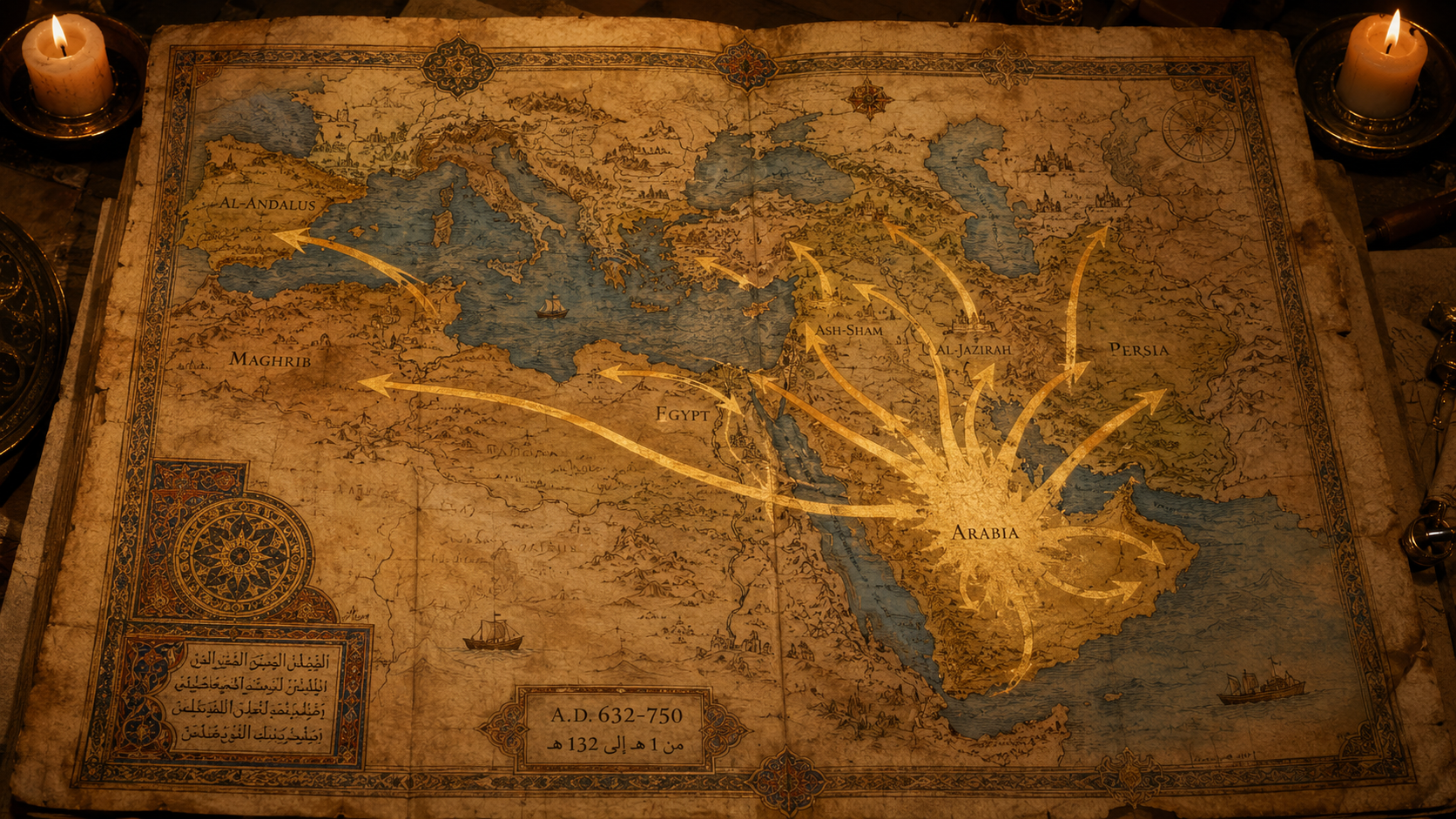
In the first Christian centuries, Rome’s great rival was not Islam — Islam did not yet exist. Rome’s rival was the apostolic church of the East, which had spread out from where the disciples taught, across Asia Minor, into Persia and beyond, and along North Africa — much of it keeping the seventh-day Sabbath and resisting Rome’s innovations. Now trace what happened. Muhammad died in 632; within thirty years the armies of Islam had taken Damascus (635), Jerusalem (638), Egypt (641), and the Persian empire; by 711 they had crossed into Spain, and by 750 the new faith stretched from Iberia to the borders of India. The lands it swallowed first and most completely were precisely the heartlands of that eastern, non-Roman Christianity. Rome itself, untouched, remained the seat of Western religion.
We draw no secret cause from this; we only set the dates down and let them speak. If some power had wished the eastern church erased, a desert religion that surged out in the seventh century and submerged exactly those territories would have done the work with terrible efficiency. (And the kingdoms inside Europe that stood in Rome’s way — the non-Nicene, reportedly Sabbath-keeping Goths — were the first to be removed; and Spain, when Islam swept in, lay under the Visigoths, themselves non-Catholic and nearer the Sabbath-keeping Ostrogoths than to Rome; see The Three Plucked Horns.) Whether or not anyone designed it, the map raises the question the title asks from a different angle: whom did the rise of Islam serve?
The synthesis
Leave the origins and look at the destination, where the evidence is public and recent. The great religious project of our age is union — the drawing-together of the faiths into one. On 14 May 1999, Pope John Paul II was given a Qur’an by a visiting delegation led by the Chaldean Patriarch of Babylon, Raphaël I Bidawid — and the pope kissed it. Cardinals and theologians speak of a “trialogue” of Judaism, Christianity, and Islam — a word coined by Benjamin Chavis, once a leader of the National Council of Churches, who soon afterward left for the Nation of Islam. Robert Schuller said of the grand mufti that he had “seldom met a man” with whom he felt “an immediate kinship of spirit.” Billy Graham, on television in 1997, allowed that “we’re closer to Islam than we really think we are.” And Mary, again, is named as the bridge.
The pattern is the old revolutionary method — thesis, antithesis, synthesis: set two forces against each other, let the collision exhaust both, and from the wreckage build the thing you wanted all along. Rub Christianity and Islam together, and present, as the only escape from the conflict, a single world religion. It is the same end the Reformers and the pioneers read in prophecy — a final, universal, counterfeit worship with one figure lifted over all. We are not asking you to accept a theory of the future. We are pointing at the direction of travel and asking where you think this road ends.
The same engine can be read backward through history. When the Orthodox East broke from Rome, it was the Ottoman armies that fell upon the Orthodox lands — the Serbs, the Romanians, the Greeks — and what escaped north into Russia did not escape the sword of Communism; and after the Russian revolution the Orthodox church itself has, in effect, said, “I’m sorry.” Two pincers, one outcome: the rival of Rome ground down between them. And the homages of our own day are not hidden — Yasser Arafat kissing the pope’s ring; an actor who had played the Christ kneeling before him; even Catholic art that shows the apostle Peter kneeling to Mary for forgiveness. The drawing-together is photographed, not theorized.
What the insiders wrote
There remains the darkest claim, and it must be handled most carefully of all, because it concerns what cannot be seen from outside — the inner circle of these systems. The charge is stark: that the sincere masses of Islam, of Rome, and of the lodges are kept in the outer court, while a hidden core knows it is serving another master entirely. We cannot see inside a secret; no one can. What we can do is read what the initiates themselves chose to write down — and ask.
Albert Pike, in Morals and Dogma (1871), wrote that the Bible lies on the lodge altar in a Christian country, the Qur’an in a Muslim one, the Hebrew scriptures in a Jewish one — each merely the local covering, none the true light. The occultist Helena Blavatsky, in Isis Unveiled (1877) and The Secret Doctrine (1888), wrote in plain words of Lucifer as a divine light, and identified the goddess of the ancient mysteries — Isis, the mother of the gods — with the Mary of Rome. These are not our words about them; they are their own words, in their own books, which anyone may read. And so the question we will pose to you and leave unanswered: if the outer doctrines are admittedly only the covering, what is being honored underneath — and is it the same thing under more than one veil?
And the link is not only in old books; it is built into the lodges themselves. At the highest visible reaches of Freemasonry sits the Shrine — formally the “Ancient Arabic Order of the Nobles of the Mystic Shrine,” open only to those who have taken the 32nd degree or the Templar vows. Its temples wear the crescent and the scimitar and the fez; and by the order’s own ritual its candidates have sworn their oath “in the name of Allah … the god of our fathers,” with the Qur’an upon the altar. A Christian who would never bow in a mosque bows there without noticing.
The thread runs back through the Islamic secret societies the Crusaders met in the East — the Ismailis; the Fatimites, whose “House of Knowledge,” the Dar al-Hikmat, was a graded lodge in Cairo; the Druze; and the Assassins, whose creed — “nothing is true, and all is allowed” — armed men to kill themselves in the act of killing others, a tactic the modern world has met again. Whether these are borrowings or branches of one older root is exactly the question the insiders’ own writings leave open.
The claim is that this hidden stream is older than Islam itself. The occult historians point to men like Origen and the bishop of Alexandria — “Christian, so-called” — as early keepers of the mystery knowledge; when the library of Alexandria fell, they say, its esoteric inheritance moved west, and “the final seat of the occult knowledge was in Rome.” One former 33rd-degree Mason, James D. Shaw (The Deadly Deception), described an initiation sealed by drinking wine from a human skull, with a member robed as a skeleton — and a “very prominent preacher” looking on. And the lodges are no fringe in the Muslim world: heads of state from Nasser to Anwar Sadat (1970–1981) are named as members of the Egyptian order and the Shrine. This part we cannot prove from the inside; no one can see into a secret. We only set down what the initiates themselves committed to print.
And the threads tie off in one place. The Masonic author Arthur Edward Waite wrote that “Babel represented the Masonic enterprise,” and the old spiral Tower of Babel is drawn, again and again, as that enterprise — with Mary set atop the spiral. Who, then, is to be queen of the new Babylon? And who is Mary, in the mouths of these writers, but Isis under a Christian name? It is the very figure Scripture names at the end — a woman, a city, a Babylon — and against whom the last call of the gospel is raised.
Firm ground and open ground
What is documented, and what is asked
Firm ground: the shared crescent-and- star and Marian moon imagery (drawn by both from a far older pagan source); Allah as a pre-Islamic moon-god whose name corresponds to the Babylonian Bel; the Christian Waraqa at the cradle of the revelation (c. 610); the Qur’an’s exaltation of Mary; the Douay-Rheims’ “she shall crush” at Genesis 3:15; Fulton Sheen’s published hope (1952) that Fátima would bridge Islam to Rome; John Paul II kissing the Qur’an (14 May 1999); the Vatican and the great cathedrals raised on older pagan sites, and the mosque in the Luxor temple and the church on the temple of Baal at Baalbek; the Shrine’s “in the name of Allah” oath with the Qur’an on its altar; the public ecumenical drive toward one religion; the seventh-century map. These are on the record. Open ground: Alberto Rivera’s claim that Rome engineered Islam — offered here only to be named and set aside, since it was exposed as fraudulent (1981); the identification of the Black Madonna with Isis (urged by a former head of the Priory of Sion in The Templar Revelation); the occult readings that decode the sun-and-moon symbols and the litany of titles that equate Mary with Isis; the Fátima “secrets” and the modern apparitions; the charge that Rome has guided Islam from the beginning; and the charge that the inner circles knowingly worship Lucifer — all of which we present strictly through what those authors themselves wrote, and the named preachers’ words as the source documents them, and leave as questions. We have not dressed the second kind as the first.
What the Qur’an itself carries
Set Rome aside for a moment and look only at the book. The Qur’an does not read as a fresh revelation from a clear sky; its departures from Scripture, the Encyclopaedia Britannica notes, can in most cases be traced to the legends of the Jewish Hagadah and to the apocryphal infancy gospels — the same uncanonical streams that fed the cult of Mary. It even frames the creation in long “day-periods” and sets man above the angels. And it carries the old spiritism openly: where the Bible calls the consulting of spirits an abomination, the Qur’an affirms the world of the jinn — beings “formed of fire” who serve as media between men and the unseen, with Iblis (Satan) named as their head. What Scripture forbids, the book embraces.
And its endgame is openly universal. The English Qur’an handed out at the United Nations commends Islam, in its own commentary, as a faith of “equality, liberty and fraternity” that “insists upon the fundamental unity of all revealed religions” — which is, almost word for word, the creed of the lodge. The book that denies the cross and the book that lies on the Masonic altar speak, at the last, the same hope: one religion for all mankind.
The one difference that is absolute
And yet, when every symbol and parallel and question is laid down, there is one place where the overlap stops cold — and it is the place that matters most. Whatever Islam and Rome may share, the Qur’an does one thing the gospel can never survive: it denies the cross.
…they said, “We killed the Messiah, Jesus the son of Mary” … but they killed him not, nor crucified him, but it was made to appear so to them…
A Christ who did not die did not rise, and did not save. It is the same emptying that the popular religion of Rome works from the other side, when it sets Mary in the place of the one Mediator and makes the Saviour’s merit flow from His mother. By two different doors, the same thing is carried out: the Son is moved out of the center. And against both stands the apostle’s plain test — who is a liar but he that denieth that Jesus is the Christ (1 John 2:22) — and the Saviour’s own definition of life:
And this is life eternal, that they might know thee the only true God, and Jesus Christ, whom thou hast sent.
That is the whole of it. The God of the gospel so loved the world that He gave His only begotten Son — gave Him to the cross, and raised Him. A God who did not give His Son, and a Son who was never given, are not the same God under two names; they are the absence of the one thing the gospel is. One Muslim convert, asked the difference between the God he had left and the Christ he had found, answered in a single line: for God so loved the world that He gave His only begotten Son. There is the sentence that no symbol, no synthesis, and no secret can cross.
Come out of her
So we end where the matter ends — not in suspicion of people, but in compassion for them. If there is a hidden architecture behind these great systems, then the millions inside them are not the schemers but the loved and the deceived: sincere Muslims bowing five times a day to a God they believe is one; sincere Catholics telling their beads before a Mary they believe will carry them home. The call of Scripture is not contempt for them. It is a hand held out:
And I heard another voice from heaven, saying, Come out of her, my people, that ye be not partakers of her sins, and that ye receive not of her plagues.
There are many in Islam who will see the light, as there are many in Rome who will — and the proof that it can be seen is that it has been seen, again and again, by those who walked out of both with their Bibles open and their hearts free. The privilege on the other side of the door is not a colder religion; it is the opposite of religion-as-bondage — a living Lord who may be spoken to directly, at any hour, with no priest and no bead and no veil, and who never forces the love He asks for. So lay the pieces side by side. Ask the question in the title honestly. And bring it — and yourself — to the only One who can answer it.
Go deeper
These companion studies open the threads of this one further, from Scripture and the historical record.