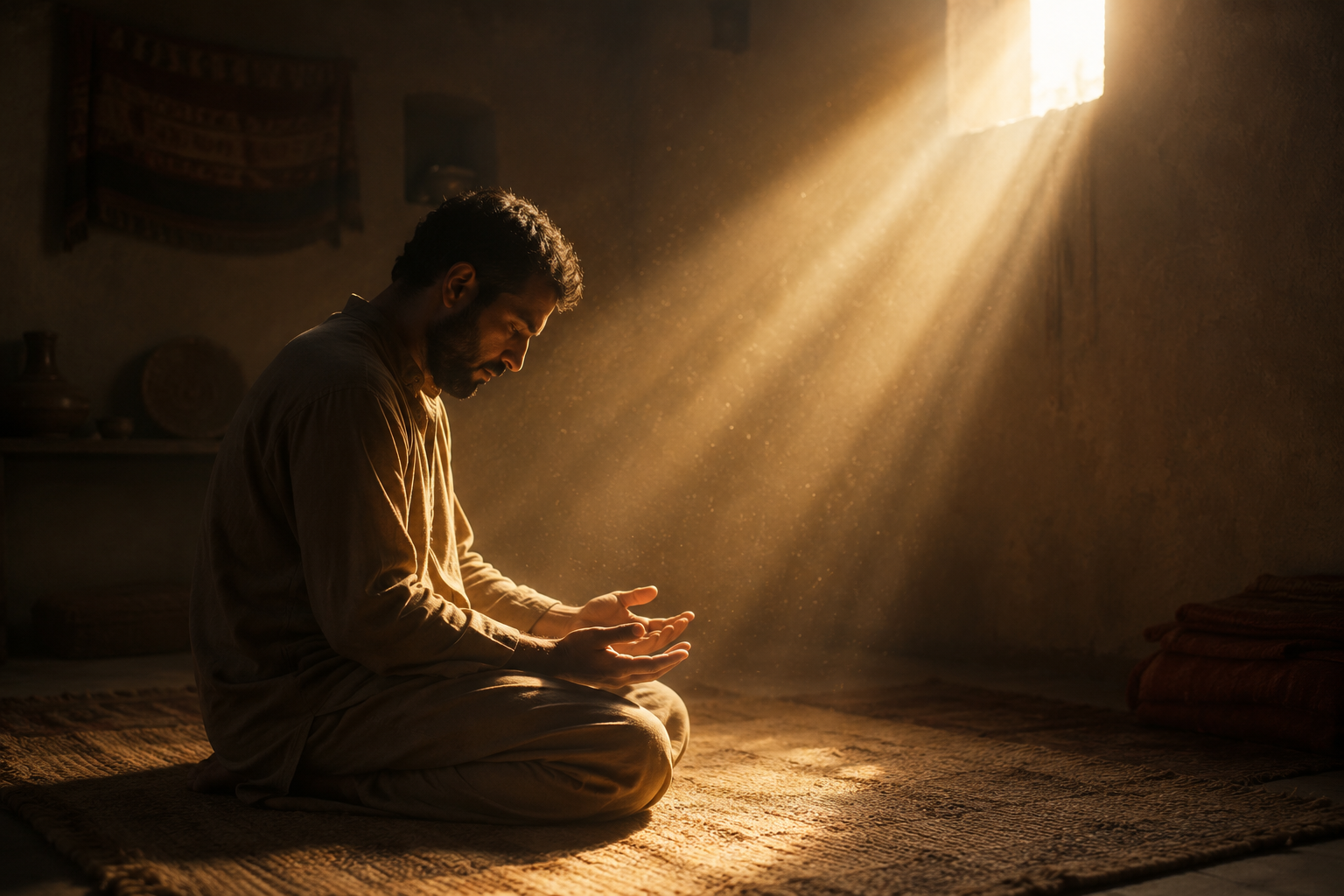

Peace be upon you. We write again as friends, and we write plainly, because flattery is not friendship. You love God; you guard His oneness with a zeal that shames many who call themselves Christians. It is because we share that love of the one God that we want to set two familiar things before you — gently, but honestly — and ask one question of each: where is the heart actually going?
A word, in peace
The two things are very different, and we will keep them apart so that neither gets blurred into the other. The first is a habit of devotion — the recordings many of our Muslim friends fill their hours with, in which a name is repeated over and over. The second is the discipline of the five daily prayers. They are not the same kind of thing, and they go wrong, if they go wrong, in different ways. But underneath both lies a single quiet assumption worth examining: that God is reached by repetition — the right name said enough times, or the right words said enough times, at the right hours. Walk through both with us, and weigh them not against our opinion but against the Book.
I. The chant and the name
You will know the recordings we mean — they are beautiful, rhythmic, and many keep them playing for hours: a single voice, or a crowd of voices, returning again and again to a name. Sometimes it is one of the names of God. But very often it is the name of the Prophet, or of Ali, or of another revered man of the faith — the name repeated hundreds of times until it fills the room and the mind and the chest. To the one listening it feels like reverence, like love, like devotion poured out.
We do not doubt the sincerity for a moment, and we will not mock it. We only want to ask one honest question about where that devotion is being sent — because we have watched honest, devout Muslims lose hours to it and call it nothing more than honoring a great man, and we think it is quietly more than that. There is a difference between admiring a good man and calling upon his name — filling the heart with it, leaning the soul upon it, letting it become the word the spirit reaches for in longing. That second thing is not admiration. It is an act of worship. And notice — this may be the most important thing in this whole letter — that it is done for the Prophet, for Ali, for the saints, in a way it is not done for God Himself. The created name is the one chanted by the hour; the Creator’s is not. Anyone who loves the oneness of God should feel a chill at that.
Worship has one address
Here the Bible is not subtle, and on this point it says exactly what your own first principle says — only it follows the principle all the way down. Worship, devotion, the calling-upon of a name in trust: these have a single rightful address, and it is God.
Thou shalt have no other gods before me. Thou shalt not make unto thee any graven image… Thou shalt not bow down thyself to them, nor serve them.
…Thou shalt worship the Lord thy God, and him only shalt thou serve.
“Him only.” Not him chiefly, with the Prophet a close second; not him mostly, with Ali for the harder days — Him only. And God will not divide the honor of His name with any creature, however exalted:
I am the LORD: that is my name: and my glory will I not give to another…
To call upon a name — in the Scriptures this is the very language of salvation, and it is reserved, without exception, for the Lord: “whosoever shall call upon the name of the LORD shall be delivered” (Joel 2:32). The name you call upon in your devotion is the name you are trusting to hear you, to help you, to save you — and no prophet, no matter how beloved, can bear that weight. To lay it on him is not to lift him up; it is, in the Bible’s plain word, to serve “the creature more than the Creator” (Romans 1:25). That exchange — devotion meant for the Maker given instead to something made — is exactly what Scripture calls idolatry, and it grieves God not because He is jealous like a small man, but because it robs His creatures of the only One who can actually answer them.
And here is something striking: the true servants of God in Scripture refuse this. When a good man fell down to worship the apostle Peter, Peter pulled him up: “Stand up; I myself also am a man” (Acts 10:26). When the apostle John fell at the feet of a mighty angel, the angel stopped him cold — “See thou do it not… worship God” (Revelation 19:10). The holier the servant, the more swiftly he turns your devotion away from himself and points it back to God. A prophet who would let his name be chanted as God’s name is meant to be chanted would not be a prophet at all.
What your own creed already knows
This is why we say the danger should be plainer to you than to almost anyone. Your whole faith is built on one magnificent sentence: that God is one, and that nothing and no one may be set beside Him. That is its glory, and we honor it. But that very sentence is the reason the name of a man must not be poured out in devotion the way the name of God alone deserves. Your own scriptures insist that the Prophet was a man — mortal, a messenger, one who would die as other men die, forbidden to be made an object of worship. To give him the adoration owed to God is not to honor him; it is to break the one truth you have given your life to defend. If your account of him is true, he would be the first to tear the headphones away and say, with Peter, “I myself also am a man — worship God.”
II. The prayer said by the clock
The second thing is different, and we must be careful to be fair about it. Five times each day — before dawn, at midday, in the afternoon, at sunset, and at night, and the devout add still more — you stop, turn, and pray: the fixed words, the opening of your Book and the set phrases, the same bows and prostrations, at the appointed hours, carried out faithfully because to neglect them, or to perform them wrongly, is felt to be a failure of faith itself.
We want to say first what is good here, because it is real. A life that halts five times a day to remember God is a standing rebuke to a careless world that never halts at all. The discipline, the reverence, the willingness to interrupt everything for God — these put most of us to shame, and we will not pretend otherwise. The question is not about your earnestness. It is about the shape of the thing: fixed words, memorized and repeated, counted, timed, and felt to be required — the same syllables, in the same order, for a lifetime. And about exactly this, the One you are praying to said something surprising, and freeing.
“Much speaking”
But when ye pray, use not vain repetitions, as the heathen do: for they think that they shall be heard for their much speaking. Be not ye therefore like unto them: for your Father knoweth what things ye have need of, before ye ask him.
Read it slowly. Jesus is not against praying often — He prayed constantly, sometimes all night long. He is against a particular idea: that prayer works by accumulation — that the right form, repeated enough times, at the right intervals, earns a hearing; that God is moved by the count, the length, the precision of the performance. He calls that the way of those who do not know God, and He says plainly why it is needless: your Father already knows what you need before you ask. You are not informing a distant master who must be worn down by repetition. You are speaking to One who is already near, already listening, already kind.
And He had warned, long before, about worship that lives in the mouth while the heart is elsewhere:
…this people draw near me with their mouth, and with their lips do honour me, but have removed their heart far from me… in vain they do worship me.
That is the precise danger of any prayer said by the clock — ours included, for many a Christian mumbles memorized words with a wandering heart and is just as guilty. The peril is not the Arabic, or the posture, or the hour. It is that the lips can run the whole circuit while the heart never leaves the ground. “Let thy words be few” (Ecclesiastes 5:2), Scripture says — not because God dislikes our speech, but because He is after our heart, and the heart is not measured in syllables.
The heart, not the count
When His disciples asked Him how to pray, Jesus gave them a model short enough to say in a breath (Matthew 6:9–13) — and He introduced it with the words “After this manner,” a pattern to shape the heart, not a formula to be counted off for merit. (He would have been the first to say that even those few lines, recited by rote with a far-off heart, become the very “vain repetition” He just condemned.) Then He threw the door wide:
But thou, when thou prayest, enter into thy closet, and when thou hast shut thy door, pray to thy Father which is in secret; and thy Father which seeth in secret shall reward thee openly.
Not five appointed performances turned toward a city, but a door shut on the world and a heart opened to a Father — at any hour, in any words, in your own tongue, in the field or the bed or the prison cell. And not five times, but without end: “Pray without ceasing” (1 Thessalonians 5:17) — not a heavier schedule than yours, but the opposite of a schedule: a whole life turned Godward, an unbroken conversation that needs no clock because it never stops.
You are not alone in this
And here we must say something plainly, friend, so that this letter never feels as though it singles you out — because it does not, and the trouble it names is not yours alone. The reflex to reach God by repetition runs through nearly every faith on earth, our own included.
- Catholic Christians count the same prayers over and over on a string of beads — the rosary — and many of those prayers are addressed not to God but to Mary and to the saints. So both of the things we have named — a name repeated, and devotion given to a creature — meet in a single practice.
- Hindu seekers tell a strand of beads (a mala) the same way, a mantra or a god’s name repeated hundreds and thousands of times; and some movements fill whole gatherings with one divine name chanted without end — the mirror image of the recordings we began with.
- Devout Jews keep fixed prayers at fixed hours from a set prayer-book, much as you keep yours, and gather to pour them out at the Western Wall in Jerusalem — praying, let us be clear, to God, at the last stone of His ancient temple, never to the stones themselves.
- And we Christians are the last who may point a finger: our own history is heavy with repeated rote prayers, counted devotions, and lips that move while the heart sleeps.
We name these not to accuse our neighbors but to set you at ease: this is no Muslim failing. It is a human one — the old instinct to believe that the right words, said often enough, in the right place, will reach heaven. And the word of the Lord Jesus we have already heard falls with the same gentle weight on every one of us, whatever our creed: not the count, but the heart.
What He actually asks
See how the same mistaken assumption runs under both practices — the chanted name and the counted prayer. Both quietly suppose that God is reached by repetition: the right name said enough, the right words said enough, at the right times. But the God of the Bible is not worked like a combination lock. He is met in the heart:
…the true worshippers shall worship the Father in spirit and in truth: for the Father seeketh such to worship him. God is a Spirit: and they that worship him must worship him in spirit and in truth.
Worship is not the right syllables aimed in the right direction; it is the living heart in real contact with the living God. And this is the gospel’s astonishing offer, the thing that makes the endless repetition unnecessary: in the Messiah, the way to God is thrown open. You do not have to earn a hearing by the count of your prayers, or borrow the merit of a saint by chanting his name. There is one Name — not the name of any prophet or holy man, however great — that may be called upon, and that actually saves:
Neither is there salvation in any other: for there is none other name under heaven given among men, whereby we must be saved.
That Name is the Lord’s own, given to His Son — the Word of God and the Spirit from Him whom even your own Book honors above other men. He does not ask you to reach Him by repetition. He asks you to come, as a child comes to a father who already loves him, with empty hands and an honest heart.
So we plead with you as friends who share your hatred of idols and your love of the one God: do not give to any man — however beloved, however great — the devotion that belongs to God alone; and do not let your prayer shrink into a count you keep, when it was meant to be a conversation you live. The God you are reaching for is nearer than the next recitation. He is not counting your words. He is waiting for your heart. Peace be upon you, and may the one true God draw you to Himself.
Go deeper
These companion studies carry the heart of this letter further, from Scripture and in the same spirit.