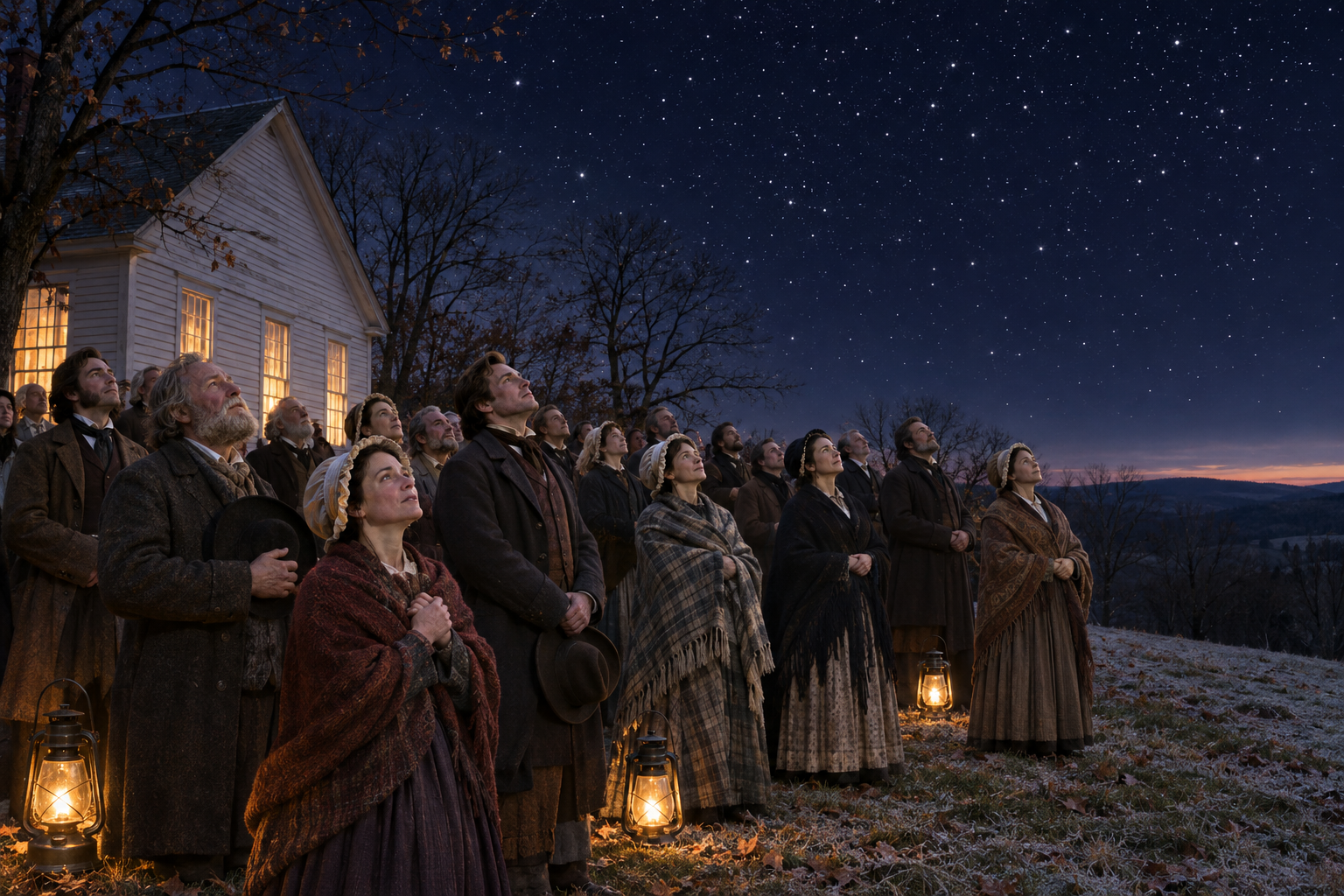
On the evening of October 22, 1844, tens of thousands of believers waited for Jesus to come. They had studied the prophecy, settled their debts, made things right with their neighbors, and given up their earthly plans. Midnight came. Then morning. He did not come. What happened that night — and what happened in the world around it — is one of the most remarkable chapters in the history of prophecy.
The night of October 22
Hiram Edson, a farmer in western New York, kept a small company of believers at his home that day. He later wrote what the night was like:
Our expectations were raised high, and thus we looked for our coming Lord until the clock tolled twelve at midnight. The day had then passed, and our disappointment had become a certainty. Our fondest hopes and expectations were blasted, and such a spirit of weeping came over us as I never experienced before. It seemed that the loss of all earthly friends could have been no comparison. We wept and wept, till the day dawn.
In Maine, a young preacher named James White heard someone say a few days later that the brethren should prepare for another cold winter. “My feelings were almost uncontrollable,” he remembered. “I left the place of meeting and wept like a child.” Another preacher, Luther Boutelle, described the silence that followed:
All was still. No Advent Herald; no meetings as formerly. Every one felt lonely, with hardly a desire to speak to any one. Still in the cold world! No deliverance—the Lord not come! … All were silent, save to inquire, ‘Where are we?’ and ‘What next?’
“Sweet as honey”
It is hard to overstate how sweet the hope had been. William Miller and those who preached with him had traced the 2300 days of Daniel 8:14 to 1844, and believed that the “sanctuary” to be cleansed was the earth, to be purified by fire at Christ’s return. In the last weeks, as one witness recalled, “Many farmers left their grass and grain standing in the field, unharvested, and went forth to warn their fellow-men” (Washington Morse, 1888). In the final ten days, wrote Miller’s biographer, “secular business was, for the most part, suspended.”
The ridicule afterward was just as real. Believers were greeted in the streets with taunts like “You have not gone up yet!” (Bliss, 1853). The story of the movement itself — who Miller was, and the roads that led out of 1844 — is told in Are Seventh-day Adventists Millerites?
“My belly was bitter”
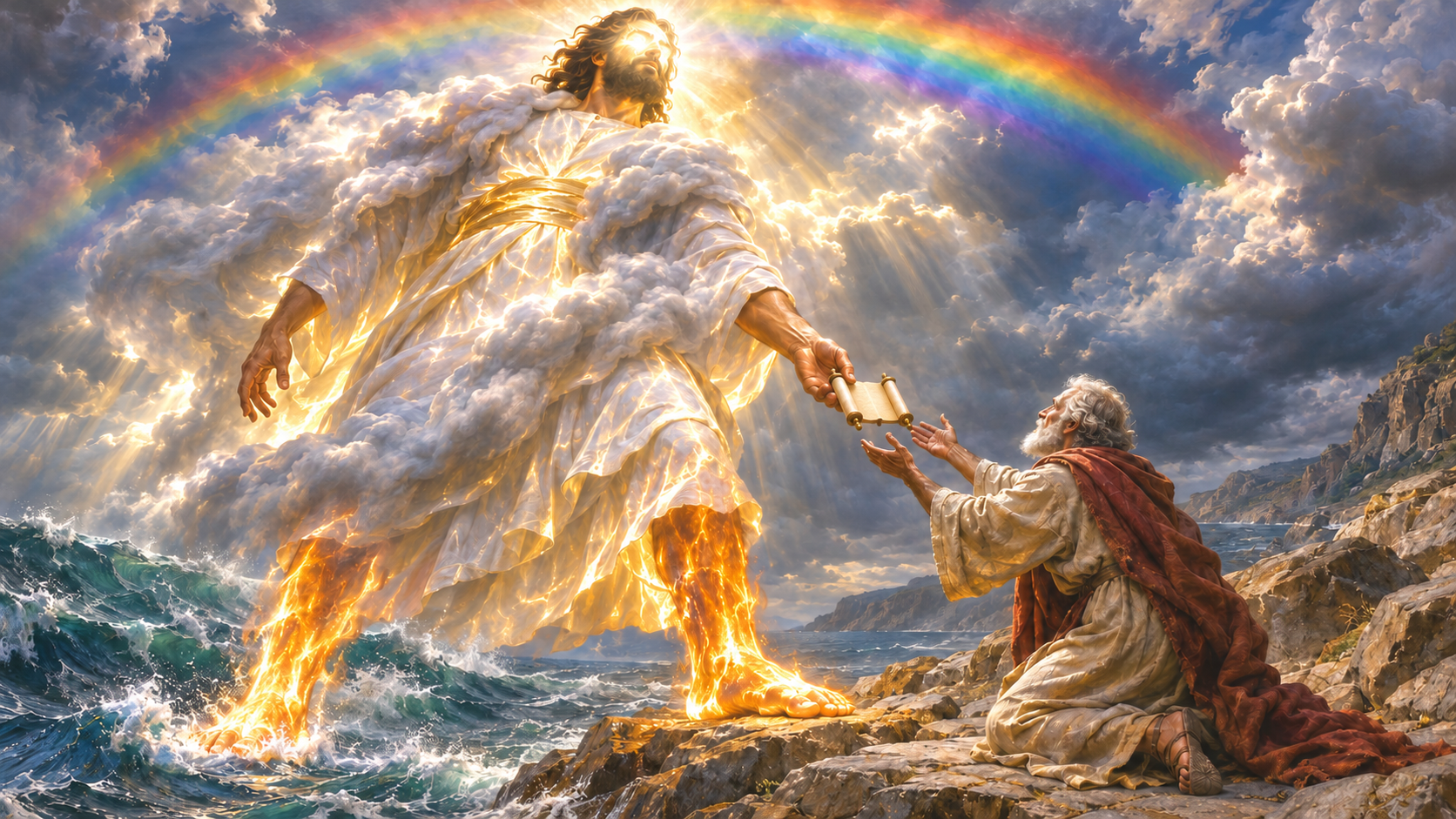
The strange thing is that the Bible had described this experience in advance. In Revelation 10 a mighty angel stands with one foot on the sea and one on the land, holding “a little book open” — and Daniel was the book that had been sealed “even to the time of the end” (Daniel 12:4). John is told to eat it:
And he said unto me, Take it, and eat it up; and it shall make thy belly bitter, but it shall be in thy mouth sweet as honey. And I took the little book out of the angel’s hand, and ate it up; and it was in my mouth sweet as honey: and as soon as I had eaten it, my belly was bitter. And he said unto me, Thou must prophesy again before many peoples, and nations, and tongues, and kings.
Sweet in the mouth, bitter in the belly, and then a commission to prophesy again. The first Sabbath-keeping Adventists saw their own experience in it. James White wrote in 1868:
But in the symbol there is a change from the sweetness of honey to bitterness. This represents the change from the joy of bright hope to the painful sadness of disappointment, experienced by believers at the passing of the time.
The disappointment did not mean the prophecy had failed. It meant the prophecy had been eaten — received, believed, and lived — and the bitterness was part of the plan. The command that follows, “Thou must prophesy again,” pointed to a message still to be given to the whole world.
“But we trusted”
It had happened before. On the Sunday after the crucifixion, two disciples walked to Emmaus with broken hearts:
But we trusted that it had been he which should have redeemed Israel: and beside all this, to day is the third day since these things were done.
They had the right Messiah and the right time — the seventy weeks of Daniel 9 had pointed to Him — but they expected the wrong event: a throne in Jerusalem, not a cross. Jesus did not tell them the prophecies had failed. “Beginning at Moses and all the prophets, he expounded unto them in all the scriptures the things concerning himself” (Luke 24:27). Ellen White drew the parallel plainly:
As the disciples were mistaken in regard to the kingdom to be set up at the end of the seventy weeks, so Adventists were mistaken in regard to the event to take place at the expiration of the 2300 days.
Jesus had even told a parable about it. “While the bridegroom tarried, they all slumbered and slept. And at midnight there was a cry made, Behold, the bridegroom cometh” (Matthew 25:5-6). And Habakkuk had written of a vision with an appointed time: “though it tarry, wait for it; because it will surely come” (Habakkuk 2:3).
The morning after
The morning of October 23, Edson and a companion set out to encourage other believers. Crossing a large field, he stopped:
Heaven seemed open to my view, and I saw distinctly and clearly that instead of our High Priest coming out of the most holy place of the heavenly sanctuary to this earth on the tenth day of the seventh month, at the end of the 2300 days, He, for the first time, entered on that day into the second apartment of that sanctuary, and that He had a work to perform in the most holy place…
Whatever one makes of that moment — later retellings added details Edson never wrote, such as the famous “cornfield” — what matters is that he and others went straight to their Bibles, and the Bible bore it out. The sanctuary of Daniel 8:14 was not the earth but the one in heaven, “the true tabernacle, which the Lord pitched, and not man” (Hebrews 8:2). Daniel had seen the Son of man come — not to the earth, but “to the Ancient of days, and they brought him near before him” (Daniel 7:13), where “the judgment was set, and the books were opened” (7:10).
The subject of the sanctuary was the key which unlocked the mystery of the disappointment of 1844.
One discovery led to another. Revelation 11:19 says “the temple of God was opened in heaven, and there was seen in his temple the ark of his testament” — and inside the ark were the Ten Commandments, the fourth of them unchanged. Within two years a small group was keeping the seventh-day Sabbath. The “hour of his judgment” had come (Revelation 14:7), and the three angels’ messages took shape as the message they must “prophesy again”. The Sanctuary Cheat Sheet answers the objections to it.
Miller himself never accepted the sanctuary explanation, but he did not give up on Christ. Three weeks after the disappointment he wrote:
Yes; and, although I have been twice disappointed, I am not yet cast down or discouraged. … I have fixed my mind on another time, and here I mean to stand until God gives me more light, and that is, to-day, to-day, and to-day, until he comes.
A teenage girl in Portland, Maine, who had lived through the same night, later summed it up in one line: “We were disappointed, but not disheartened” (Ellen G. White, Life Sketches, p. 62).
Satan’s counter-agenda
If 1844 marked the opening of the judgment in heaven, we should expect the enemy to answer it on earth. Revelation says as much: “the devil is come down unto you, having great wrath, because he knoweth that he hath but a short time” (Revelation 12:12), and “the dragon was wroth with the woman, and went to make war with the remnant of her seed, which keep the commandments of God, and have the testimony of Jesus Christ” (12:17).
The message God was raising up in those years is summed up in the first angel of Revelation 14:
And I saw another angel fly in the midst of heaven, having the everlasting gospel to preach unto them that dwell on the earth, and to every nation, and kindred, and tongue, and people, Saying with a loud voice, Fear God, and give glory to him; for the hour of his judgment is come: and worship him that made heaven, and earth, and the sea, and the fountains of waters.
Now look at what else was born in the same months. In 1844 alone, a new religion in Persia announced that the prophecy of Daniel had been fulfilled in a man; a young German philosopher declared religion an opiate; the theory of evolution was written down and published; and a prophet in Illinois taught that God Himself had once lived on an earth as a man. Four years later, the “spirits of the dead” began to rap at a farmhouse in New York. Each one strikes at a different part of the message God was restoring. This is not a verdict on the sincerity of anyone caught up in these movements. It is a pattern — and the pattern is hard to miss.
Counterfeit 1 · May 22, 1844
Another “return of Christ” — from the same prophecy
Strikes at · The visible, personal Second Coming
On the evening of May 22, 1844, in Shiraz, Persia, a young merchant known as the Báb (“the Gate”) declared that he was the one whose coming had been foretold. The Bahá’í faith dates its calendar from that year. What is astonishing is how its own scriptures argue the point — from the very prophecy the Millerites preached:
Therefore, from the date of the edict of Artaxerxes to rebuild Jerusalem until the day of the birth of Christ there are 456 years, and from the birth of Christ until the day of the advent of the Báb there are 1,844 years, and if 456 years are added to this number it makes 2,300 years. That is to say, the fulfilment of the vision of Daniel took place in A.D. 1844, and this is the year of the advent of the Báb.
The same 2300 days, the same decree, the same year — with a counterfeit at the end. Later, his successor Bahá’u’lláh wrote to the Christians, “Say, Lo! The Father is come” and “He, verily, hath again come down from heaven, even as He came down from it the first time.” Jesus warned of exactly this: “if they shall say unto you, Behold, he is in the desert; go not forth: behold, he is in the secret chambers; believe it not. For as the lightning cometh out of the east, and shineth even unto the west; so shall also the coming of the Son of man be” (Matthew 24:26-27). When He comes, “every eye shall see him” (Revelation 1:7).
Counterfeit 2 · February 1844
A world without God
Strikes at · “Fear God, and give glory to him”
In February 1844, in a Paris journal, a 25-year-old Karl Marx published the essay that contains his most famous line:
Religion is the sigh of the oppressed creature, the heart of a heartless world, and the soul of soulless conditions. It is the opium of the people.
The same essay declares that “the criticism of religion is the prerequisite of all criticism.” That year he wrote his Economic and Philosophic Manuscripts and began his lifelong partnership with Friedrich Engels; in 1848 they published the Communist Manifesto. Here was a gospel with no God in it — salvation of man by man, and judgment by history instead of by the Judge of all the earth. Paul had warned, “Beware lest any man spoil you through philosophy and vain deceit, after the tradition of men … and not after Christ” (Colossians 2:8).
Counterfeit 3 · January–October 1844
Creation without a Creator
Strikes at · “Worship him that made heaven, and earth” — and the Sabbath
In January 1844 Charles Darwin confided to a friend that he had come to a conclusion he hardly dared to say:
At last gleams of light have come, & I am almost convinced (quite contrary to opinion I started with) that species are not (it is like confessing a murder) immutable.
By July 1844 he had finished a written sketch of his theory and asked his wife, in case of his sudden death, to see it published. That October, an anonymous book called Vestiges of the Natural History of Creation brought the idea of life developing by natural law to the reading public, and became a sensation. In the very years that God was calling the world to “worship him that made heaven, and earth” — and restoring the seventh-day Sabbath, the memorial that “in six days the LORD made heaven and earth” (Exodus 20:11) — the world was handed a story of creation that needed no Creator at all.
Counterfeit 4 · April 7, 1844
“Ye shall be as gods”
Strikes at · The eternal, unchanging God
On April 7, 1844, in Nauvoo, Illinois, Joseph Smith preached a funeral sermon that became one of the defining teachings of his church. As it was printed that August:
First, God himself, who sits enthroned in yonder heavens, is a man like unto one of yourselves, that is the great secret. … God himself; the Father of us all dwelt on an earth the same as Jesus Christ himself did…
Scripture does teach that God has a real form and that we were made in His image. What it never teaches is that God was once a mortal who lived on an earth and rose to godhood — or that men may climb the same ladder. “Before the mountains were brought forth, or ever thou hadst formed the earth and the world, even from everlasting to everlasting, thou art God” (Psalm 90:2). “For I am the LORD, I change not” (Malachi 3:6). The promise that men can become gods is the oldest offer in the world: “ye shall be as gods” (Genesis 3:5). Smith was killed at Carthage, Illinois, on June 27, 1844.
Counterfeit 5 · 1844 → March 31, 1848
“Ye shall not surely die”
Strikes at · The sleep of death and the resurrection
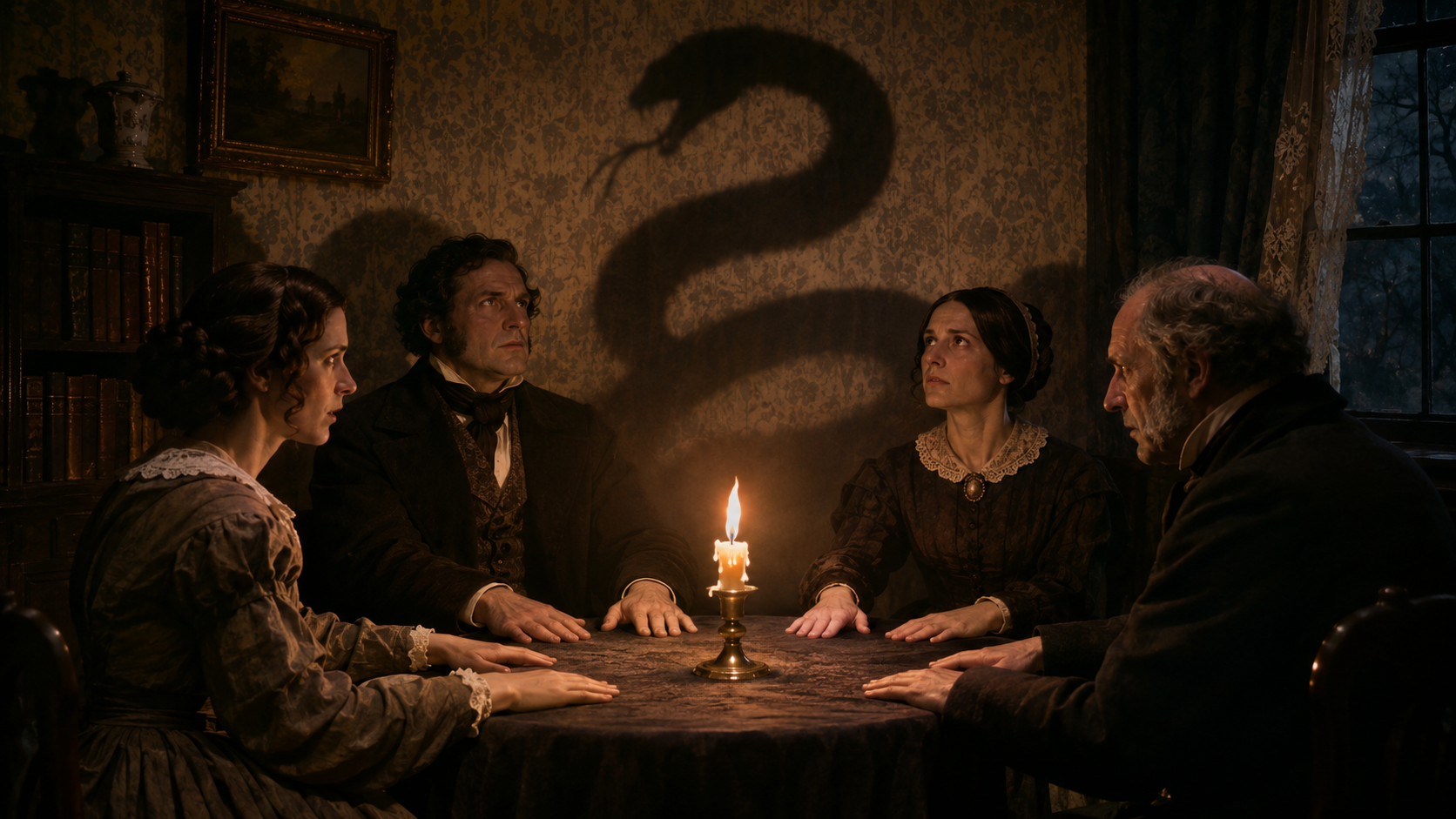
In March 1844 a young man in Poughkeepsie, New York, Andrew Jackson Davis, began to claim visits and instruction from the spirits of the dead; his trance lectures, published in 1847, prepared the ground. On March 31, 1848, at a farmhouse in Hydesville, New York, two young sisters named Fox began to communicate with “spirits” by rapping, and modern Spiritualism swept the country and then the world.
A year later, in March 1849 — months before the Fox sisters first appeared on a public stage — Ellen White wrote that she had been shown “the mysterious knocking in New York and other places was the power of Satan” (Early Writings, p. 43). Forty years after it began, one of the sisters herself stood on a stage in New York and confessed:
I am here to-night as one of the founders of Spiritualism, to denounce it as an absolute falsehood from beginning to end, as the flimsiest of superstitions, the most wicked blasphemy known to the world.
But the deception did not die with the confession. Ellen White called it Satan’s “masterpiece of deception” (The Great Controversy, p. 561). It rests entirely on the first lie ever told — “Ye shall not surely die” (Genesis 3:4) — and it rose in the same years that Adventists were recovering the Bible truth that “the dead know not any thing” (Ecclesiastes 9:5). God’s answer has not changed: “should not a people seek unto their God? for the living to the dead? To the law and to the testimony” (Isaiah 8:19-20).
And one providence
Not everything born in 1844 was a counterfeit. On May 24, 1844, Samuel Morse sent the first long-distance telegraph message, from Washington to Baltimore, in the words of Numbers 23:23: “What hath God wrought!” Daniel had been told that in the time of the end “many shall run to and fro, and knowledge shall be increased” (Daniel 12:4). The same years that raised the counterfeits also built the roads the true message would travel.
Truth and counterfeit, side by side
Lay the two lists next to each other, and the counterfeits line up against the truths almost point for point:
The truth
“Behold, he cometh with clouds; and every eye shall see him” — a visible, personal return.
The counterfeit
The Báb (1844) and Bahá’u’lláh: “the Father is come” — a return already fulfilled in a man.
The truth
“Fear God, and give glory to him” — the everlasting gospel to every nation.
The counterfeit
Marx (1844): religion is “the opium of the people”; man saves man.
The truth
“Worship him that made heaven, and earth” — and the Sabbath, the Creator’s memorial, restored.
The counterfeit
Darwin’s essay and Vestiges (1844): creation without a Creator.
The truth
“From everlasting to everlasting, thou art God” — the Father unchanging, the Son His only begotten.
The counterfeit
Nauvoo (1844): God once dwelt on an earth as a man; men may become gods.
The truth
“The dead know not any thing” — the sleep of death until the resurrection.
The counterfeit
Spiritualism (1844 → 1848): the dead are alive and speaking.
Underneath them all lie the serpent’s three lies in Eden — “Ye shall not surely die,” “ye shall be as gods,” and man “knowing good and evil” for himself (Genesis 3:4-5). The study The Three Signs of a False Religion traces them through the world’s belief systems, and The Hour of God’s Judgment lists the wider family of counter-movements of the nineteenth century. The point here is the timing: the enemy did not wait. When the hour of judgment opened in heaven, the counterfeits opened on earth.
Joy cometh in the morning
The believers who wept until dawn on October 23 did not know that the night they lived through had been written about long before. The little book had been sweet, and then bitter, and then came the command: “Thou must prophesy again.” Out of that bitterness came a people who found their High Priest in the heavenly sanctuary, the Sabbath of the Creator, the sleep of the dead, and a message for every nation — and who learned never again to set a day for His return.
For his anger endureth but a moment; in his favour is life: weeping may endure for a night, but joy cometh in the morning.
Cast not away therefore your confidence, which hath great recompence of reward. For ye have need of patience, that, after ye have done the will of God, ye might receive the promise. For yet a little while, and he that shall come will come, and will not tarry.
Further reading
Library
Are Seventh-day Adventists Millerites?
The movement, the roads out of 1844, and where the Witnesses came from.
Cheat sheet
The Sanctuary Cheat Sheet
Daniel 8:14 and every common objection to the event of 1844.
Library
The Hour of God’s Judgment
The judgment-hour message — and the wider list of counter-movements.
Library
The Three Signs of a False Religion
The serpent’s three lies in Eden, and the systems built on them.