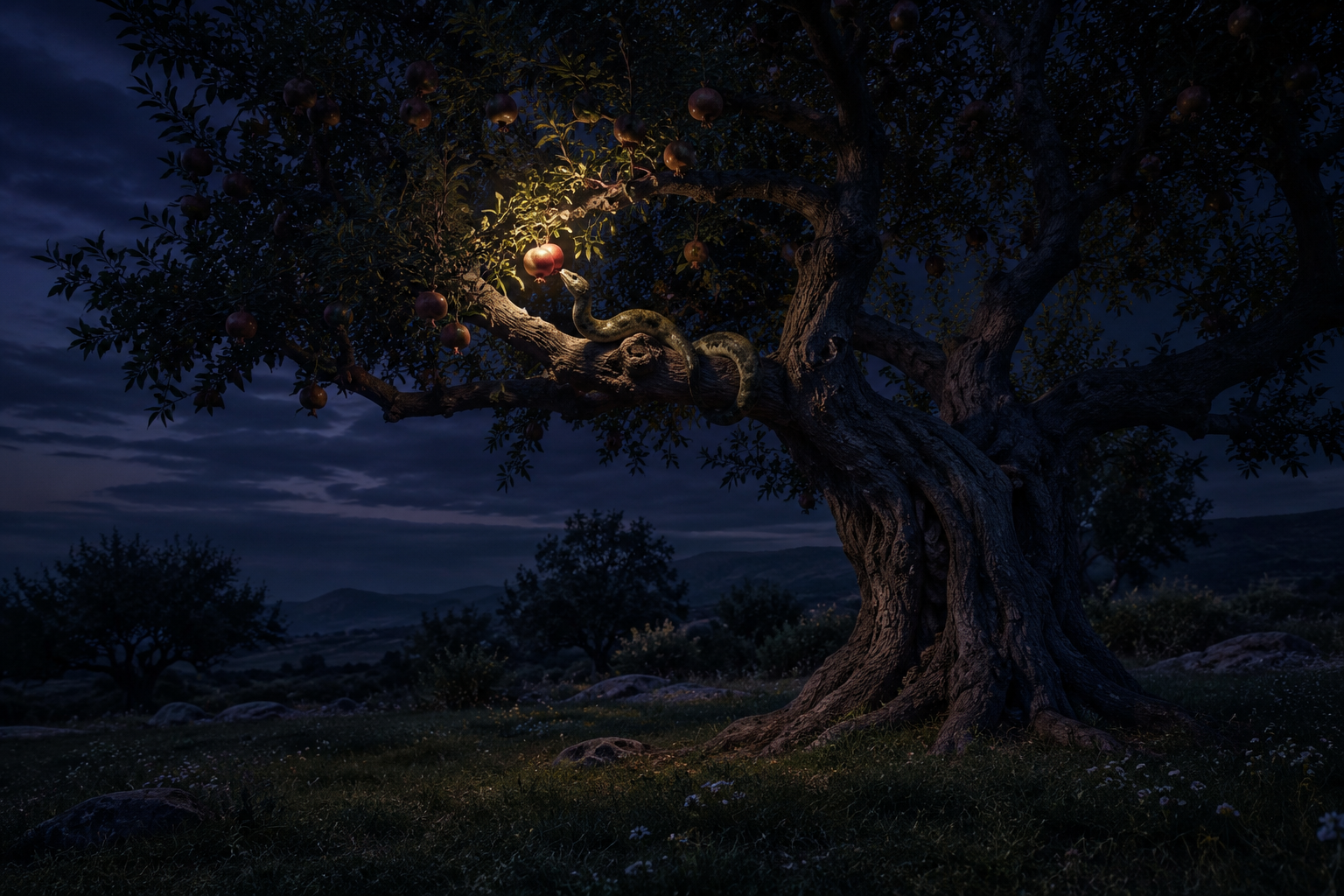


There are thousands of religions in the world, and no one has time to study them all. But you do not have to. Nearly every false system ever built rests on one, two, or all three of the same lies — and all three were spoken in a single conversation, at the beginning, by one voice, to one woman, beside one tree. Learn those three sentences and you are handed a key that quietly unlocks the deception in almost anything: a cult, a philosophy, a trending spirituality, a whole world religion — even, in places, the church on the corner.
One conversation, three lies
God had given the man and the woman one boundary, and He had told them plainly what lay past it: “in the day that thou eatest thereof thou shalt surely die” (Genesis 2:17). Then the serpent arrived, and in two short verses he answered God with a counter-gospel so compact it has never needed revising:
And the serpent said unto the woman, Ye shall not surely die: For God doth know that in the day ye eat thereof, then your eyes shall be opened, and ye shall be as gods, knowing good and evil.
Read it slowly and you will find not one lie but three, stacked in order:
One — “Ye shall not surely die.” Death is not real; something in you cannot die. Two — “Ye shall be as gods.” You are, or may become, divine. Three — “knowing good and evil.” You will decide for yourself what is good and what is evil.
That is the whole architecture of deception in one breath. The serpent did not need to found a religion; he planted three seeds and let history grow them. Every counterfeit faith since is, at bottom, one of these seeds come to harvest — usually dressed in new robes, in a new century, in a new tongue, but the same seed. Walk them one at a time and you will start seeing them everywhere.
The first lie: “Ye shall not surely die”
The first lie says death is not what God said it was. God said the wages of sin is death — a real ending, a return to the dust. The serpent said no: you will not really die; the essential you will simply move on, slip its body, carry on conscious somewhere else. It is the doctrine of the deathless soul, and it is the quiet foundation under a startling share of the world’s religions.
Scripture is not vague about this. The soul is not an immortal spark; it is the whole living person, and it can die: “the soul that sinneth, it shall die” (Ezekiel 18:4). The dead are not conscious somewhere; they sleep: “the dead know not any thing” (Ecclesiastes 9:5), and “his breath goeth forth, he returneth to his earth; in that very day his thoughts perish” (Psalm 146:4). Immortality is not something you already own; it belongs to God alone — “Who only hath immortality” (1 Timothy 6:16) — and He gives it as a gift, to His people, at the resurrection, when “this mortal must put on immortality” (1 Corinthians 15:53). If man already had an undying soul, the resurrection would be pointless and the gift would be no gift. The first lie empties the cross of half its meaning.
Now watch where the seed has grown:
Modern Christianity. We name it first, and on purpose, because the most widespread carrier of the serpent’s first lie in the Western world is not a pagan temple — it is the Christian funeral. The teaching that the soul is naturally immortal, that the good go straight to heaven and the lost to an ever-burning hell the moment the heart stops, did not come from the Hebrew prophets; it came into the church from Greek philosophy, and it flatly contradicts “the dead know not any thing.” A faith can carry the name of Christ and still be repeating, at the graveside, the exact words of the serpent: you shall not surely die.
Roman Catholicism builds a whole architecture on the deathless soul — purgatory, where the departed are said to suffer on toward heaven; prayers offered to dead saints as though they hear; the assumption and apparitions of a Mary who is addressed as a living intercessor. Every stone of it presupposes that the dead are awake. Spiritualism is the first lie made into a practice: séances, mediums, “crossing over,” contacting the departed — which Scripture calls seeking after “them that have familiar spirits” (Leviticus 19:31), and warns that the voice on the other side of the veil is never grandmother but a familiar spirit wearing her memory. Islam too teaches a soul conscious between death and judgment; Hinduism and Buddhism carry the lie in its Eastern dress — reincarnation, the self endlessly reborn, unable ever truly to die; and the old ancestor religions of Africa and Asia feed and fear the spirits of the dead for the same reason. Different temples, one foundation stone: you cannot really die.
The tell: any system in which death is not death — in which something in you sails on, awake, the moment the body fails — has picked up the serpent’s first sentence, whatever else it teaches.
The second lie: “Ye shall be as gods”
The second lie is the one the serpent most wanted to sell, because it is the sin that ruined him. Before there was a garden, there was a covering cherub who said in his heart, “I will be like the most High” (Isaiah 14:14), and of the prince of Tyre the same spirit speaks: “thou hast said, I am a God… yet thou art a man, and not God” (Ezekiel 28:2). Having fallen by reaching for godhood, he offered the identical bait to the creatures God had just made: ye shall be as gods. It has been his favorite lie ever since.
Against it stands the plainest line in all of Scripture — that God is God, and there is no other: “before me there was no God formed, neither shall there be after me” (Isaiah 43:10); “I am the first, and I am the last; and beside me there is no God” (Isaiah 44:6). Between the Creator and the creature is a line no technique, no meditation, no ascension will ever erase. You did not make yourself, you cannot keep yourself alive for the next five minutes without borrowed breath, and you are not, and will never become, God.
Here we must be careful, because the lie counterfeits something true and glorious. God does lift man astonishingly high. He made us in His own image; He calls us to become “the sons of God” (1 John 3:2), and even “partakers of the divine nature” (2 Peter 1:4). But look closely at the difference, because everything hangs on it. What Scripture offers is a gift, received from a Father, by grace — a creature made to share His likeness of character and to be His child. What the serpent offers is a status, seized — the self declaring its own divinity, the creature climbing onto the Creator’s throne. A son who grows to resemble his father is the joy of heaven. A creature who announces, “I am my own god,” is the echo of Lucifer. The line is not between low and high; it is between received and seized — between the child who is given everything and the rebel who grasps at the one thing that was never his.
And the seed of the second lie is everywhere:
Hinduism teaches it most nakedly: atman is Brahman — the individual self is the divine, and the goal is to wake up to a godhood you already possess. Buddhism, in its own key, makes liberation a thing the self achieves for itself, with no Creator to answer to and no God above. The New Age and the manifestation movement preach it in modern English — “you are the creator of your reality,” “the god within,” “your higher self” — the human imagination seated, quietly, where God belongs. Mormonism promises that faithful men will one day become gods themselves, ruling worlds of their own — “as God now is, man may become.” Freemasonry and the old mystery religions teach the initiate to perfect the divine spark within until he is deified — the ancient dream of apotheosis, man climbing into godhood by secret knowledge. Scientology tells you that you are, at the core, an immortal godlike being who has forgotten what he is. And in the diluted street version all around us — “you are enough, you are your own higher power, worship yourself” — the same lie is sold without even the dignity of a temple.
The tell: any system whose road ends with the self on the throne — where you are god, or God is reduced to an impersonal force you learn to steer — is selling the serpent’s second line.
The third lie: “knowing good and evil”
The third lie is the subtlest, because it sounds like growth. Who could object to knowing good and evil? But read what the tree actually offered. It was not a lecture on ethics; it was a transfer of authority. To take that fruit was to seize for oneself the right to decide what is good and what is evil — a right that belongs to the Maker alone. God had already told them what was good and what was forbidden. The serpent’s offer was: never mind what He said — you be the judge now. It is the declaration of moral independence, the creature appointing himself the author of right and wrong.
Scripture treats that as the very definition of a people gone astray: “every man did that which was right in his own eyes” (Judges 21:25) is not a description of freedom but of ruin. There is a fixed standard outside of us, and to invert it is pronounced a curse: “Woe unto them that call evil good, and good evil; that put darkness for light, and light for darkness” (Isaiah 5:20). For the road that feels most obviously right to the self-appointed judge is the very one the Maker marks as fatal: “There is a way which seemeth right unto a man, but the end thereof are the ways of death” (Proverbs 14:12).
The seed of the third lie has grown into the whole spirit of the modern age:
Secular humanism and atheism make man the measure of all things by default — with no God above, morality can only be a human invention, revised by each generation to taste. Moral relativism — “live your truth,” “my truth, your truth,” “who are you to judge” — is the third lie turned into a slogan: there simply is no fixed good and evil, so every self is its own little supreme court. Modern secular culture re-writes the line between good and evil by the decade, calling what God calls sin a virtue and what God calls good a bigotry — openly doing what Isaiah warned. Satanism simply enthrones the lie and stops pretending: “Do what thou wilt shall be the whole of the law” is the third sentence of Eden, carved over the door. And the lie slips into the church too, wherever the name of Christ is kept but His revealed standard is quietly traded for “whatever seems right to me” — a Christianity that lets the believer, and not the Lawgiver, decide which of God’s words still apply.
But the third lie’s most common costume is not the harsh one — it is the gentle, beloved one, and it has been the reigning message of popular storytelling for decades. From the children’s cartoon to nearly every Hollywood film of the last twenty years, the same creed is preached from a thousand screens and songs: follow your heart. Listen to your heart. The answer is inside you; be true to yourself. It is the moral of an astonishing share of the movies a person grows up on — and it sounds like wisdom, and even like love, which is exactly why it disarms sincere people the blunt versions never could. Yet it moves the throne just as surely — it simply seats your own feelings where God’s word belongs and crowns the heart as the final judge of good and evil. And Scripture’s verdict on that particular judge is blunt: “The heart is deceitful above all things, and desperately wicked: who can know it?” (Jeremiah 17:9), and “He that trusteth in his own heart is a fool” (Proverbs 28:26). The heart was never meant to be your compass; it was meant to be given to God and steered by Him — “Trust in the LORD with all thine heart; and lean not unto thine own understanding” (Proverbs 3:5).
The tell: any system in which man — not God — is the final court of what is good and what is evil has swallowed the serpent’s third line, however reasonable it sounds.
How the three work together
Some systems carry only one of the lies; many carry two; a few carry all three at once. The New Age is the clean example of the full set: death is not real (you reincarnate), the self is divine (you are the creator of your reality), and there is no fixed good and evil (follow your own truth). Put the three together and you do not have three separate errors — you have a complete alternative religion, the religion of self, with the human being installed at every point where God belongs: immortal like God, divine like God, and sovereign over good and evil like God.
That is exactly the point. The three lies are not random; they are a single coordinated bid to move God off His throne and seat the creature there instead. It was the first religion ever invented — invented in heaven, by a covering cherub, before a single human sinned — and every counterfeit built since is that same religion in a fresh disguise. This is the DNA of Babylon: strip the labels off the world’s spiritual confusion and underneath you find, again and again, the same three sentences from beside the same tree.
The three questions
So here is the tool, small enough to carry in your pocket. When any teaching, any spirituality, any religion is set before you — new or ancient, exotic or familiar — put it to three questions:
One
What does it say about death?
Does it deny that death is real — teaching an undying soul, a self that sails on conscious, or a wheel of rebirth? Or does it agree with God that the dead sleep, and that life beyond the grave is a gift He gives at the resurrection?
Two
What does it do with God and the self?
Does it make man into a god, or shrink God into a force you learn to steer — putting the self, in the end, on the throne? Or does it keep the Creator on the throne and leave you a beloved creature and child?
Three
Who decides good and evil?
Does it hand you the authority to define right and wrong for yourself — your truth, your feelings, your own heart, your own eyes? Or does it bow to a fixed good that God, not man, has already revealed?
Answer “the serpent’s way” to any one of the three and you have found his fingerprint on the thing — no matter how gentle, how wise, or how spiritual it feels. You do not need to have studied the religion for years. You need to know the three lies, and then simply listen for them.
The three truths that answer them
It would be a poor mercy to expose three lies and leave you with nothing. So set beside each one the truth that undoes it — and notice that every truth is not a heavier burden but a lifted one.
Against the first lie: death is real — and so is the answer to it
You will die, and pretending otherwise has never saved anyone. But the God who tells you the truth about death also holds its only cure — not a spark of deathlessness hidden in you, but a Person outside you: “I am the resurrection, and the life: he that believeth in me, though he were dead, yet shall he live” (John 11:25). “For the wages of sin is death; but the gift of God is eternal life through Jesus Christ our Lord” (Romans 6:23). The dead are not lost in a far country; they sleep, and they will hear His voice. That is a firmer hope than any immortal soul the serpent ever promised.
Against the second lie: you are not God — and that is the best news you will hear
The weight the serpent hands you when he makes you a god is unbearable: a universe to hold up, an outcome to force, no one above you to run to. Lay it down. You are not God — and the true God is not a rival to be climbed over but a Father who stoops to make you His child. You were never built to carry a world; you were built to be carried. Come down off the throne you were never meant to hold, and take instead the place the whole of heaven envies: a son, a daughter, of the living God.
Against the third lie: you are not the author of good and evil — and that is a rescue
A world where every man is his own final judge of right and wrong is not free; it is at war — each little sovereign colliding with every other. The mercy is that good is not up to us, and never was. “He hath shewed thee, O man, what is good” (Micah 6:8). There is a fixed North, a law that is simply the character of a good God written down, and to live by it is not bondage but the only firm ground there is.
And here is where the whole thing turns, for the answer to Eden is not merely a doctrine but a second Adam. Where the first man grasped upward at godhood and reaped death, the Son of God moved the opposite way entirely — He “made himself of no reputation” and “humbled himself, and became obedient unto death, even the death of the cross” (Philippians 2:7-8). The serpent said climb up and be gods; the Son of God came down and became a servant. The one who was truly the Son did not seize — He received, and He obeyed, and “by the obedience of one shall many be made righteous” (Romans 5:19). The exact reversal of the three lies is the shape of the gospel.
The choice is still the choice
In the garden there were two trees, and behind them two religions: one that receives life, godliness, and good from the hand of God, and one that seizes them for the self and calls the theft freedom. That is still the only real choice underneath all the thousands of names. The serpent has always had these three lies, whispered in ten thousand accents. Now you know his voice. When you hear you cannot really die, or you are your own god, or you decide what is good, you will know exactly who is speaking, and how old the trick is — and you will know the Father who is still holding out the better thing: not a technique, not a secret, not a throne, but Himself.
Further reading
The three lies answered one at a time, from the Scriptures — and the God the whole world has been reaching past.
On the first lie — death and the soul
On the second lie — God and the self
On the whole system — and the war behind it