Christians talk about worship constantly. We call our gatherings worship services, we sing worship songs, and we say that worship is what we were made for. Yet ask a sincere believer to explain why God wants to be worshiped — why a God of love would ask for praise at all — and the answer usually trails off. It is worth slowing down over, because the answer reaches past a doctrine and into the reason we come to God in the first place.
An honest question
Picture a man who will not speak to his friends in the morning until each of them has told him how wonderful he is. We would not call him great. We would call him needy. Yet Scripture calls on us, again and again, to praise God, to bless His name, and to bow down before Him.
Skeptics have not missed this. Their objection runs something like this: If God is perfectly good and perfectly secure, why does He keep asking to be praised? Isn’t a being who needs constant adoration, by definition, insecure? It is a fair question, and it deserves a better reply than offense. The surprising thing is that the way many of us actually worship would hand the skeptic his case.
Jesus addressed this very subject in one of the most personal conversations recorded in the Gospels.
A conversation at a well
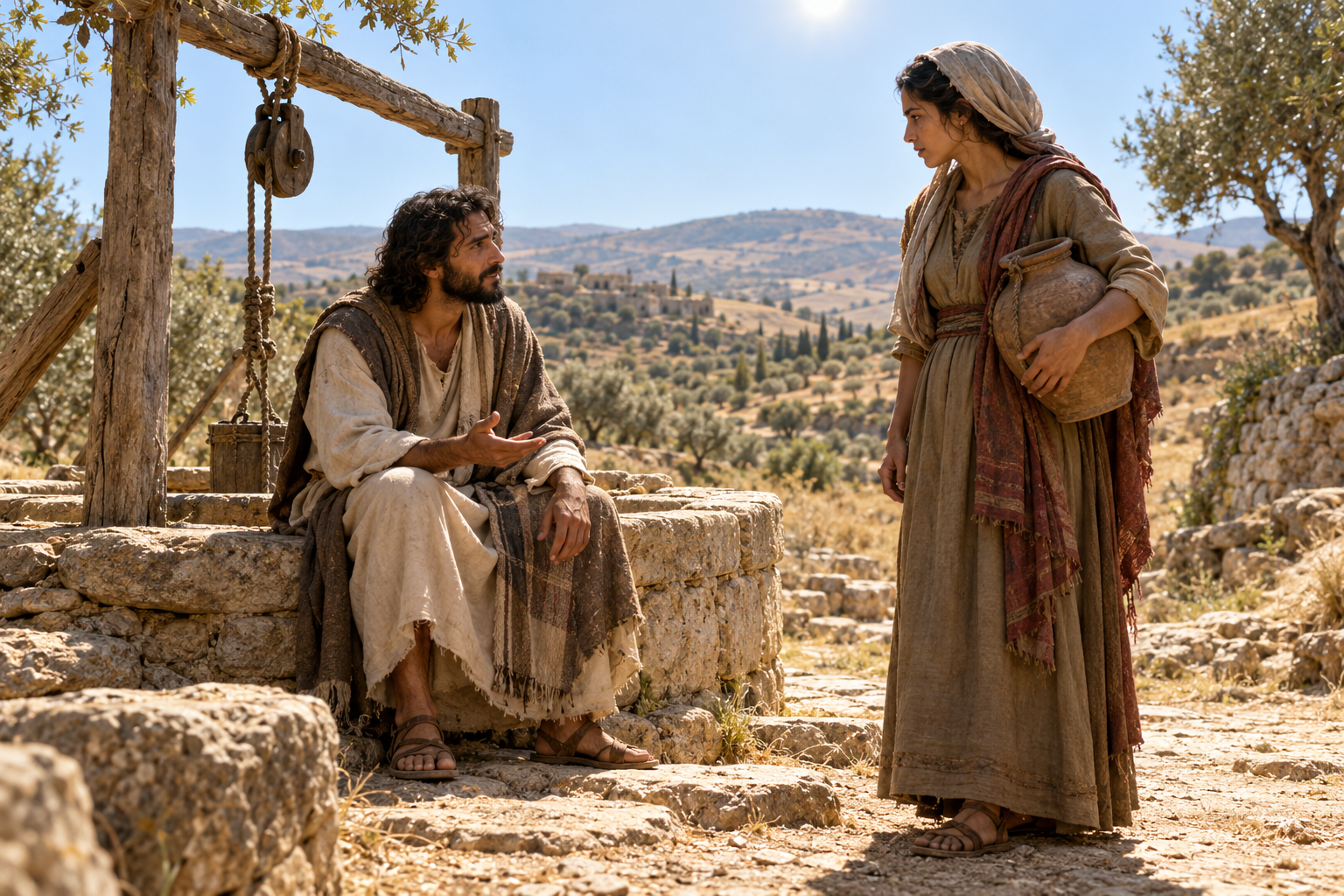
It was midday in Samaria. A tired traveler sat by Jacob’s well and asked a woman for a drink, and before long He was telling her the story of her own life: “thou hast had five husbands; and he whom thou now hast is not thy husband” (John 4:18). Faced with being known that thoroughly, she reached for a safer topic — a religious controversy: “Our fathers worshipped in this mountain; and ye say, that in Jerusalem is the place where men ought to worship” (John 4:20). An argument about places is always more comfortable than a conversation about the heart.
Jesus did not take the bait. He went to the root:
Woman, believe me, the hour cometh, when ye shall neither in this mountain, nor yet at Jerusalem, worship the Father. Ye worship ye know not what: we know what we worship: for salvation is of the Jews. But the hour cometh, and now is, when the true worshippers shall worship the Father in spirit and in truth: for the Father seeketh such to worship him. God is a Spirit: and they that worship him must worship him in spirit and in truth.
“The Father seeketh.” God is not waiting passively for worship; He is out looking for worshippers — and not just any worshippers, but true ones. From that one sentence come three questions:
One — Who is the true worshipper? Two — What does it mean to worship “in spirit and in truth”? Three — Why does the Father seek worship at all?
Who: the true worshipper worships the Father
The verse answers the first question itself. The true worshippers “shall worship the Father.” Jesus does not direct the woman to a three-in-one deity or an abstract divine essence; He directs her to a Person — His Father. And He insists that knowing whom you worship matters: “Ye worship ye know not what: we know what we worship” (John 4:22). Worship is not a feeling released into the air. It is a response to Someone.
The Son is not left outside that worship. It is the Father’s own will “that all men should honour the Son, even as they honour the Father” (John 5:23), and when He brings His firstbegotten into the world He commands, “let all the angels of God worship him” (Hebrews 1:6). We come to the Father through His Son, honoring the Son as the Father Himself has honored Him: “For through him we both have access by one Spirit unto the Father” (Ephesians 2:18).
Yet a right name on our lips is not the whole of it. Jesus describes the true worshipper as one who worships in spirit and in truth — which brings us to the second question.
In spirit: from the inside out
In the woman’s day, worship was something you could see from a distance. A family from Galilee would walk for days to reach Jerusalem for the feasts, for “three times in a year shall all thy males appear before the LORD thy God in the place which he shall choose” (Deuteronomy 16:16). There were lambs to select, offerings to bring, washings to perform, and priests to stand before. Worship had a location, a calendar, and a long list of visible acts.
Into that world Jesus announced that the hour had come when the place would no longer be the point. The true worshipper worships in spirit — first from within, from a heart that is actually present before God. The woman wanted to settle which mountain was right. Jesus wanted her. No amount of correct religious opinion, and no amount of outward ceremony, can stand in for a heart that has turned toward God.
We still mistake the setting of worship for worship itself. A beautiful building, skilled musicians, a moving sermon, a full room — these can all help. But a person can enjoy every one of them and never once meet God, while another can meet Him in an empty field with no music at all.
for the LORD seeth not as man seeth; for man looketh on the outward appearance, but the LORD looketh on the heart.
In truth: the reality, not the shadow
“In truth” certainly includes worshipping according to what is true — Jesus had just told the woman that her people worshipped what they did not know. But the word reaches further. The whole system of temple worship was a set of shadows: the lamb, the altar, the priest, and the veil were all pictures of something still to come. Now the thing they pictured was sitting at the well, asking her for water.
For the law was given by Moses, but grace and truth came by Jesus Christ.
Christ is the substance the shadows were cast by. “I am the way, the truth, and the life: no man cometh unto the Father, but by me” (John 14:6). To worship in truth is to come to the Father through Him — not through our own record, our church membership, our religious achievements, or even our grasp of correct doctrine, but through a living Person. Doctrine describes Him; it cannot replace Him.
A map is not the journey
Hidden inside Jesus’ words is a warning that is easy to read past: it is possible to worship according to custom rather than according to truth. Customs are not the enemy. Some of them are lovely, and many were given by God. The danger comes when the custom quietly takes the place of the God it was meant to lead us to.
Think of a map. A good map is a gift — it is accurate, it shows the way home, and a traveler without one is in trouble. But a person can study a map for years, defend its accuracy against every rival map, and never take a single step down the road. Those of us who have been given the great landmarks of Bible truth — the Sabbath, the sanctuary, the sleep of the dead, the soon return of Christ — hold a very good map. The question is whether we have walked the road.
For I desired mercy, and not sacrifice; and the knowledge of God more than burnt offerings.
Israel had the best map in the world. They had the temple, the priesthood, the sacrifices, and the oracles of God. Every one of those things pointed to the Messiah. And when He came, the people most familiar with the map did not recognize the destination standing in front of them. They clung to the signs and rejected the One the signs were about. Jesus never despised what God had given them; He was inviting them to arrive.
Truth that has never become an experience is a map that has never become a journey. God is not looking for people who can recite the route. He is looking for people who know Him.
This kind of knowing cannot be passed down. Parents can hand their children the map, and they should, but no one can walk the road on someone else’s behalf. Every believer must come to God personally. The question is not only what do I believe? but whom do I know? — and whether I know the Father through His Son.
Two men went up to pray
Jesus told a story about two worshippers in the same building on the same day:
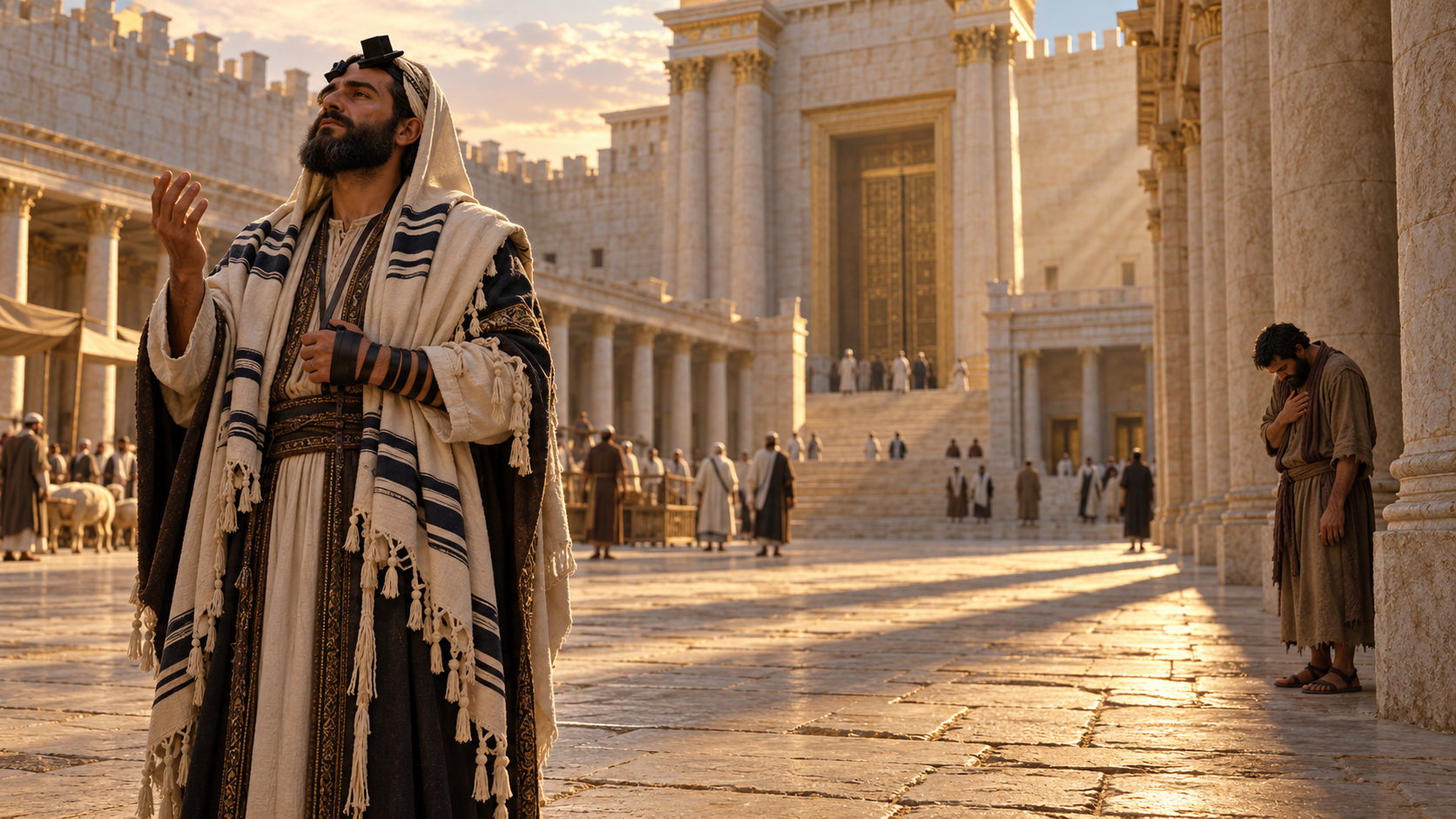
Two men went up into the temple to pray; the one a Pharisee, and the other a publican. The Pharisee stood and prayed thus with himself, God, I thank thee, that I am not as other men are, extortioners, unjust, adulterers, or even as this publican. I fast twice in the week, I give tithes of all that I possess. And the publican, standing afar off, would not lift up so much as his eyes unto heaven, but smote upon his breast, saying, God be merciful to me a sinner. I tell you, this man went down to his house justified rather than the other: for every one that exalteth himself shall be abased; and he that humbleth himself shall be exalted.
The Pharisee was not a villain by the standards of his day. He gave generously, he fasted faithfully, and he kept himself clear of the sins he named. In any congregation he would be the dependable member — the one who never misses, who knows the rules, who can be counted on. Bring him into our own day and his prayer might sound like this: I am vegan. I don’t drink coffee. I don’t eat meat. I don’t eat cheese. I worship on the Sabbath. I pay my tithe. I wear a long skirt. I wear a necktie.
None of those are bad things — many of them are things this site teaches. Nothing on the Pharisee’s list was wrong in itself either. What was wrong was what he did with it: he brought it to God as proof that he did not need mercy.
The publican brought nothing at all except his need. Bring him into our day, too, and he might pray: Lord, I don’t eat healthy. I don’t follow the health message. I don’t keep the Sabbath. I don’t pay tithe. I don’t dress the way I should, and I listen to the wrong music. Be merciful to me, a sinner. He could not even look up. And Jesus says he was the one who went home right with God.
Why does God resist the proud?
Scripture says it plainly: “God resisteth the proud, and giveth grace to the humble” (1 Peter 5:5). It would be easy to read that as rivalry, as though God guards His own pride and cannot stand competition. The truth is the reverse. God resists the proud because He is not proud. His Son “humbled himself, and became obedient unto death” (Philippians 2:8). Pride is simply foreign to the character of the God we worship, and those who cling to it are walking in the opposite direction from Him.
Scripture observes that worshippers always come to resemble the object of their worship. Of the idols of the nations it says:
They that make them are like unto them; so is every one that trusteth in them.
People who bow to lifeless gods become hard and unseeing like them. People who worship the living God become living, and humble, like Him. That is why true worship cannot coexist with self-congratulation: the heart that truly bows before a humble God is being made humble.
The sacrifices of God are a broken spirit: a broken and a contrite heart, O God, thou wilt not despise.
For thus saith the high and lofty One that inhabiteth eternity, whose name is Holy; I dwell in the high and holy place, with him also that is of a contrite and humble spirit, to revive the spirit of the humble, and to revive the heart of the contrite ones.
The heart beneath the works
This does not make works unimportant. Scripture is clear that our works will be judged. But they are judged as the fruit of a heart, and from the outside the fruit can be imitated. Jesus warned that on the last day many will point to an impressive record:
Many will say to me in that day, Lord, Lord, have we not prophesied in thy name? and in thy name have cast out devils? and in thy name done many wonderful works? And then will I profess unto them, I never knew you: depart from me, ye that work iniquity.
I never knew you. The missing thing was not activity; it was relationship. A faithful record, a careful diet, a well-kept Sabbath — these are good, and a heart that loves God will gladly walk in them. But they cannot be the ground we stand on before Him. Only Christ can be that.
“Thou art worthy”
Now the third question: why does the Father seek worship? Scripture lets us look into heaven itself for the answer:
And the four beasts had each of them six wings about him; and they were full of eyes within: and they rest not day and night, saying, Holy, holy, holy, Lord God Almighty, which was, and is, and is to come.
Unending praise, day and night. Read carelessly, this could sound like the skeptic’s picture: a throne surrounded by beings who must never stop applauding. But John does not leave us guessing why they praise. He tells us what they say:
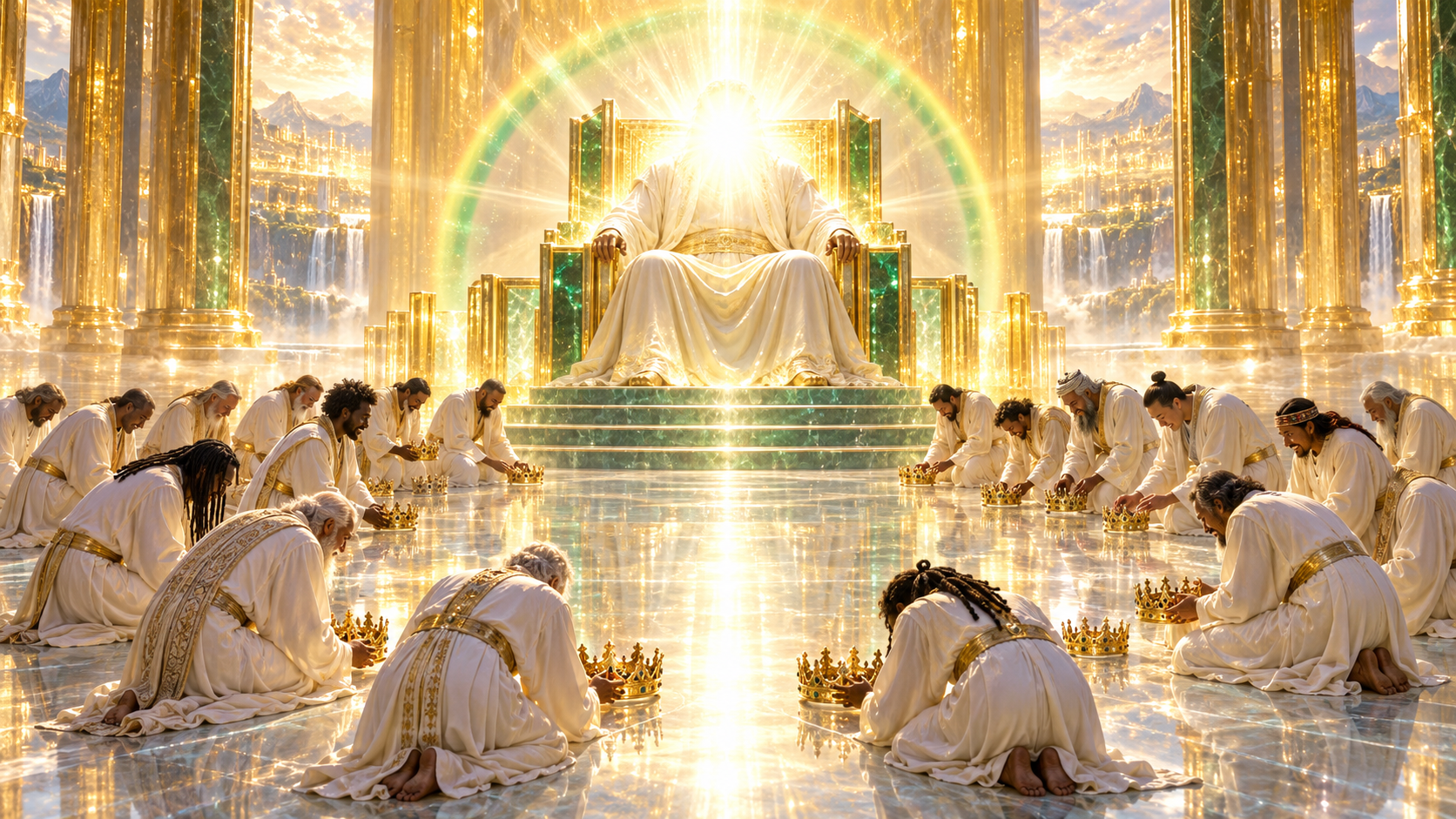
The four and twenty elders fall down before him that sat on the throne, and worship him that liveth for ever and ever, and cast their crowns before the throne, saying, Thou art worthy, O Lord, to receive glory and honour and power: for thou hast created all things, and for thy pleasure they are and were created.
Thou art worthy. Their worship is not extracted from them; it is a conclusion they have reached. They have looked at who He is and what He has done, and praise is the only honest response. The crowns they cast down are not confiscated — they are offered. In the next chapter the same song rises to the Lamb, for a second reason:
Thou art worthy to take the book, and to open the seals thereof: for thou wast slain, and hast redeemed us to God by thy blood out of every kindred, and tongue, and people, and nation;
Blessing, and honour, and glory, and power, be unto him that sitteth upon the throne, and unto the Lamb for ever and ever.
The Father is worthy because He created all things; the Lamb is worthy because He was slain and bought us back to God. Heaven’s worship is not a toll paid at a gate. It is a verdict about God, freely given by those who know Him best.
The reasons that prove the atheist right
So we must ask ourselves honestly why we worship. Because we were told to? To stay on God’s good side? To secure a place in heaven? Out of habit, because it is what our family has always done on the Sabbath? Jesus applied Isaiah’s words to people who were extremely religious:
This people honoureth me with their lips, but their heart is far from me. Howbeit in vain do they worship me, teaching for doctrines the commandments of men. For laying aside the commandment of God, ye hold the tradition of men, as the washing of pots and cups: and many other such like things ye do.
Their teaching was wrong and their traditions had displaced God’s commandment — but underneath both was the real problem: their heart is far from me.
Here is the uncomfortable truth. If we worship God for any reason other than that He is worthy, we are quietly agreeing with the skeptic. If our only reason is that God commanded it, we are describing a God who made creatures to satisfy His need for attention. If our reason is to keep Him from turning against us, or to earn our way into heaven, we are describing a God who withholds His kindness until He is flattered enough.
Imagine a father who only fed the child who complimented him most at the dinner table. No one would call him loving; we would call him cruel. Yet that is the God we portray whenever our worship is a transaction — praise paid in, favor paid out. The God of the Bible is nothing like that.
Why we praise what we love
The real reason for worship is something we already understand from ordinary life. When you hear a song that moves you, you play it for someone else. When a couple gets engaged, they cannot stop showing the ring. When you see a sky lit up at sunset, you call whoever is nearby to come and look. No one pays us to do any of this. The praise simply comes.
It comes because praise is how delight completes itself. A joy kept entirely silent feels unfinished. When we share it — listen to this, look at this — the joy grows rather than shrinks. Praise is not a fee we add on top of enjoyment; it is enjoyment reaching its full expression.
Once we have not just heard about what God has done but actually experienced it, praise rises the same way. That is true worship: not a payment toward something we hope to receive, but the overflow of something we have already received. When Jesus healed ten lepers, only one came back:
And one of them, when he saw that he was healed, turned back, and with a loud voice glorified God, And fell down on his face at his feet, giving him thanks: and he was a Samaritan.
He did not give thanks in order to be healed. He gave thanks because he had been. That is the direction true worship flows. By contrast, worship without experience is like writing a glowing review of a book you never opened: the words may be correct, but there is nothing behind them.
O taste and see that the LORD is good: blessed is the man that trusteth in him.
God does not ask us to take His goodness on hearsay. He says taste. He is confident in what He offers; He knows that whoever genuinely experiences Him will not want to go back. His invitation is not believe the reports about Me but come and find out for yourself. And everyone who tastes ends up doing the same thing: telling others to come and taste too.
Why the Father seeks worshippers
With that in view, we can finally answer why God seeks worship. Begin with what the answer is not. God does not need it. Paul told the Athenians that God is not “worshipped with men’s hands, as though he needed any thing, seeing he giveth to all life, and breath, and all things” (Acts 17:25). God Himself says, “If I were hungry, I would not tell thee: for the world is mine, and the fulness thereof” (Psalm 50:12). Our praise adds nothing to Him that He lacks.
What He wants is for us to have life. “For God so loved the world, that he gave his only begotten Son, that whosoever believeth in him should not perish, but have everlasting life” (John 3:16). And His Son said, “I am come that they might have life, and that they might have it more abundantly” (John 10:10). Not a thin, dutiful existence, but a life full of joy and peace.
Put the two truths together. If we naturally praise what we delight in, and if praise is delight at its fullest, then the Father seeks worshippers because He wants us to have the fullest joy there is — the joy of knowing Him — and He knows what that joy sounds like when it is complete.
God does not seek worship because He lacks something. He seeks it because we do.
“In thy presence is fulness of joy; at thy right hand there are pleasures for evermore” (Psalm 16:11). When Jesus said the Father seeketh such to worship him, He was describing a Father who longs for His children to find that fullness.
A father in the doorway
Think of a father who spends his evenings in the garage, for weeks, restoring an old bicycle for his daughter’s birthday — sanding the rust, painting it her favorite color, fitting new tires. On the morning of her birthday he wheels it into the yard and then steps back into the doorway to watch. She comes outside, sees it, and shrieks: Dad! Look at it! It’s beautiful!
Was he standing in the doorway because he needed to be praised? Of course not. He was waiting for her joy. Her shout was simply the sound her happiness made, and her happiness was the reason he built the bicycle in the first place.
That is the Father who seeks worshippers. He is not waiting for compliments to soothe an uncertain ego. He is waiting for the moment His goodness reaches us so fully that it comes back out as praise — because that moment means we have found what He made us for.
Love first — and the keeping follows
Paul shows what this looks like in a real life. Few people ever had more religious credentials to lean on than he did:
For we are the circumcision, which worship God in the spirit, and rejoice in Christ Jesus, and have no confidence in the flesh. Though I might also have confidence in the flesh. If any other man thinketh that he hath whereof he might trust in the flesh, I more: Circumcised the eighth day, of the stock of Israel, of the tribe of Benjamin, an Hebrew of the Hebrews; as touching the law, a Pharisee; Concerning zeal, persecuting the church; touching the righteousness which is in the law, blameless.
The true worshippers, he says, worship God in the spirit, rejoice in Christ, and put no confidence in pedigree or performance. Then he tells us what all of his credentials became once he met Christ:
Yea doubtless, and I count all things but loss for the excellency of the knowledge of Christ Jesus my Lord: for whom I have suffered the loss of all things, and do count them but dung, that I may win Christ, And be found in him, not having mine own righteousness, which is of the law, but that which is through the faith of Christ, the righteousness which is of God by faith: That I may know him, and the power of his resurrection, and the fellowship of his sufferings, being made conformable unto his death;
That I may know him. That is worship moved by love — the merchant who, “when he had found one pearl of great price, went and sold all that he had, and bought it” (Matthew 13:46).
Many earnest believers wear themselves out because they have the order backward. They try to produce devotion by keeping more requirements, and the requirements grow heavier until faith itself feels like a burden. If that is where you are, the answer is not to grit your teeth harder. Go back to the beginning. Ask Christ to show you His love until you love Him in return. That is the first work, and everything else grows out of it.
Watch a new father at three in the morning, pacing the hallway with a crying baby. No rulebook got him out of bed. No one had to command him to be gentle, or patient, or awake. He does a hundred hard things a day without being told, and he would be puzzled if you called it a burden. Love made the rules unnecessary — not because the things stopped mattering, but because he wanted to do them.
If ye love me, keep my commandments.
Notice the order: love, then keeping. God is not looking for a stack of good deeds to be laid before Him like a payment; He owns everything already. He is asking a simpler and deeper question: Do I have your heart? The Sabbath, the health message, a modest and simple life — these are good gifts, and a heart in love with God will walk in them gladly. But they are the fruit of love, never its price. “We love him, because he first loved us” (1 John 4:19).
Not the price of admission
Scripture pictures the end of the story as a wedding: “Blessed are they which are called unto the marriage supper of the Lamb” (Revelation 19:9). No one thinks of a wedding as a fee two people pay to be allowed to love each other. The wedding is where their love was always heading. So it is with eternal life, which Jesus defined Himself:
And this is life eternal, that they might know thee the only true God, and Jesus Christ, whom thou hast sent.
Eternal life is not a prize handed out for enough worship. It is knowing God, brought to its fullness. Worship is not the price of admission; it is what a heart does once it has come to know Him. The deepest misunderstanding of worship is that God is taking something from us. In truth He is giving: inviting us into the greatest joy a human being can know. Once we know Him, worship stops being an obligation and becomes something we could not hold back if we tried.
This is not a side issue. Scripture says worship will be the final question placed before the whole world: “Fear God, and give glory to him; for the hour of his judgment is come: and worship him that made heaven, and earth, and the sea, and the fountains of waters” (Revelation 14:7). In that last test, worship held up only by habit or fear will give way. Worship rooted in knowing God will stand.
Taste and see
So the question comes home to each of us. Have we learned the vocabulary of worship, or have we met the One worthy of it? It is possible to spend a lifetime in church, singing every song and keeping every appointment, and never discover that God is actually good company. And it is possible, on any ordinary day, to discover it for the first time.
Do not settle for religion as a performance, or for faith as a way of being accepted by a group of people. You have one life. Spend it knowing the God who made you, who gave His Son for you, and who is looking for you — not to collect your praise, but to give you a joy so large that praise is the only thing that will fit it.
The skeptic asked why a loving God would want to be worshiped. The answer is that He wants you happy, with the deepest happiness there is. He is not waiting on your praise because He needs it. He is waiting for it because, when it finally comes from the bottom of your heart, it will mean you have found Him.
O taste and see that the LORD is good. Once you have tasted, you will not be able to keep it to yourself.
Further reading
Who it is we worship, how a sinner is accepted, and why worship is the last question the world will face.
Whom we worship
The publican’s gospel
Worship and the last days