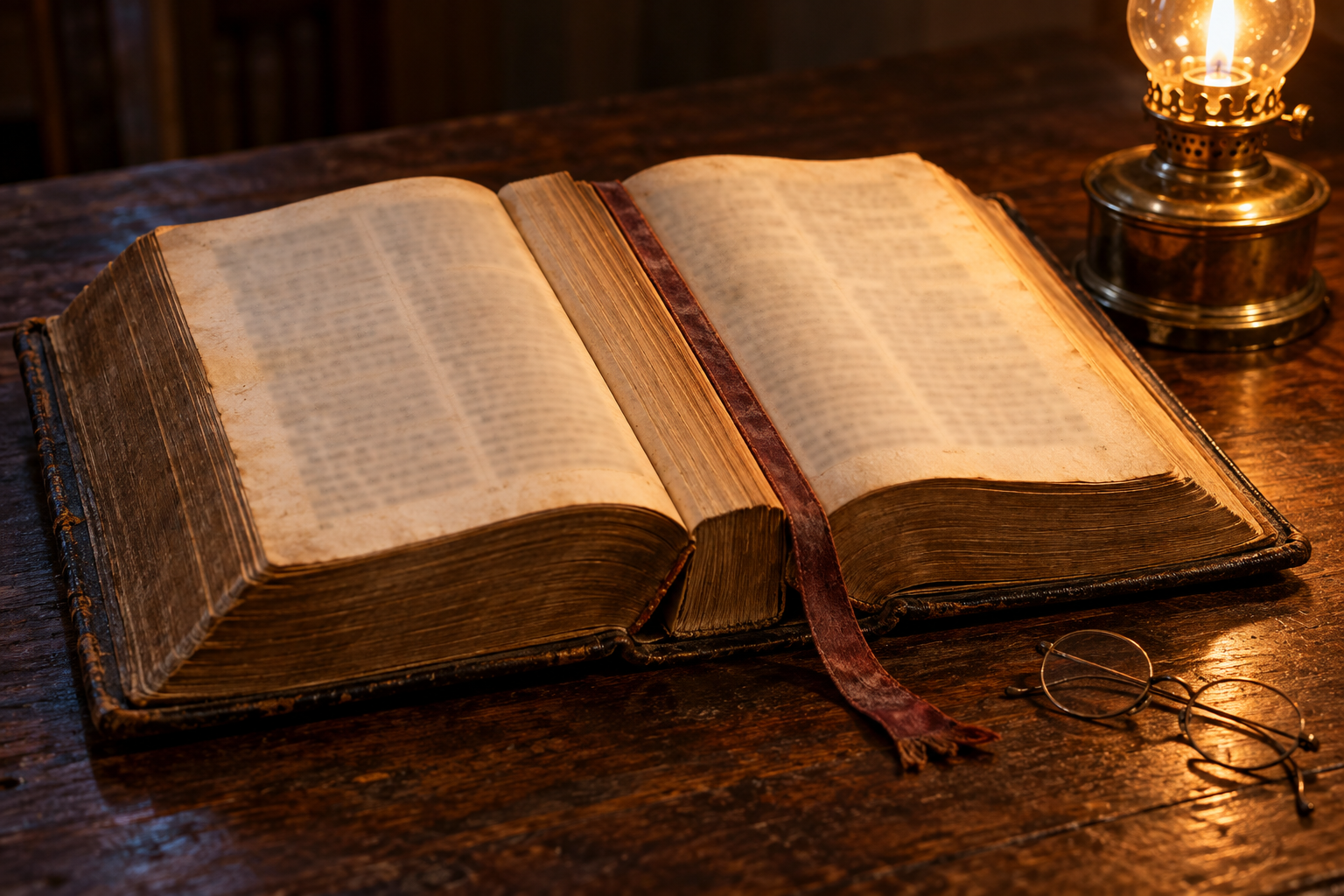

Open an old family Bible and you may find, between Malachi and Matthew, a section of books most Protestants have never read: Tobit, Judith, the Wisdom of Solomon, the Maccabees, and others. They are called the Apocrypha, a Greek word meaning “hidden.” And among Seventh-day Adventists they raise a question with an unusual edge, because the pioneers of the movement read them, quoted them, and, in 1850, Ellen White herself wrote that “the Apocrypha was the hidden book, and that the wise of these last days should understand it.”
So should Adventists treat these books as Scripture? This study sets out the evidence plainly: what the books are, what they say of themselves, where they agree with the Bible and where they do not, what the pioneers actually did with them, and what Ellen White actually said. Where the evidence is clear, we say so. Where it is not, we say that too.
The study in brief
- The Apocrypha was printed in many Bibles, but it was never part of the Hebrew Scriptures Jesus named.
- Several of the books say of themselves that no prophet was speaking when they were written.
- Some contain errors of history and approve of deception; others are valuable history and devotion.
- The pioneers valued parts of it but, when asked, would not call it inspired.
- Ellen White called it “the hidden book” and, in the same breath, called the Bible “the standard book.”
- Read it as the Reformers did: for history and instruction, never as a rule of faith.
What the Apocrypha is
The books usually meant by “the Apocrypha” are Jewish writings from the centuries between the Old and New Testaments, most of them preserved in Greek:
| Book | What it contains |
|---|---|
| 1 and 2 Esdras | A retelling of Ezra; a Jewish apocalypse of visions |
| Tobit | A pious exile, a journey, an angel in disguise |
| Judith | A widow who saves her city by beheading an enemy general |
| Additions to Esther and to Daniel | Prayers and stories added to the Bible’s books (Susanna, Bel and the Dragon, the Song of the Three Children) |
| Wisdom of Solomon | A meditation on wisdom, written in Greek |
| Ecclesiasticus (Sirach) | Proverbs and counsel from Jesus son of Sirach |
| Baruch, with the Epistle of Jeremy | Writings attached to Jeremiah’s scribe |
| Prayer of Manasses | A prayer of repentance put in the mouth of King Manasseh |
| 1 and 2 Maccabees | The Jewish revolt against the Greek kings, second century before Christ |
Their history in the church is mixed. Many were included in the great Greek manuscripts of the Bible. The Roman church declared most of them Scripture at the Council of Trent in 1546, though not 1 and 2 Esdras or the Prayer of Manasses. The Reformers kept them apart. The King James translators of 1611 printed them in a separate section between the Testaments, under the heading Apocrypha, and the Church of England that commissioned that translation stated their status in its articles of faith:
And the other Books (as Hierome saith) the Church doth read for example of life and instruction of manners; but yet doth it not apply them to establish any doctrine.
“Hierome” is Jerome, the translator of the Latin Bible, who had drawn the same line over a thousand years earlier. In 1826 the British and Foreign Bible Society resolved to stop circulating Bibles that contained the Apocrypha, and it gradually dropped out of ordinary editions. That is why the pioneers’ generation still owned Bibles that contained it.
Why this is not the Enoch question
It would be easy to answer the Apocrypha the way we answered the Book of Enoch, but it would not be fair. Enoch was never in the Hebrew Bible, the Greek Old Testament, or the Bible of the church at large (only in the broader canon of the Ethiopian church), so “they took it out” is simply false. The Apocrypha is different: it really was printed in Bibles, including the King James. So the honest question is not whether these books were ever bound between the covers. It is whether they were ever part of the Scriptures God gave to Israel and that Jesus called the word of God.
The Scriptures Jesus named
And he said unto them, These are the words which I spake unto you, while I was yet with you, that all things must be fulfilled, which were written in the law of Moses, and in the prophets, and in the psalms, concerning me.
The law, the prophets, and the psalms: the three divisions of the Hebrew Bible. The books of the Apocrypha were never part of that collection. The Jewish people to whom “were committed the oracles of God” (Romans 3:2) never received them. Near the end of the first century the Jewish historian Josephus counted Israel’s sacred books at twenty-two, the same books as our Old Testament counted differently, and added that the books written after the time of Artaxerxes had not been esteemed of the like authority, “because there hath not been an exact succession of prophets” (Against Apion 1.8). The Old Testament ends with Malachi looking forward to the next prophet God would send: “Behold, I will send you Elijah the prophet” (Malachi 4:5). The books of the Apocrypha were written in the silence between.
What the books say of themselves
The strongest witness on this question comes from the Apocrypha itself. 1 Maccabees, the most valuable history in the collection, describes its own age as a time without prophets:
So was there a great affliction in Israel, the like whereof was not since the time that a prophet was not seen among them.
Twice more it says the people were waiting for a prophet who had not yet come. They laid up the defiled altar stones “until there should come a prophet to shew what should be done with them” (1 Maccabees 4:46), and they made Simon their leader “until there should arise a faithful prophet” (14:41). The author knew he was not one.
2 Maccabees is even more open. It introduces itself as a summary of another man’s work: “All these things, I say, being declared by Jason of Cyrene in five books, we will assay to abridge in one volume” (2 Maccabees 2:23). And it closes with a writer’s apology:
And if I have done well, and as is fitting the story, it is that which I desired: but if slenderly and meanly, it is that which I could attain unto.
No prophet of the Bible ends his message by hoping he did it well enough. They spoke because “holy men of God spake as they were moved by the Holy Ghost” (2 Peter 1:21). These are honest human writers, and they tell us so.
Errors of history
Several of the books contain errors that cannot be explained by interpretation.
- Judith opens “In the twelfth year of the reign of Nabuchodonosor, who reigned in Nineve, the great city” (Judith 1:1). Nebuchadnezzar was king of Babylon, and Nineveh had already fallen before his reign began.
- Tobit says he was young when his tribe broke away from Jerusalem, “all the tribe of Nephthali my father fell from the house of Jerusalem” (Tobit 1:4), the division of the kingdom in Jeroboam’s day. Yet he also went into the Assyrian captivity (1:2), roughly two centuries later, and died “being an hundred and eight and fifty years old” (14:11). The numbers cannot all be true.
- The Epistle of Jeremy (Baruch 6) tells the exiles they will remain in Babylon “many years, and for a long season, namely, seven generations” (Baruch 6:3). The real Jeremiah, by the word of the LORD, said “after seventy years be accomplished at Babylon I will visit you” (Jeremiah 29:10).
Where they contradict Scripture
Beyond history, some passages teach or approve what Scripture forbids.
An angel who gives a false name
In Tobit, the angel sent to guide Tobit’s son introduces himself with an invented identity: “I am Azarias, the son of Ananias the great, and of thy brethren” (Tobit 5:12). Only at the end of the book does he reveal, “I am Raphael, one of the seven holy angels” (12:15). The angels of God in Scripture are messengers of truth; “Lying lips are abomination to the LORD” (Proverbs 12:22).
A prayer for help to deceive
Judith, the heroine of her book, asks God to bless her lies: “Smite by the deceit of my lips the servant with the prince”; and again, “make my speech and deceit to be their wound and stripe” (Judith 9:10, 13). The book presents her deceit as the means of deliverance. The God of the ninth commandment does not answer prayers for help in lying.
An offering for the dead
This is the passage Rome relies on for purgatory, and it deserves to be read fairly. After a battle, Judas Maccabeus sends silver to Jerusalem for a sin offering on behalf of fallen soldiers:
…he sent it to Jerusalem to offer a sin offering, doing therein very well and honestly, in that he was mindful of the resurrection: For if he had not hoped that they that were slain should have risen again, it had been superfluous and vain to pray for the dead. … Whereupon he made a reconciliation for the dead, that they might be delivered from sin.
Notice what the passage actually says: Judas’s hope was the resurrection, not an intermediate place of purification. That is a point in its favour. But the book still approves an offering to remove the sin of men already dead, and calls it “an holy and good thought.” The law of Moses provides no such offering, and Scripture closes the door on it: “it is appointed unto men once to die, but after this the judgment” (Hebrews 9:27). The dead “know not any thing” and have no more “a portion for ever in any thing that is done under the sun” (Ecclesiastes 9:5–6).
A suicide held up as noble
2 Maccabees 14 tells of an elder named Razis who, about to be captured, “fell upon his sword; Choosing rather to die manfully, than to come into the hands of the wicked” (14:41–42), and the account goes on in gruesome detail as an example of courage. Scripture records the deaths of Saul and Judas by their own hands, but never commends them.
Often misread: four fair answers
Not every charge commonly brought against these books stands up. Honesty requires saying so, and a case built on misread verses only weakens the true ones.
“The souls of the righteous are in the hand of God” (Wisdom 3:1). This is often cited as proof of the immortal soul. But in the hand of God is the Bible’s own phrase for being kept in God’s care: “the righteous, and the wise, and their works, are in the hand of God” (Ecclesiastes 9:1); “all his saints are in thy hand” (Deuteronomy 33:3). The same passage goes on, “yet is their hope full of immortality” (Wisdom 3:4), a hope still to be fulfilled. It can be read in harmony with the sleep of the dead.
“Alms doth deliver from death, and shall purge away all sin” (Tobit 12:9). This sounds like salvation by works, but it echoes the Bible’s own language: “By mercy and truth iniquity is purged” (Proverbs 16:6); “break off thy sins by righteousness, and thine iniquities by shewing mercy to the poor” (Daniel 4:27); “righteousness delivereth from death” (Proverbs 10:2). Read charitably, it describes the fruit of a turned heart. (Ecclesiasticus 3:30 goes further, “alms maketh an atonement for sins,” where Scripture says “it is the blood that maketh an atonement for the soul”, Leviticus 17:11; that line is harder to defend.)
The fish’s heart and liver (Tobit 6–8). Tobit’s son is told to burn part of a fish so that “the devil shall smell it, and flee away” (Tobit 6:17), and it is sometimes mocked as witchcraft. That is unfair. God commanded physical acts in Scripture too, from the brazen serpent to the clay on the blind man’s eyes, and the same verse tells the couple to “pray to God which is merciful.” The one real difference is where the power lies: in Scripture, spirits flee at the word of Christ, “I charge thee, come out of him” (Mark 9:25), and at His name (Acts 16:18), not at a smell.
“Being good, I came into a body undefiled” (Wisdom 8:20). Many read this as the Greek idea of souls existing before birth. It can also be read as poetic language for a good natural disposition. It is not clear enough to build an argument on, either way.
What the pioneers actually did
The early Adventists did read and quote the Apocrypha, most of all 2 Esdras, a Jewish apocalypse full of end-time imagery. In James White’s 1847 pamphlet A Word to the Little Flock, he lists it among the prophetic witnesses to the day of God’s wrath:
Ezekiel saw it in the men with “slaughter-weapons,” slaying “utterly, old and young.” – Ezekiel 9:5, 6. John saw it in the “seven last plagues;” while Esdras saw it in the famine, pestilence, and the sword.
The same pamphlet prints Ellen White’s early visions with Scripture references added in brackets, six of them to 2 Esdras. The publisher’s note is explicit that those references “were inserted by James White”, who “assumed the full responsibility for the insertion of all these references.” Joseph Bates went furthest: in his 1846 tract The Opening Heavens he introduced a passage of 2 Esdras with the words “the prophet says.”
But when a reader of the church’s paper asked the question directly in 1858, the editors gave a careful answer:
Concerning the Apocrypha, we regard portions of it as containing much light and instruction. If we were asked to specify, we should mention 2 Esdras, Wisdom of Solomon, and 1 Maccabees. … The question of the inspiration of these books — the reasons that might be adduced in favor of such an opinion, and the objections that might lie against it, we have never made a subject of particular study, and are not therefore prepared to discuss.
Portions of it, much light and instruction, and no claim of inspiration. That is the pioneers’ position in their own words. It is very close to the Reformers’: read it for instruction, but do not build doctrine on it.
What Ellen White actually said
Ellen White spoke of the Apocrypha in two early visions. Both were written down at the time, and neither was published in her lifetime. Here is what the records say.
Topsham, Maine, September 23, 1849. The manuscript records that she was “(Taking the large Bible containing the apocrypha:)” and says, in the broken phrases of a vision: “Pure and undefiled, a part of it is consumed”; “The Word of God, take it … bind it long upon thine heart, pure and unadulterated”; and “a part of it is burned unadulterated, a part of the hidden book, a part of it is burned (the apocrypha).” A separate account, signed by three of the Howland women, describes a vision at Brother Curtis’s in Topsham in which she “took the large family Bible from the table … and said the hidden book was not there,” and Brother Curtis confirmed that the Apocrypha was not in that Bible (Manuscript Releases, vol. 15, p. 66).
Oswego, New York, January 1850. This is the clearer statement:
I saw that the Apocrypha was the hidden book, and that the wise of these last days should understand it. I saw that the Bible was the standard book, that will judge us at the last day.
Read the two sentences together. The Apocrypha is the hidden book, to be understood by the wise. The Bible is the standard book, the one that will judge us. She does not call the Apocrypha inspired, and she sets it beside the Bible precisely to distinguish the two. The Ellen G. White Estate draws the same conclusion: the Apocrypha “is not described as inspired, but is contrasted with the Scriptures which are called the ‘standard Book, that will judge us at the last day.’” And it notes that she did not afterward call the church’s attention to the subject, counselling “a minimum of attention.”
What we know, and what we don’t
What we know
- None of these books was ever part of the Hebrew Scriptures that Jesus named “the law of Moses, … the prophets, and … the psalms.”
- Several of them say plainly that they were written when no prophet was in Israel, or present themselves as ordinary human histories.
- Some contain clear errors of history, and some approve of deception.
- The early Adventists read them, quoted them, and valued parts of them, especially 2 Esdras, the Wisdom of Solomon, and 1 Maccabees.
- When asked directly, the church’s paper declined to call them inspired, saying the question had never been studied.
- Ellen White, in 1850, called the Apocrypha “the hidden book” and the Bible “the standard book, that will judge us at the last day.”
What we don’t know
- Exactly what Ellen White meant by “the hidden book.” She never explained it.
- What “a part of it is burned” in the 1849 vision referred to. The words were spoken in vision and written down at the time.
- Why the subject almost disappears from her later writings. She is not known to have urged the church to study the Apocrypha after 1850.
- How much of her later language consciously echoes the Apocrypha. Some Adventist scholars find allusions; how many are deliberate is debated.
- Which of the pioneers, if any, regarded 2 Esdras as truly inspired. Joseph Bates seems to have; the church paper would not say.
Where the record is silent, we will not fill the silence. What can be said with confidence is enough: nothing in the pioneers’ words or in Ellen White’s makes the Apocrypha a rule of faith, and her own words make the Bible the standard by which everything, the Apocrypha included, will be judged.
How to read it
There is real value in these books. 1 Maccabees is the best account we have of the Jewish struggle against the Greek king Antiochus Epiphanes, and of the rededication of the temple that the Jews remembered at the feast of the dedication mentioned in John 10:22. The Wisdom of Solomon and Ecclesiasticus contain much that is wise and devout. The pioneers found light there, and so can we.
But they must be read the way a wise reader reads any good book that is not the word of God: with the Bible open beside it, testing every line. “To the law and to the testimony: if they speak not according to this word, it is because there is no light in them” (Isaiah 8:20). “Prove all things; hold fast that which is good” (1 Thessalonians 5:21). Read for history and instruction, the Apocrypha can help us understand the world into which Jesus was born. Read as Scripture, it would teach us to pray for the dead and to admire a lie.
A note on what is being critiqued
The questions here are about books, not about the people who love them. Catholic and Orthodox believers have received these books for centuries, and many Adventists who study them today do so out of a sincere desire to know everything God may have to say. That desire is good. The study above is offered in the same spirit the pioneers showed in 1858: honest about what is known, honest about what is not, and unwilling to call anything Scripture that God has not made Scripture.
The standard book
In the end, Ellen White’s 1850 sentence gives the best summary of all. There is a hidden book, and there is a standard book. The hidden book may be understood; the standard book will judge us. Paul told Timothy that it is the holy Scriptures “which are able to make thee wise unto salvation through faith which is in Christ Jesus” (2 Timothy 3:15), and the psalmist found in them all the light a traveller needs:
Thy word is a lamp unto my feet, and a light unto my path.
The sixty-six books are not a small inheritance. They are the word that will judge us, and the word that leads us to the One Who will judge with mercy. Read the Apocrypha if you wish, and read it wisely. But build your faith on the standard book.
Further reading
The canon, the dead, and the gift of prophecy, from Scripture alone.
Library
Is the Book of Enoch Scripture?
The companion study: a book never received by Israel or the church at large, tested by the Scriptures Jesus named.
Library
The Dead Sea Scrolls
What was really found at Qumran, and why the scrolls confirm the Bible we already have.
Doctrine pillar
State of the Dead
The dead sleep until the resurrection. Why prayers and offerings for the dead have no place in Scripture.
Doctrine pillar
The Spirit of Prophecy
How God has spoken through His prophets, and how every message is tested by the law and the testimony.
Library
Come Out of Babylon
Rome’s teachings, purgatory among them, tested by Scripture, and the mercy in the call to leave.
Primary sources
The Old Landmarks
What the Adventist pioneers actually believed, in their own words, every quotation traced to its source.