
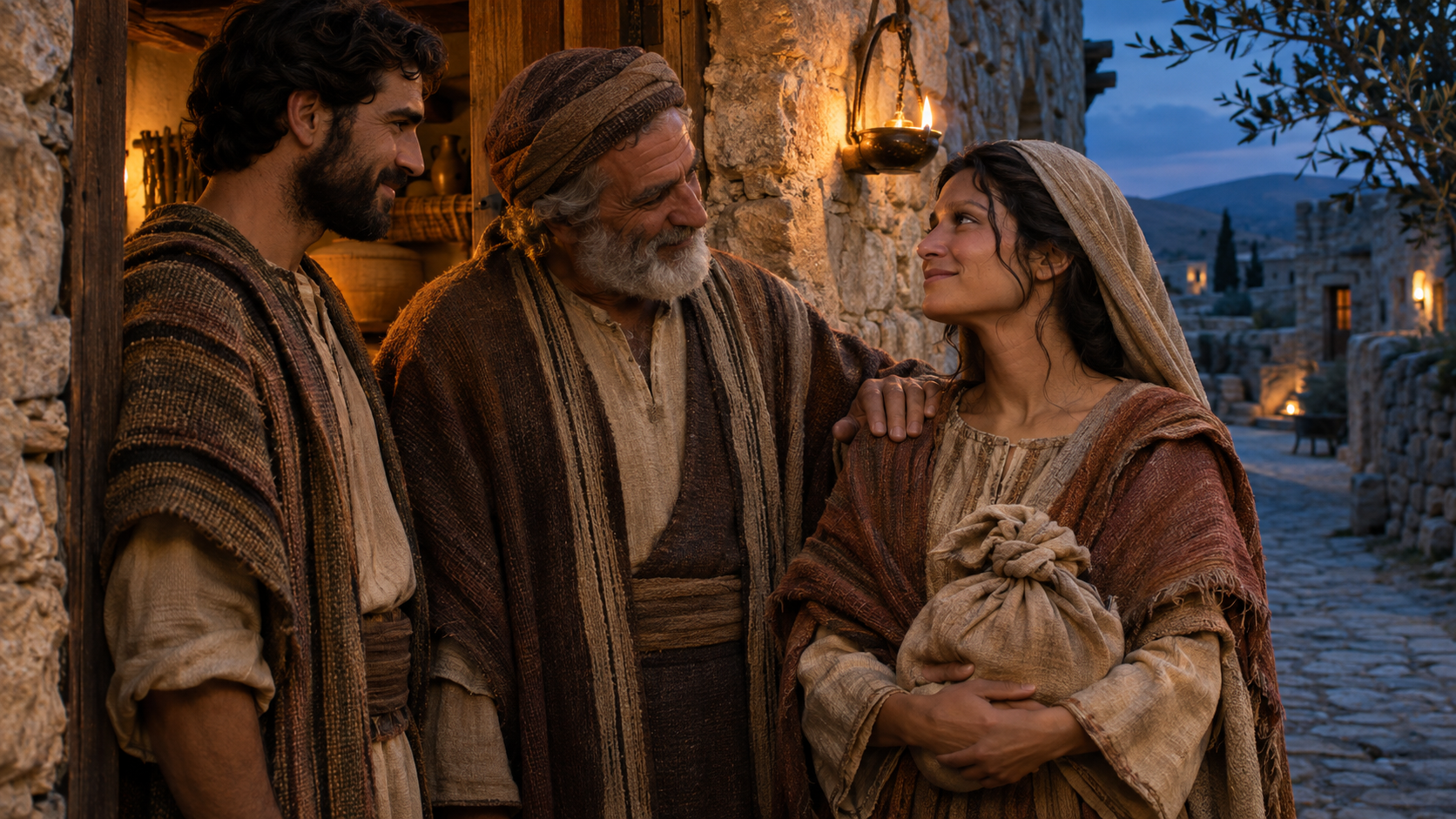

A woman is being beaten by her husband. She is a Christian, and she has been told that Jesus allowed divorce for one reason only, unfaithfulness, so she must stay. Is that what the Bible teaches? It is not, and the rest of this study shows why from Scripture itself.
The question
The question came up in a debate that circulated online. A Christian woman and a Muslim woman argued over whether a wife must remain married to a man who beats her, since Jesus said that unfaithfulness is the only ground for divorce. By the end, the Muslim woman was making a different point: that Muslims and Christians actually agree on the rules of divorce, and that the Christian position leaves a woman trapped.
Both arguments missed the mark. The question underneath them is a real one, and many women carry it quietly: If I leave, am I disobeying God? It deserves a careful answer from the text, from the world in which the text was written, and from the character of the God Who gave it.
The short answer
A Christian woman should not sit still and endure being beaten. She should tell people what is happening to her, get to safety, and let those whose duty it is protect her. Nothing Jesus said forbids that. He was not asked about violence, and He did not answer a question about violence. Leaving a dangerous home is not the same thing as divorce, and Scripture plainly allows a wife to depart (1 Corinthians 7:11). A man who follows Jesus does not strike his wife. A man who does strike her has broken the commands of Christ long before she ever walks out the door.
If you are being hurt
- In immediate danger: call 911 (or your local emergency number).
- United States: National Domestic Violence Hotline, 1-800-799-7233, or text START to 88788. Free, confidential, 24 hours, with help in Spanish. Online at thehotline.org.
- If he checks your phone or computer, use a device he cannot see, and clear your history after visiting this page.
What Jesus was actually asked
Everything turns on the question that was put to Him. Matthew records it carefully:
The Pharisees also came unto him, tempting him, and saying unto him, Is it lawful for a man to put away his wife for every cause?
“For every cause.” That phrase was a live controversy among the teachers of the day. Moses had allowed a man to send his wife away when he found “some uncleanness in her” (Deuteronomy 24:1), and the schools argued over what that meant. The later Jewish record of the debate, the Mishnah (Gittin 9:10), preserves the positions. The school of Shammai said a man could divorce only for sexual misconduct. The school of Hillel said he could divorce her even if she spoiled his dinner. Rabbi Akiva, a little later, said he could divorce her if he simply found a woman he liked better.
Notice who held the power in every one of those positions. The question was how easily a man could put a woman out of his house. In that world a divorced woman could lose her home, her standing and her living in a day. So when Jesus answered, He shut a door that men had been using against women:
Moses because of the hardness of your hearts suffered you to put away your wives: but from the beginning it was not so. And I say unto you, Whosoever shall put away his wife, except it be for fornication, and shall marry another, committeth adultery.
This was protection, not a trap. Jesus took marriage back to “the beginning,” when a man was to “cleave unto his wife” and the two were “one flesh” (Genesis 2:24). He was answering men who wanted to discard their wives cheaply. To take those words and turn them into a rule that holds a beaten woman in place is to use the Lord’s shield for women as a chain on them.
It also matters when He said it. Jesus spoke these words to Pharisees testing Him in Judea, before the cross, before Pentecost, before there was a church with elders and a common life. His teaching on marriage is permanent, and it is not to be set aside. But He gave it in answer to one question. The rest of what Scripture says about husbands, violence and refuge did not stop applying because it was not part of that conversation.
Leaving is not divorcing
Paul, writing to a church in a Roman city, deals directly with a wife leaving her husband. Even while he upholds the Lord’s command, he does not pretend separation never happens or forbid it outright:
And unto the married I command, yet not I, but the Lord, Let not the wife depart from her husband: But and if she depart, let her remain unmarried, or be reconciled to her husband: and let not the husband put away his wife.
“And if she depart.” The apostle makes room for a wife who has left, and tells her what her path is from there. So the choice before an abused Christian woman is not “stay and be beaten, or sin.” She may go somewhere safe. Whether the marriage can ever be restored is a second question, and it depends on whether he truly repents. Her safety does not have to wait for anyone to settle it.
Scripture never treats running from violence as a lack of faith. When Saul tried to pin David to the wall, his own wife, Michal, “let David down through a window: and he went, and fled, and escaped” (1 Samuel 19:12). When a plot was laid against Paul in Damascus, the disciples “took him by night, and let him down by the wall in a basket” (Acts 9:25). Jesus told His own followers, “when they persecute you in this city, flee ye into another” (Matthew 10:23). And the wisdom of Proverbs is plain: “A prudent man foreseeth the evil, and hideth himself: but the simple pass on, and are punished” (Proverbs 22:3). If God’s servants could flee a king, a mob and a persecutor, a wife may flee a man who beats her.
What God says about a man who strikes
The New Testament does not leave a husband’s conduct to guesswork. It gives him a standard so high that violence is unthinkable under it:
Husbands, love your wives, even as Christ also loved the church, and gave himself for it; … So ought men to love their wives as their own bodies. He that loveth his wife loveth himself. For no man ever yet hated his own flesh; but nourisheth and cherisheth it, even as the Lord the church.
Christ gave Himself for the church. He did not beat it into obedience. A husband is to “nourish” and “cherish” his wife as he does his own body. Paul adds, “Husbands, love your wives, and be not bitter against them” (Colossians 3:19). Peter tells husbands to give “honour unto the wife” as fellow heirs of the grace of life, “that your prayers be not hindered” (1 Peter 3:7). A man who dishonors his wife damages his own walk with God.
A man who strikes is disqualified from church leadership: an elder must be “no striker” (1 Timothy 3:3). The church is told not even to keep company with a professing brother who is a “railer,” a verbally abusive man (1 Corinthians 5:11). And the Old Testament speaks just as bluntly. Malachi, rebuking men who were dealing treacherously with the wives of their youth, says the LORD hates the putting away, “for one covereth violence with his garment” (Malachi 2:16). The Psalms put it most simply of all: “the wicked and him that loveth violence his soul hateth” (Psalm 11:5).
One of the women in that debate said that someone following the words of Jesus would never beat his wife. She was right. A man who beats his wife is not following Jesus, whatever name he goes by.
What a woman did back then
It is fair to ask what a wife in Bible times could actually do. She had no police, no shelters, no hotline and no restraining order. That does not mean she had nothing. Her protection came from other places, and it is worth seeing them clearly, because they show God was not indifferent to her.
Her family stood behind her
A woman’s first refuge was the family she came from. Marriage joined two families, not two individuals, and her father, brothers and uncles still regarded her honor as their own. If she was mistreated, they were shamed, so they had every reason to step in. Laban, whatever his faults, made Jacob swear to it before they parted: “If thou shalt afflict my daughters, or if thou shalt take other wives beside my daughters, no man is with us; see, God is witness betwixt me and thee” (Genesis 31:50). A father put his son-in-law on oath before God over the way his daughters would be treated.
A wronged woman could also go home. When Tamar was violated, she went to live in her brother Absalom’s house (2 Samuel 13:20). Something in that same story shows the danger of the old world as well. Absalom told her, “hold now thy peace, my sister.” Families gave shelter, but they also kept secrets to guard their reputations, and silence protected the guilty. That is the one part of the old pattern a Christian should never copy.
The point bears repeating in our own words: just telling people what is happening makes an enormous difference. When a woman’s family knows, the man can no longer act in private. In a world where the whole family stood behind the marriage, a husband who beat his wife had to answer to her father and her brothers.
The law set limits
The law of Moses gave a wife rights that her husband could not take away. Even a girl sold into service and then taken as a wife was protected: “her food, her raiment, and her duty of marriage, shall he not diminish. And if he do not these three unto her, then shall she go out free without money” (Exodus 21:10–11). The same chapter frees a servant whose master destroys an eye or a tooth (21:26–27). The law draws no line from that verse to a wife, but its logic is hard to miss. If a man could lose a slave for knocking out a tooth, the law gives no ground for a husband to beat his wife and keep her.
Some Jewish communities wrote these protections into a contract. Marriage contracts from the Jewish colony at Elephantine in Egypt, from the fifth century before Christ, include a clause allowing either spouse to stand before the assembly and declare, in effect, “I hate my husband” (or wife), pay the stated sum, and go free. One of them, written for a woman named Mibtahiah in about 449 BC, gives her exactly that right. Much later, the Mishnah (written down around AD 200) lists cases in which a Jewish court would compel a husband to grant his wife a divorce. Those rulings came after the New Testament, but they show that Jewish tradition never treated a wife as having no way out.
And there were the elders. Justice in an Israelite town happened in public, at the city gate, where the elders sat (Ruth 4:1–2). Women went there too. The law itself pictures a widow going “up to the gate unto the elders” to bring her own complaint against a man who refused her what the law owed her (Deuteronomy 25:7). The daughters of Zelophehad stood before Moses and the whole congregation to claim their rights (Numbers 27:1–2), and God sided with them.
The Roman world was different again
By the time of Jesus and Paul, most of the Mediterranean lived under Roman law, and there the rules for women were very different. In the common form of Roman marriage a wife remained under her own father’s authority, not her husband’s, and either spouse could end the marriage. When a wife left, her dowry, in large part, went back with her. That is why Jesus could speak of a woman who would “put away her husband” (Mark 10:12), and why Paul had to tell Christian wives in Corinth, “let not the wife depart” (1 Corinthians 7:10). Leaving was something they could actually do.
Among the Jews of Judea it was harder. A woman could not issue the bill of divorce herself. When Herod’s sister Salome sent her husband one, the historian Josephus remarked that it “was not according to the Jewish laws; for with us it is lawful for a husband to do so” (Antiquities 15.259). Even then, a Jewish wife could flee to her family, appeal to the elders, and press for her husband to release her.
Then and now
Realistically, a woman in that world relied almost entirely on her relatives, her community and the minimums of the law. What she needed has not changed. Only the means have.
| What she needed | Then | Now |
|---|---|---|
| A place to go tonight | Her father’s house, or a brother’s (2 Samuel 13:20) | Family, a trusted church family, a shelter |
| Someone to confront him | Her father, brothers and uncles, whose honor was bound up in hers (Genesis 31:50) | Family, church elders, and the police |
| A public hearing | The elders at the city gate (Deuteronomy 25:7) | The courts, protective orders |
| Her rights in writing | The law’s minimums for a wife (Exodus 21:10–11) and, in some communities, a marriage contract | Legal marriage, custody and support law |
| Money to live on | Her dowry and her family, and little else | Work, assistance programs, advocates |
She also had real limits. A woman with no living father or brothers, or with a family too poor or too afraid to act, could be left with almost nothing. That is exactly the woman Scripture tells God’s people to look after: “Pure religion and undefiled before God and the Father is this, To visit the fatherless and widows in their affliction” (James 1:27).
What the church added
When the apostolic church formed, it gave a woman something new: a second family. Jesus promised that those who lost home and relatives for His sake would receive “an hundredfold now in this time, houses, and brethren, and sisters, and mothers” (Mark 10:30). The early believers met in homes, shared their goods and cared for widows by name (Acts 6:1; 1 Timothy 5:16). A woman with no family to stand behind her now had brothers and sisters in Christ, and elders who answered to God for the flock.
It also gave the husband something new: accountability inside the community of faith. The commands to husbands were not private advice. They were the standard the church held its members to, and the church had a process for a member who would not keep it. Jesus laid it out in three steps:
Moreover if thy brother shall trespass against thee, go and tell him his fault between thee and him alone: if he shall hear thee, thou hast gained thy brother. But if he will not hear thee, then take with thee one or two more, that in the mouth of two or three witnesses every word may be established. And if he shall neglect to hear them, tell it unto the church: but if he neglect to hear the church, let him be unto thee as an heathen man and a publican.
Applied to abuse, that means a man reported for hurting his wife would be confronted by the church’s leaders, with witnesses. If he refused to change, he would be put out of fellowship. One caution is needed for today. The first step of Matthew 18, going to him alone, is not something a frightened wife should be asked to do with a violent man. The elders and witnesses go. She goes somewhere safe.
The church also never told believers to keep crimes away from the authorities. Paul calls the civil ruler “the minister of God to thee for good” and “a revenger to execute wrath upon him that doeth evil” (Romans 13:4). When men plotted to kill Paul, his sister’s son reported it to the Roman commander, and Paul sent him to do so (Acts 23:16–17). Calling the police on a man who beats his wife is not a betrayal of the faith. It is using one of the protections God appointed.
Pray, and set a watch
A woman in danger should certainly pray. She should ask God to change her husband or to bring her out, and believe, as Jesus said, that the prayer is heard: “What things soever ye desire, when ye pray, believe that ye receive them, and ye shall have them” (Mark 11:24). But praying and acting are not opposites in Scripture. When Nehemiah’s builders were threatened, he wrote, “we made our prayer unto our God, and set a watch against them day and night” (Nehemiah 4:9). They did both.
Often the answer to a prayer for rescue is an open door: a sister who says “come stay with us,” an elder who believes her, a shelter with a free bed, an officer who takes her statement. Walking through that door is not doubting God. It is receiving what she asked for.
Abigail is the Bible’s clearest picture of a wise wife married to a dangerous man. Nabal was “churlish and evil in his doings,” and his own servants said “a man cannot speak to him” (1 Samuel 25:3, 17). When his folly put the whole household in danger, she did not wait in silence. She acted quickly, went around him, and saved lives, and David blessed God for her “advice” (25:32–33). Scripture praises her for it.
Do Christians and Muslims have the same rules?
The Muslim woman in the debate said that, on divorce, Muslims and Christians are really in agreement. We say this with respect for our Muslim friends: on this question the two books do not say the same thing. The difference also runs the opposite way from what the debate assumed.
In Islamic law a husband may divorce his wife by pronouncement, and the Qur’an allows a wife to free herself by returning what she received (Qur’an 2:229). This is called khul’, and the best-known example is the wife of Thabit ibn Qays, who gave back the garden he had given her as her dowry and was released (Sahih al-Bukhari 5273). So Islam permits divorce far more broadly than Jesus did.
On violence, the Qur’an addresses a husband who fears his wife’s defiance with three steps: advise her, leave her bed, “and [finally], strike them” (Qur’an 4:34, Sahih International). Many Muslims are troubled by this verse, and many scholars restrict it severely; one early authority, Ibn Abbas, is recorded as saying it meant a tap with a small tooth-stick. We do not doubt that many Muslim husbands are gentle. But the text is there, and there is no verse like it in the Bible. Nowhere does the Bible give a husband permission to strike his wife, lightly or otherwise.
So the two faiths are not on the same page. Jesus made it harder for a man to discard his wife, and the New Testament never permits him to strike her. Where we do agree with many Muslims is in the practical answer: a woman whose husband is hurting her should be protected and allowed to leave. We would gladly talk further about the deeper questions with anyone willing; our letter to our Muslim friends is a good place to begin.
What about divorce and remarriage?
This is the question many women are most afraid of, and it is the one that can wait. Scripture names two situations that release a believer from the marriage bond: fornication (Matthew 19:9) and desertion by an unbelieving spouse, of whom Paul says, “A brother or a sister is not under bondage in such cases: but God hath called us to peace” (1 Corinthians 7:15). Many careful believers hold that a man who drives his wife out of the home by violence has deserted the marriage as surely as a man who packs a bag and leaves. Others are more cautious.
That question does not need to be answered for a woman to be safe tonight. Separation does not require it. It should be worked through later, slowly, with Scripture, prayer and counsel she can trust, and with the facts of whether her husband has truly repented. What she must never be told is that God requires her to stay where she is being hurt. “God hath called us to peace.”
If you are in danger now
If you are reading this about your own home, here is what Scripture and common sense point to together:
- Tell someone. A family member, a trusted friend, a pastor or elder. Secrecy protects the one doing harm. You are not betraying your husband by telling the truth.
- Make a plan to be safe. Know where you would go, keep your documents, some money, medicine and a spare phone charger where you can reach them, and agree on a code word with someone you trust.
- Call for help. In an emergency, call 911. The hotline below can help you plan, find shelter and understand protective orders, in English or Spanish.
- Keep praying, and keep walking. Ask God for protection and for a way out, and take the way when He opens it.
If you are being hurt
- In immediate danger: call 911 (or your local emergency number).
- United States: National Domestic Violence Hotline, 1-800-799-7233, or text START to 88788. Free, confidential, 24 hours, with help in Spanish. Online at thehotline.org.
- If he checks your phone or computer, use a device he cannot see, and clear your history after visiting this page.
And hear this from the Word: “The LORD is nigh unto them that are of a broken heart” (Psalm 34:18). The Christ Who came “to set at liberty them that are bruised” (Luke 4:18) does not ask you to stay bruised to please Him. David knew what it was to be hurt by someone close: “it was not an enemy that reproached me; then I could have borne it … But it was thou, a man mine equal, my guide, and mine acquaintance” (Psalm 55:12–13). He also prayed, “Oh that I had wings like a dove! for then would I fly away, and be at rest” (55:6). That prayer is in your Bible for you.
To churches, and to the man
To pastors and church members: believe her first, and protect her first. Do not send her home to “submit more.” Do not ask her to confront him alone. Help her get safe, involve the authorities when a crime has been committed, and then deal with him as Matthew 18 and 1 Corinthians 5 require. The church that stood in for a woman’s missing father and brothers in the first century should not be the place that sends her back into danger in this one.
To the man who hurts his wife: you will not find permission for it anywhere in this Book. You will find instead a Savior Who can change what you cannot change in yourself, and Who gave Himself for His bride. Get help, accept the consequences, and let her be safe while God works on you. Real repentance does not demand that she trust you again on your timetable. Read Christ Our Righteousness, and come to Him honestly.
A bruised reed shall he not break, and the smoking flax shall he not quench: he shall bring forth judgment unto truth.
Further reading
Hard texts
The Hard Passages
The slave laws, the captive laws and other verses quoted against the Bible, read in their setting.
For our Muslim friends
A Letter to Our Muslim Friends
Where we stand together, and the one question that divides us.
The heart of it
Christ Our Righteousness
The love that changes a man from the inside, which no rule can do.
The whole story
The Great Controversy
Why love that is forced is not love, in heaven or in a home.