Daniel 2 and Daniel 7 each trace the history of the world from Babylon to the end. Daniel 8 tells it a third time — but with a different focus. There are no lions or bears here, only a ram and a goat, animals of the sanctuary. The language changes too: from Daniel 2:4 to the end of chapter 7 the book is written in Aramaic, the language of the empire; with chapter 8 it returns to Hebrew, the language of God’s people and their temple. This vision is about the sanctuary — what would be done against it, and how long until it would be set right.
The setting
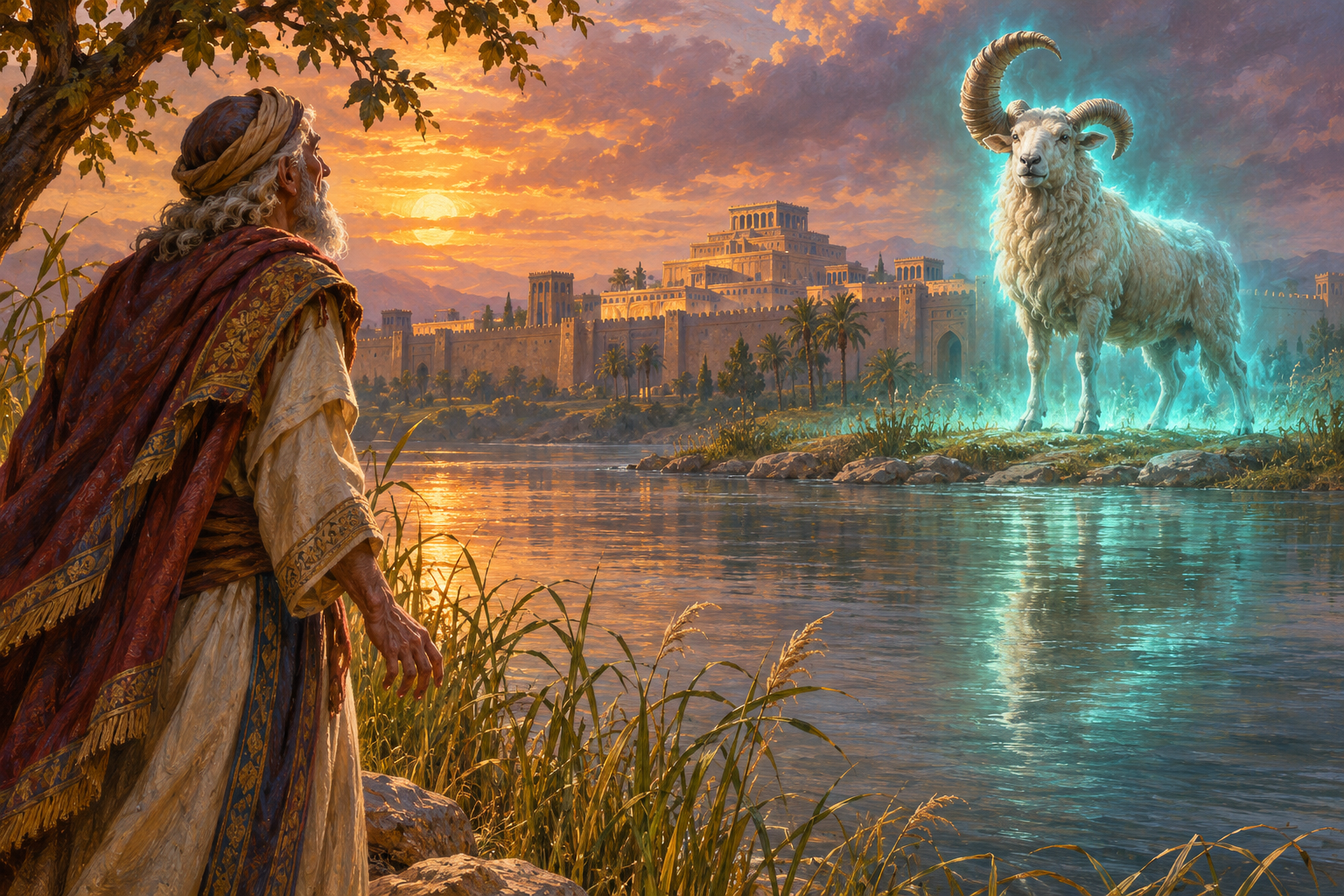
The vision came “in the third year of the reign of king Belshazzar” (Daniel 8:1), around 550 BC, while Babylon still ruled. In vision Daniel stood at Shushan, the future Persian capital, by the river Ulai. Babylon is not even pictured. The vision begins with the empire about to replace it.
The ram with two horns
Then I lifted up mine eyes, and saw, and, behold, there stood before the river a ram which had two horns: and the two horns were high; but one was higher than the other, and the higher came up last. I saw the ram pushing westward, and northward, and southward; so that no beasts might stand before him …
We do not have to guess who the ram is. Gabriel says it outright: “The ram which thou sawest having two horns are the kings of Media and Persia” (8:20). Two horns, one higher and later: Media rose first, but Persia, under Cyrus, became the greater partner. Its conquests ran west into Asia Minor, north toward the Caspian, and south into Egypt — exactly the three directions Daniel saw. It is the same power as the bear raised up on one side in Daniel 7.
The goat that touched not the ground
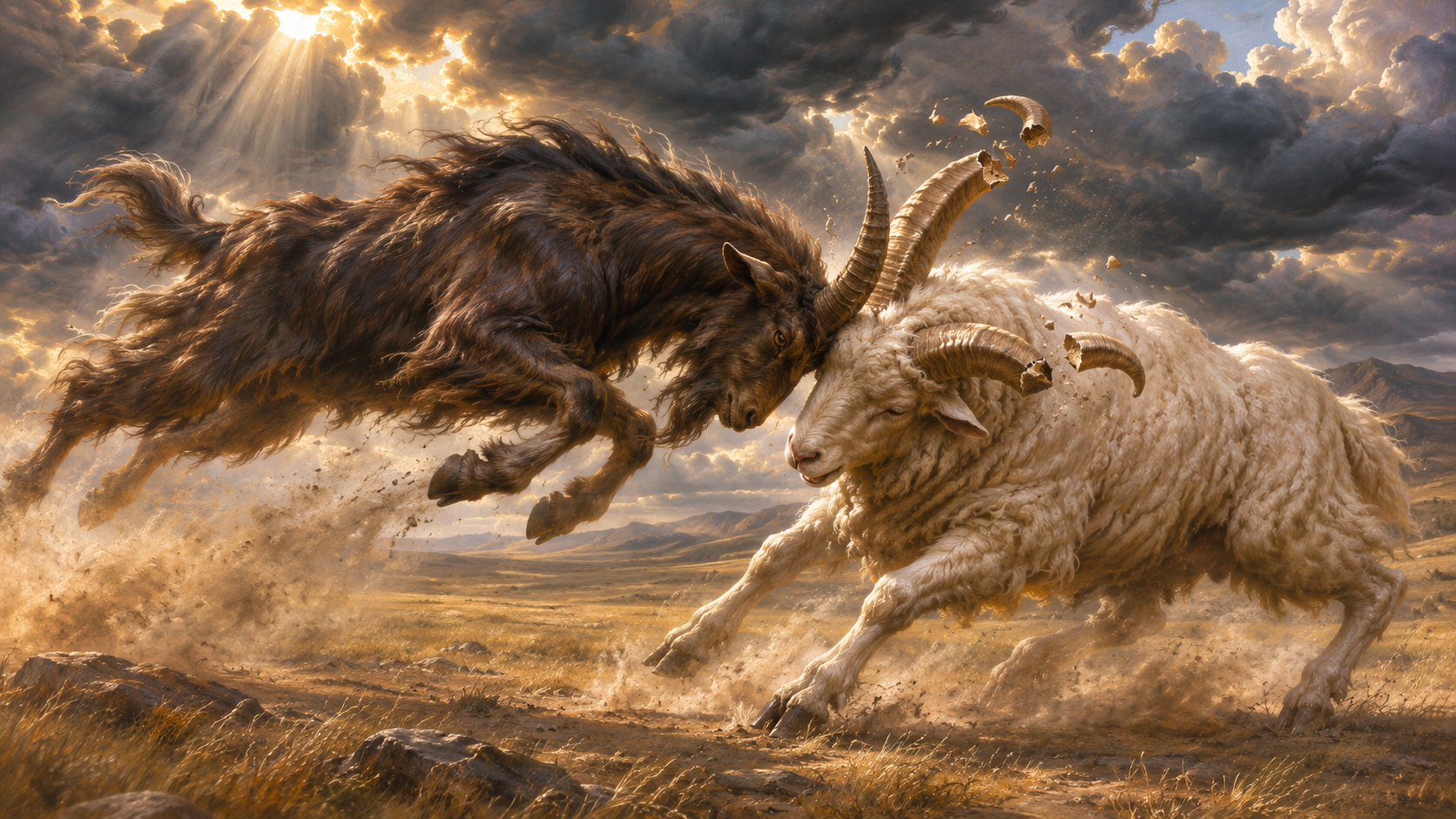
And as I was considering, behold, an he goat came from the west on the face of the whole earth, and touched not the ground: and the goat had a notable horn between his eyes. … and he cast him down to the ground, and stamped upon him: and there was none that could deliver the ram out of his hand.
Again Gabriel interprets: “the rough goat is the king of Grecia: and the great horn that is between his eyes is the first king” (8:21). A goat from the west, moving so fast it seemed not to touch the ground, is Alexander the Great, who crossed into Asia in 334 BC and broke Persia in three great battles — the Granicus (334), Issus (333), and Gaugamela (331). In about three years the Persian Empire was gone.
The great horn broken — and four in its place
Therefore the he goat waxed very great: and when he was strong, the great horn was broken; and for it came up four notable ones toward the four winds of heaven.
At the height of his power, in 323 BC, Alexander died in Babylon at the age of 32. His empire did not pass to his family; after years of war among his generals it settled into four kingdoms — Cassander in Macedonia, Lysimachus in Thrace and Asia Minor, Seleucus in Syria and the east, and Ptolemy in Egypt. Gabriel said it in one sentence: “four kingdoms shall stand up out of the nation, but not in his power” (8:22). The leopard of Daniel 7 had four heads for the same reason.
The little horn
And out of one of them came forth a little horn, which waxed exceeding great, toward the south, and toward the east, and toward the pleasant land.
Watch the scale of the vision. The ram “became great” (v. 4). The goat “waxed very great” (v. 8). This horn “waxed exceeding great” (v. 9) — greater than Persia, greater than Alexander. It comes “out of one of them” — out of one of the four quarters toward which the horns had spread, the four winds of heaven — and it grows toward the south, the east, and “the pleasant land,” the land of Israel.
One power fits. Rome rose in the west and swallowed the Greek kingdoms one by one: Macedonia after the battle of Pydna (168 BC), Syria in 64 BC, Judea when Pompey entered Jerusalem in 63 BC, and Egypt in 30 BC. When Jesus was born, it was under a decree “from Cæsar Augustus, that all the world should be taxed” (Luke 2:1). And it was Rome that stood “against the Prince of princes” (8:25): a Roman governor sentenced Him, Roman soldiers crucified Him, and the chief priests cried, “We have no king but Cæsar” (John 19:15). In AD 70 Roman armies destroyed the temple — “the people of the prince that shall come shall destroy the city and the sanctuary” (Daniel 9:26).
The horn that grew upward
Then the vision changes direction. The horn stops growing across the map and starts growing up:
And it waxed great, even to the host of heaven; and it cast down some of the host and of the stars to the ground, and stamped upon them. Yea, he magnified himself even to the prince of the host, and by him the daily sacrifice was taken away, and the place of his sanctuary was cast down. And an host was given him against the daily sacrifice by reason of transgression, and it cast down the truth to the ground; and it practised, and prospered.
This is no longer a war of armies but a war on worship. In Daniel 7 the same Roman power appears as the dreadful beast, and then as a little horn that rises among its ten horns to “speak great words against the most High,” persecuting the saints, and thinking “to change times and laws” (Daniel 7:25). Daniel 8 shows the same power from the sanctuary side: Rome in its religious form, the power Paul foresaw that would sit “in the temple of God, shewing himself that he is God” (2 Thessalonians 2:4).
Notice the word sacrifice in verses 11 and 12 is printed in italics in the King James Bible — it was supplied by the translators. Daniel wrote only the daily (Hebrew tamid, “continual”), the word used for the continual ministry of the sanctuary. That continual ministry now belongs to Christ, who “ever liveth to make intercession” for us (Hebrews 7:25) as “a minister of the sanctuary, and of the true tabernacle, which the Lord pitched, and not man” (Hebrews 8:2). The little horn did not reach heaven and stop Christ’s work; it cast “the place of his sanctuary” down in the minds of men — putting a human priesthood, a repeated sacrifice, and an earthly mediator where Christ alone should stand. It “cast down the truth to the ground.” But “there is none other name under heaven given among men, whereby we must be saved” (Acts 4:12).
“How long?”
Then Daniel hears two heavenly beings talking — and one asks the question every persecuted believer has asked:
How long shall be the vision concerning the daily sacrifice, and the transgression of desolation, to give both the sanctuary and the host to be trodden under foot? And he said unto me, Unto two thousand and three hundred days; then shall the sanctuary be cleansed.
Notice what is being measured: “the vision” — the whole vision, which began with the Persian ram. A span that starts in the Persian era and reaches “the time of the end” (8:17) cannot be six or seven literal years. The time is symbolic, like the animals, and Scripture’s own key for symbolic time is a day for a year: “I have appointed thee each day for a year” (Ezekiel 4:6; Numbers 14:34). The 2300 “days” — literally “evening-mornings,” the language of creation’s days — are 2300 years.
And the KJV margin gives the meaning of cleansed: “Heb. justified” — set right, vindicated, restored. After the long centuries in which the truth of Christ’s priesthood was trodden down, God would set the sanctuary right.
“At the time of the end shall be the vision”
Gabriel stresses three times that this vision reaches to the end: “at the time of the end shall be the vision” (8:17); “what shall be in the last end of the indignation: for at the time appointed the end shall be” (8:19); “it shall be for many days” (8:26). And the little horn meets its end the way the empires of Daniel 2 do: “he shall be broken without hand” (8:25) — the same phrase as the stone “cut out without hands” (Daniel 2:34). No human army ends this power. God does.
This is also why the common view that the little horn is Antiochus IV Epiphanes, a Seleucid king of the 160s BC, does not fit. Antiochus came out of one of the four Greek kingdoms but never became “exceeding great” — he was turned back from Egypt by a single Roman envoy — and he was dead long before “the Prince of princes” was born. The objections are answered one by one in The Sanctuary Cheat Sheet.
Three visions, one history
Set the three great outlines of Daniel side by side, and Daniel 8 locks into place:
| Daniel 2 | Daniel 7 | Daniel 8 | Power |
|---|---|---|---|
| Head of gold | Lion | — | Babylon |
| Breast and arms of silver | Bear | Ram with two horns | Media-Persia |
| Belly and thighs of brass | Leopard with four heads | Goat; great horn, then four | Greece |
| Legs of iron | Dreadful beast | Little horn, growing horizontally | Rome — imperial |
| Feet of iron and clay | Little horn among ten | Little horn, growing upward | Rome — papal |
| Stone cut out without hands | Judgment; kingdom to the saints | Sanctuary cleansed; horn “broken without hand” | God’s kingdom |
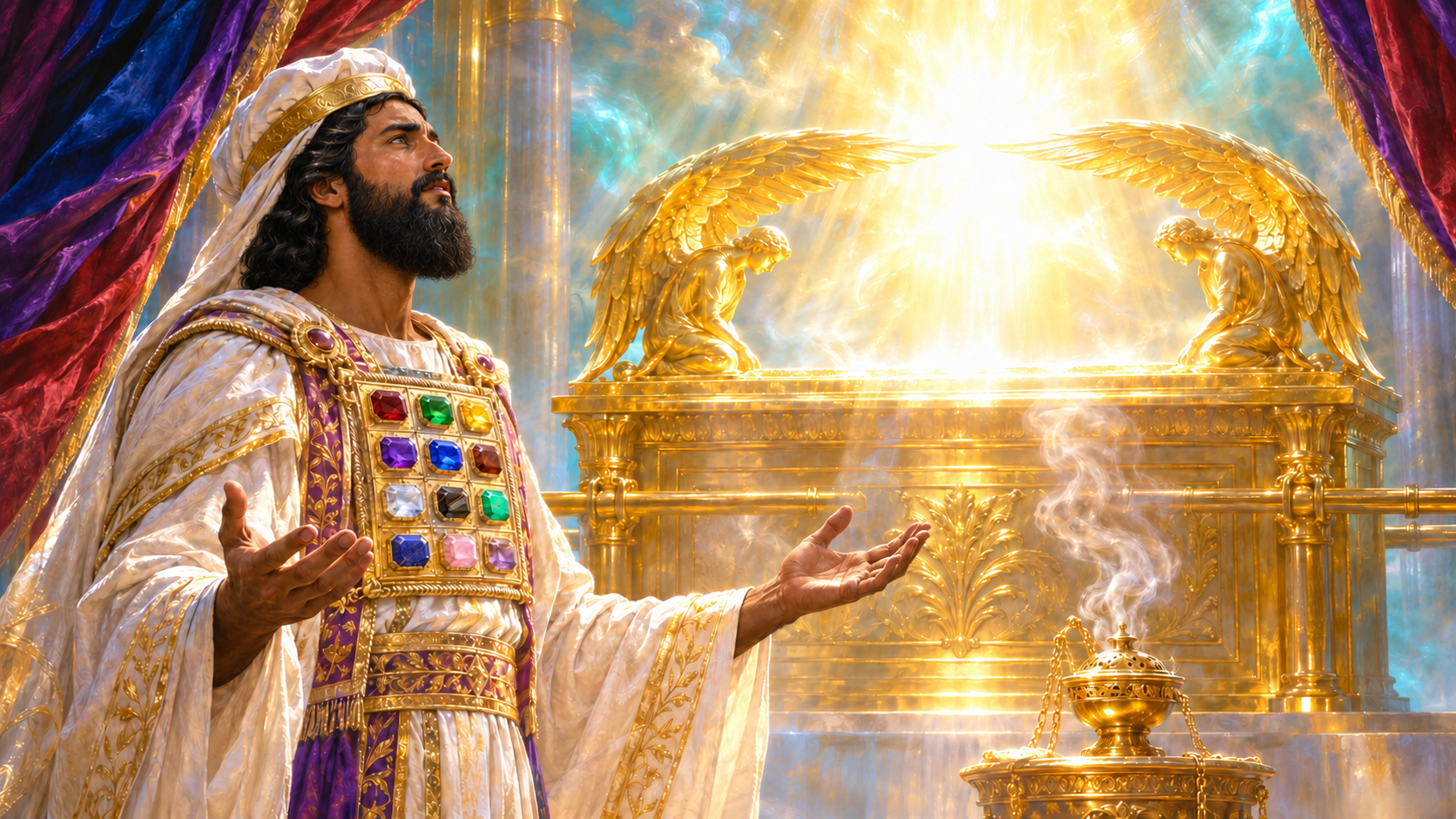
Where Daniel 7 ends with the judgment — “the judgment was set, and the books were opened” (7:10), and the Son of man brought “near before” the Ancient of days (7:13) — Daniel 8 ends with the sanctuary cleansed. They are the same event seen from two sides. In Israel’s sanctuary, the cleansing came once a year on the Day of Atonement: “on that day shall the priest make an atonement for you, to cleanse you, that ye may be clean from all your sins before the LORD” (Leviticus 16:30). Hebrews says the heavenly sanctuary has its own cleansing — “the heavenly things themselves with better sacrifices” — where Christ now appears “in the presence of God for us” (Hebrews 9:23-24). The cleansing of the sanctuary is the antitypical Day of Atonement: the judgment that clears God’s people and prepares for Christ’s return.
“None understood it” — and the key in Daniel 9
Gabriel explained the ram, the goat, the horns, and the little horn. One thing he did not explain: the time. “And I Daniel fainted, and was sick certain days … and I was astonished at the vision, but none understood it” (8:27). About twelve years later the same angel came back: “the man Gabriel, whom I had seen in the vision at the beginning … said, O Daniel, I am now come forth to give thee skill and understanding … understand the matter, and consider the vision” (Daniel 9:21-23).
What he gave was a starting point. “Seventy weeks are determined” — literally cut off — “from the going forth of the commandment to restore and to build Jerusalem” (9:24-25). That decree went forth in 457 BC. The seventy weeks, cut off from the 2300, reached to the Messiah — and the rest of the 2300 reached to the cleansing of the sanctuary:
| Date | What it marks |
|---|---|
| 457 BC | The decree to restore and build Jerusalem (Ezra 7) — both the 70 weeks and the 2300 days begin. |
| AD 27 | “Messiah the Prince”: Jesus anointed at His baptism (end of 69 weeks). |
| AD 31 | Messiah “cut off” in the midst of the 70th week. |
| AD 34 | The 70 weeks (490 years) end; the gospel turns to the nations. |
| AD 1844 | The 2300 years end: “then shall the sanctuary be cleansed.” |
Count 2300 years from 457 BC, remembering there is no year zero, and you arrive at AD 1844. The same decree that dated the Messiah to the year dates the opening of the final work of judgment in heaven — the hour Revelation announces: “Fear God, and give glory to him; for the hour of his judgment is come” (Revelation 14:7). The seventy weeks are walked step by step in the Daniel 9 study, and the story of the people who first preached 1844 — and what they learned when it came — is told in The Great Disappointment.
Go deeper
- Daniel 7: Four Beasts and the Little Horn — the same powers, and the judgment scene.
- Daniel 9: The Seventy Weeks — the key to the time of Daniel 8.
- The Sanctuary Cheat Sheet — every common objection to Daniel 8:14, answered.
- The Hour of God's Judgment — the heavenly sanctuary and the last-day message.
Our High Priest
Daniel 8 is a hard chapter — a vision of a power that tramples the truth and the people of God for centuries. But it ends with the sanctuary set right, and the One at its center is not the little horn. It is the Prince of the host, our High Priest, still ministering for us in the presence of God.
Seeing then that we have a great high priest, that is passed into the heavens, Jesus the Son of God, let us hold fast our profession. … Let us therefore come boldly unto the throne of grace, that we may obtain mercy, and find grace to help in time of need.